
Georgetown University’s Strategic Leap into the Future of Retail with NRF Partnership
Your scholarly editor is pleased to introduce the NRF Business of Retail Initiative at Georgetown University‘s McDonough School of Business, a groundbreaking collaboration set to profoundly impact the future of retail studies. This transformative endeavor is made possible by a substantial $6 million gift from the National Retail Federation (NRF) and its NRF Foundation. Pay attention here! This significant investment isn’t just about money; it represents a strategic alignment of academic rigor and industry leadership, aiming to cultivate the next generation of business leaders who are exceptionally well-versed in the complexities and innovations of the retail sector.
According to recent data, this partnership, officially announced in September 2025, is designed to integrate academic excellence with unparalleled industry expertise. The primary goal is to elevate retail studies, recognizing retail as a vital global economic sector. Matthew Shay (EMBA’11), president and chief executive officer of the NRF, articulated that Georgetown McDonough was chosen specifically for its esteemed reputation among academics, researchers, elected leaders, and policymakers. Here’s an interesting fact: Shay, an alumnus himself, has a deep understanding of the school’s strengths, making this a particularly meaningful collaboration. He expressed confidence that this partnership will yield enduring research and impactful results, significantly enhancing the retail sector’s standing and influence.
The NRF Business of Retail Initiative is multifaceted, incorporating several key components designed to foster comprehensive engagement and development. Central to this initiative is the endowment of the National Retail Federation Chair in Retail Studies. Studies show that an endowed chair attracts top-tier academic talent, bringing specialized knowledge and research focus to the university. This position will be pivotal in guiding the academic and research endeavors of the initiative, ensuring a cutting-edge curriculum.
Furthermore, the initiative will establish the National Retail Federation Summit, an annual event poised to become a critical forum for industry leaders, academics, and students to convene. This summit will facilitate discussions on pressing issues and innovations in retail, bridging the gap between theoretical knowledge and practical application. It’s a prime example of how this initiative aims to disseminate research findings directly to retailers and policymakers, ensuring that academic insights translate into real-world impact.
To nurture future talent, the initiative will support two National Retail Federation MBA Fellows. These fellowships will provide invaluable opportunities for advanced students specializing in retail, offering crucial financial assistance and immersive experiences. This is a direct investment in human capital, ensuring that bright minds are drawn to and supported within the retail industry.
Finally, the $6 million gift will provide substantial research grants. These grants will encourage in-depth studies into the evolving landscape of retail, covering critical areas such as artificial intelligence, technology, supply chains, law, and policy. According to recent data, these research efforts will actively involve retail industry leaders, ensuring that academic inquiries are aligned with real-world challenges and opportunities. The findings and resources generated from this research will be widely shared with NRF’s extensive network, which includes over 125 university members and 3,500 high school, community college, and workforce development partners. This broad dissemination strategy is key to empowering a diverse range of educational and professional institutions with cutting-edge retail knowledge.
Paul Almeida, dean and William R. Berkley Chair of the McDonough School of Business, emphasized that this initiative will expose students to new retail concepts in a crucial global economic sector, open doors to new career opportunities, and empower the community through impactful programming. Here’s an interesting fact: Georgetown McDonough was selected not only for its reputation but also for its existing academic excellence, boasting high-caliber faculty with deep expertise in retail, a Global Retail Marketing course, and active student clubs like the Georgetown Retail and Luxury Association. This pre-existing foundation makes it an ideal home for an initiative of this scope, allowing for immediate integration and amplified impact.
The Evolving Landscape of Retail Education: Blending Academia with Industry Expertise
Your scholarly editor observes that the NRF Business of Retail Initiative is poised to fundamentally transform retail education, meticulously integrating academic excellence with unparalleled industry expertise. Pay attention here! This is not merely an augmentation of existing programs but a strategic recalibration, designed to immerse students in dynamic retail concepts, equip them with invaluable real-world experience, and empower them to actively shape the future trajectory of the industry.
Studies show that effective modern business education demands a cross-disciplinary research approach, particularly in a sector as complex and rapidly evolving as retail. The NRF Business of Retail Initiative is specifically structured to address new and pressing challenges, encompassing the revolutionary impact of artificial intelligence (AI), emergent technologies, the intricate dynamics of global supply chains, and the evolving landscape of law and policy. According to recent data, these areas are not isolated; they are deeply interconnected, and a holistic understanding is crucial for any aspiring retail visionary. For instance, the ethical implications of AI in personalized marketing or the legal ramifications of blockchain in supply chain transparency are not niche concerns but central tenets of contemporary retail strategy.
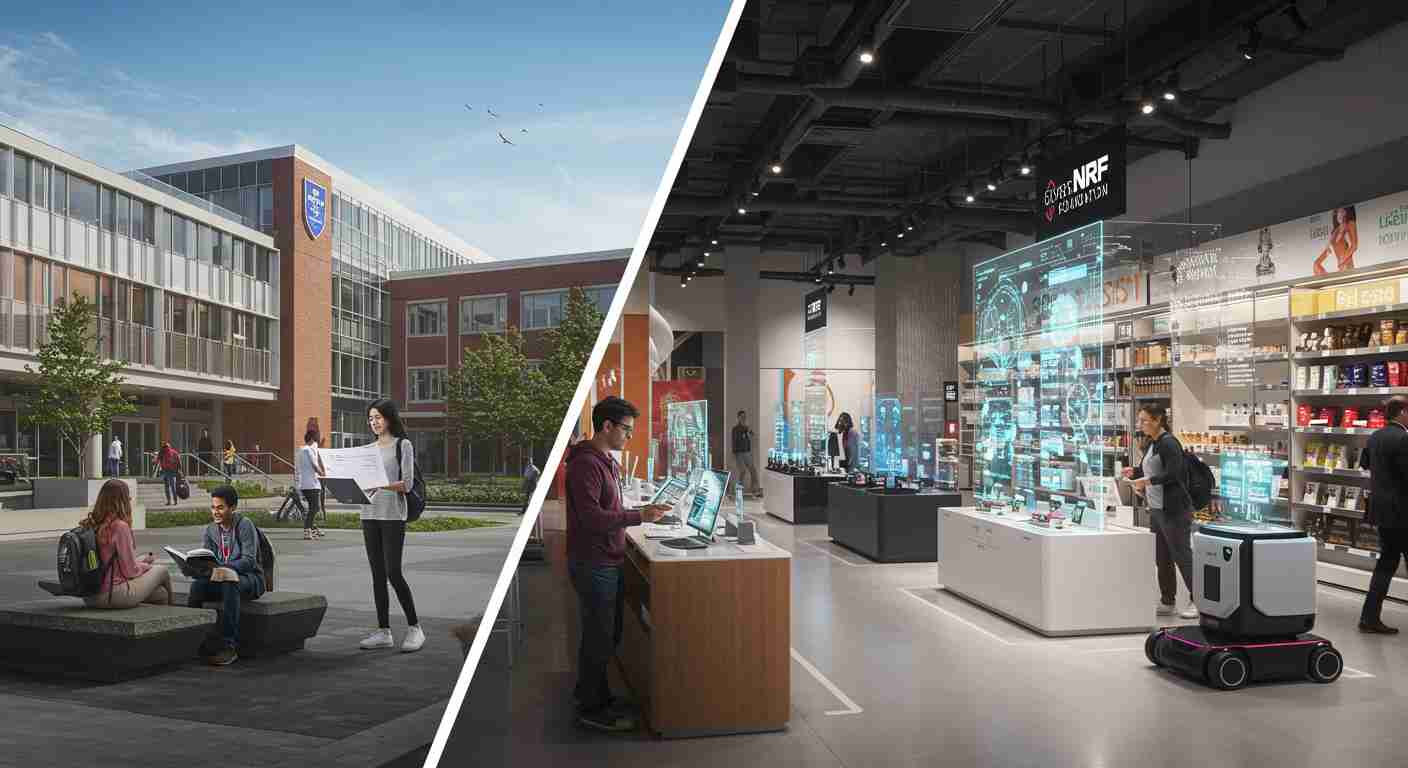
The initiative’s leadership appointments underscore its commitment to both academic rigor and practical relevance. Kelly Lee, an Assistant Teaching Professor of Marketing, has been appointed as the program director. Her expertise ensures that the curriculum remains innovative and responsive to industry needs, guiding students through an educational journey that is both challenging and directly applicable. Complementing this, Luc Wathieu, a distinguished Professor of Marketing, will serve as the research director. Here’s an interesting fact: Professor Wathieu’s role will be crucial in defining themes for projects and events, including the annual NRF Summit, ensuring that the research conducted is not only academically sound but also directly addresses the most pertinent issues faced by retail leaders today.
Moreover, the NRF Business of Retail Initiative is strategically aligned with McDonough’s other forward-thinking endeavors, creating a powerful synergy. Its integration with the Business of Sustainability Initiative means that students will explore how retail can drive environmental and social responsibility, from ethical sourcing to circular economy principles. As studies indicate a growing consumer demand for sustainable practices, this alignment positions graduates to lead purpose-driven retail operations. Similarly, its connection with the AI, Analytics, and the Future of Work Initiative will provide students with a deep understanding of how technological advancements are reshaping the retail workforce and consumer experience. According to recent data, AI adoption in retail is accelerating, with 80% of retail executives expecting to adopt AI automation by the end of 2025. This integration ensures that graduates are not only familiar with cutting-edge technologies but also understand their strategic implications and ethical considerations.
The initiative aims to cultivate the next generation of retail visionaries, individuals who possess not only keen business acumen but also practical skills and cutting-edge knowledge. Through exposure to leading retailers, students will gain real-world experience, moving beyond theoretical case studies to engage with live industry challenges. This hands-on approach is vital; as your scholarly editor often emphasizes, true mastery comes from applying knowledge in complex, dynamic environments. The program will offer opportunities to contribute to shaping the future of the retail industry, whether through participation in research projects addressing personalization and frictionless commerce, or through engagement with concepts like “agentic shopping,” where AI agents execute purchases on behalf of consumers. This forward-looking curriculum ensures that Georgetown McDonough graduates will be uniquely prepared to innovate and lead in a sector undergoing continuous, dramatic transformation.
AI and Technology’s Transformative Role in Retail: Implications for Business Education
Your scholarly editor notes that the profound impact of Artificial Intelligence (AI) and advanced technology on the retail sector cannot be overstated. Pay attention here! This transformation is not merely incremental; it is fundamentally reshaping everything from consumer behavior to operational efficiencies, and consequently, revolutionizing the demands placed upon business education. According to recent data, the global AI market, currently valued at approximately $391 billion, is projected for a staggering nearly fivefold increase to $1.81 trillion by 2030, exhibiting a Compound Annual Growth Rate (CAGR) of 35.9%. This explosive growth underscores AI’s pervasive integration across various sectors, with retail being a particularly fertile ground for its applications.
Studies show that AI is not just a tool for back-office optimization; it is actively redefining the consumer shopping journey. Professor Luca Cian of the University of Virginia (2026 USNews Ranking: 26) Darden School of Business reveals that nearly 60% of consumers now use AI to assist with their shopping decisions. Here’s an interesting fact: almost half of these respondents trust AI more than a friend for outfit advice, indicating a significant shift in how consumers perceive trust and objectivity in purchasing decisions. This phenomenon, which Professor Cian terms “augmented decision-making,” sees consumers offloading the mental burden of choice to AI, accelerating decision-making processes. Indeed, 77% of people report that AI helps them make faster decisions, effectively compressing the traditional marketing funnel and demanding that brands establish influence earlier and more intuitively.
The integration of AI into retail manifests in several emerging concepts. Personalized experiences, for instance, are being taken to unprecedented levels. Netflix, a prime example often cited in studies, generates $1 billion annually from its AI-powered recommendation system. In retail, this translates to hyper-customized product suggestions, promotions, and even store layouts based on individual consumer data analyzed by AI. Beyond personalization, advanced logistics are undergoing a revolution. AI optimizes supply chains, from inventory management and demand forecasting to routing and last-mile delivery, leading to significant reductions in operating costs and increases in throughput. Studies indicate that companies adopting comprehensive digital technologies can achieve 10-20% reductions in operating costs and 5-10% increases in throughput.
Furthermore, frictionless commerce is rapidly becoming the norm, driven by AI. This includes automated checkout systems, smart shelves, and seamless online-to-offline retail experiences. Here’s an interesting fact: by 2025, it’s predicted that over 95% of online and telephone customer interactions in retail will be AI-assisted. This shift towards efficiency is complemented by cutting-edge concepts like “agentic shopping,” which involves autonomous software agents acting on behalf of consumers for tasks such as comparing offers or making purchases. This represents a paradigm shift where AI systems become intermediaries in the purchasing process, requiring brands to adapt their marketing strategies to engage not just with human consumers, but also with these intelligent agents.
The imperative for brands to adapt their marketing strategies to engage with AI systems is critical. This necessitates a nuanced approach, as consumers trust AI more for practical purchases but prefer human input for emotional or hedonic products. Consequently, brands must build trust not only with consumers but also with the algorithms that determine what products those consumers see. This means understanding how AI ranks and recommends products and ensuring transparency in AI deployment to prevent a “black box” experience where the reasoning behind recommendations is unclear. Ethical considerations and transparency are paramount; studies show that only 8.5% of people fully trust AI Overviews in online searches, with concerns over inaccurate, misleading, or biased content being widespread. Moreover, 76% of CEOs worry about the lack of transparency and potential for biases in the AI market, underscoring the need for responsible AI development and deployment.
Given this transformative landscape, business education must evolve to prepare students for an AI-driven retail environment. Universities, like Georgetown, are incorporating AI literacy and practical AI applications into their curricula. This includes not only understanding the technical aspects of AI but also its strategic, ethical, and societal implications. For instance, the McDonough School of Business’s alignment with its AI, Analytics, and the Future of Work Initiative is a testament to this forward-thinking approach. According to recent data, 83% of companies consider AI a top priority in their business plans, underscoring the demand for graduates who are not just digitally literate but AI-fluent.
Here’s an interesting fact: many educational institutions are leveraging powerful tools and platforms to achieve this. Microsoft AI solutions, for example, are widely adopted, with over 85% of Fortune 500 companies utilizing them. Microsoft’s Chief Marketing Officer, Alysa Taylor, reported over 1,000 real-life examples of organizations using Microsoft AI for business transformation and innovation. These solutions are proving instrumental in enriching employee experiences, reinventing customer engagement, reshaping business processes, and bending the curve on innovation. Universities like Auburn and Babson College are integrating Microsoft Copilot to enhance AI literacy and create predictive models, while the University of Maryland developed TerpAI, a chatbot powered by Azure OpenAI, as an educational resource for faculty and students. These initiatives are crucial for equipping students with the skills to effectively deploy and manage AI in retail, ensuring they can harness its power for operational efficiency, personalized customer experiences, and strategic growth, all while navigating the ethical complexities that accompany this powerful technology.
Cultivating the Next Generation of Retail Leaders: Career Opportunities and Talent Development
The discussion now naturally progresses to the career opportunities and talent development pathways ignited by the NRF Business of Retail Initiative. Your scholarly editor finds it imperative to highlight that this initiative arrives at a crucial juncture, directly confronting the persistent talent shortage that has long plagued the retail sector. Studies show that despite the industry’s vast economic impact, employing 55 million Americans and contributing $5.3 trillion to the U.S. GDP, attracting and retaining skilled professionals remains a significant challenge. According to the January 2025 Labor Market Review, the scarcity of talent with the right skills persists, even with increasing integration of AI into workplaces. This initiative, therefore, serves as a vital bridge, aiming to close this pervasive skills gap by offering specialized training and clear career pathways that resonate with the demands of modern retail.
Pay attention here! The initiative’s focus on talent development is holistic, recognizing that the retail landscape is in a state of continuous evolution. This necessitates an unwavering commitment to continuous learning, upskilling, and adaptability among the workforce. Consider the strategies implemented by Ahold Delhaize, one of the world’s largest food retail groups, as detailed by their Chief Human Resources Officer, Natalia Wallenberg. Wallenberg emphasizes fostering a “learning organization” where skill-building opportunities are accessible and relevant to every associate, not just a select few. This inclusive approach, making training available from frontline staff to distribution center employees, is critical as digital transformation requires all staff to master new skills—from assisting customers with loyalty programs to navigating multi-channel commerce.
The NRF Business of Retail Initiative embraces this philosophy, providing specialized training that directly addresses the emerging demands of the industry. This includes the growing demand for workforce AI skills. According to recent data, individuals unable to adapt and acquire these new AI-centric skills risk being marginalized in the job market. The initiative’s cross-disciplinary research, which delves into AI, technology, and supply chains, will directly inform its educational offerings, ensuring that students are equipped with competencies like managing generative AI systems, understanding predictive analytics, and navigating the complexities of agentic shopping. Here’s an interesting fact: the ability to collaborate with and manage AI systems is becoming as crucial as traditional business acumen. The initiative’s partnership with leading technology providers, potentially leveraging tools similar to Microsoft AI solutions that enhance AI literacy and practical AI applications, will be instrumental in this upskilling endeavor.
A core strength of this initiative lies in its direct connection between students and leading retailers. Rebecca Hamilton, a marketing professor at McDonough, underscored how the initiative fosters invaluable connections between the school, its students, and real-world industry insights. Students enrolled in courses like “Global Retail Marketing” will engage in live case studies with major retailers such as Macy’s and have direct access to top executives, including senior vice presidents from companies like Walmart. This direct exposure provides immediate access to industry insights, moving beyond theoretical frameworks to practical applications and challenges. Sophia Leissner, president of the Georgetown Retail and Luxury Association (GRLA), an active student organization, enthusiastically described the initiative as validating the importance of retail as a field of study and innovation. She highlighted the direct access students will gain to leading organizations, employers, and insights into the evolving retail landscape, preparing them to contribute to fostering innovation and resilience.
This direct access is particularly significant in a sector characterized by high turnover and evolving skill demands. By connecting students with industry leaders, the initiative not only opens doors to diverse career opportunities but also provides a clear understanding of the career pathways available. This proactive approach helps to mitigate the challenge of limited advancement opportunities often cited in the retail sector, instead illustrating dynamic growth trajectories within companies. Moreover, the emphasis on continuous learning and adaptability cultivated through specialized training ensures that students are not just prepared for their first job but are ready for long-term professional growth in a dynamic industry.
Your scholarly editor concludes that the NRF Business of Retail Initiative’s long-term impact on talent development and the professional growth of students entering this dynamic industry will be profound. It systematically addresses the persistent talent shortage by providing a robust framework for specialized training, upskilling, and direct industry engagement. By emphasizing continuous learning, particularly in AI and emerging technologies, and fostering strong connections between academia and leading retailers, the initiative is poised to cultivate a new generation of retail leaders who are not only knowledgeable but also agile, innovative, and deeply connected to the evolving demands of the global retail market.
Reference:
- $6M Gift from NRF Foundation Establishes the NRF Business of Retail Initiative at Georgetown University’s McDonough School of Business
- Georgetown University Receives $6 Million for New Retail Initiative
- NRF and Georgetown University Launch Retail Research Programme
- National Retail Federation Donates $6 Million to MSB for Retail Studies Initiative
- NRF and Georgetown McDonough Launch NRF Business of Retail Initiative
- 50 NEW Artificial Intelligence Statistics (July 2025)
- Nearly 60% Use AI to Shop — Here’s What That Means for Brands and Buyers
- AI-powered success—with more than 1,000 stories of customer transformation and innovation
- Training the Retailers of Tomorrow: Ahold Delhaize’s Upskilling Strategy
- January 2025 Labor Market Review: The Talent Shortage Persists