
A Tale of Two Campuses: Contrasting Approaches to LGBTQ+ Inclusion in U.S. Universities
Today, I’ve stumbled upon something fascinating, a stark reflection of the multifaceted landscape of higher education in the United States. Your adventurous editor has been digging into a tale that, at first glance, seems to present two entirely different worlds, yet upon closer inspection, reveals the intricate pressures and values shaping our universities today. Buckle up for this one, as we dive into a narrative where joyous celebration meets academic retraction, all within the span of just a few months in the same country.
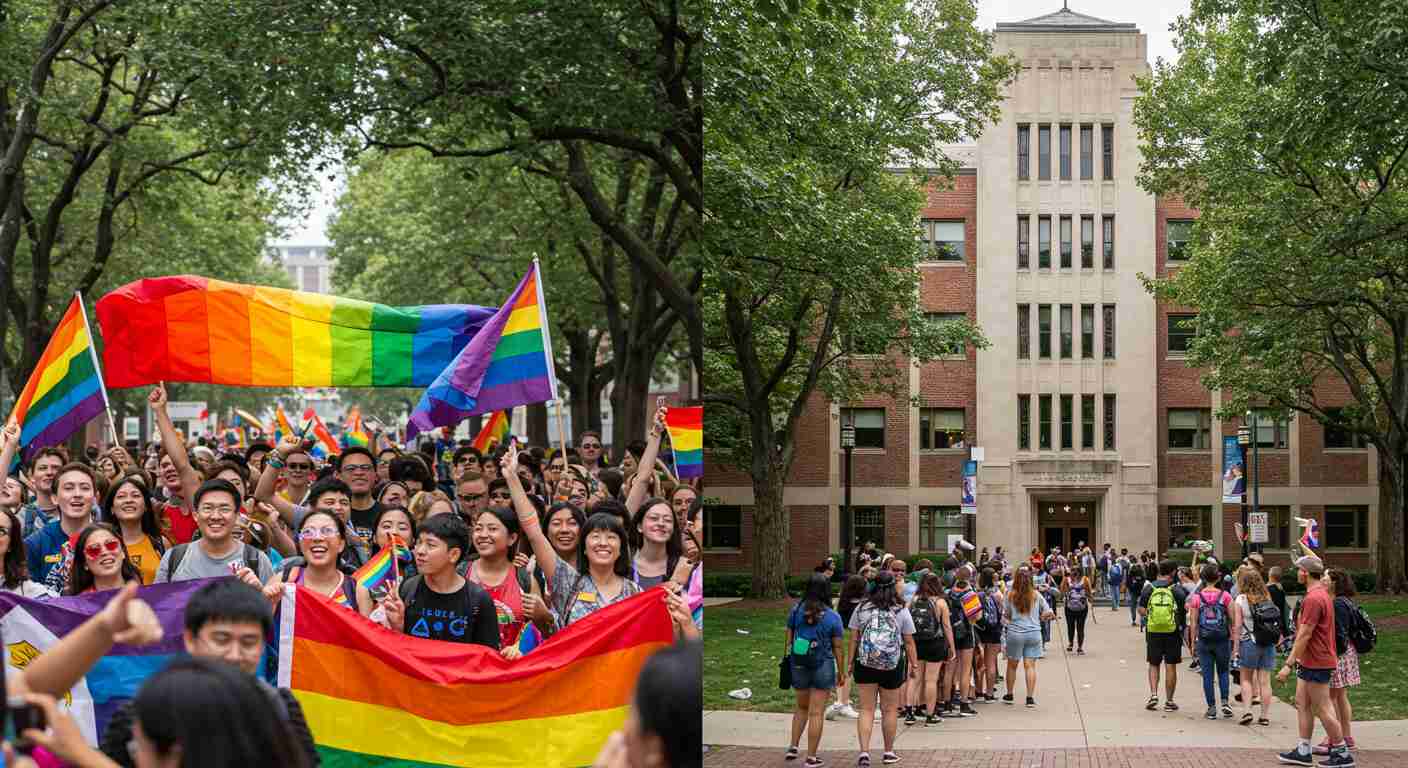
On one side, we have the vibrant hues of Duke University‘s annual Pride Parade. Despite a drizzly September day, the campus and the wider Durham community erupted in a “powerful act of resistance and visibility,” as Angel Collie, director of Duke’s Center for Sexual and Gender Diversity (CSGD), so eloquently put it. Pictures splashed across Duke Today showed a community undeterred, celebrating identity and belonging, an unapologetic reflection of its diverse student body. This wasn’t just a one-off event; it was a reaffirmation of Duke’s long-standing commitment to LGBTQ+ inclusivity, a commitment woven into its institutional fabric through resources like the CSGD, and articulated through administrative statements celebrating Pride Month and LGBTQ+ History Month. It’s a story of an institution that actively works to be a “nourishing” environment, where students find space for joy and love, even amidst ongoing challenges.
But then, the plot thickens. Simultaneously, another prominent U.S. institution, Baylor University, a private Baptist research university, was making headlines for a very different reason. In July, its Diana R. Garland School of Social Work rescinded a significant $640,000 grant intended for research on LGBTQ+ inclusion in congregational settings. The university’s President, Linda A. Livingston, clarified that while the research itself wasn’t the issue, “the activities that followed as part of the grant” extended into “advocacy for perspectives on human sexuality that are inconsistent with Baylor’s institutional policies.” This decision, supported by both the Dean and principal investigator, was rooted in Baylor’s reaffirmed “biblical understanding of human sexuality,” emphasizing purity in singleness and fidelity in marriage between a man and a woman. It was a move to protect what the university perceives as its “Christian mission and historic Baptist identity.”
These two seemingly disparate events—a university celebrating Pride with open arms versus another retracting a grant for LGBTQ+ research—are more than just isolated incidents. They are crucial windows into the deeper institutional values, missions, and the often-conflicting pressures faced by universities across the U.S. In the broader landscape of higher education, these actions aren’t merely administrative decisions; they reflect the core identity of an institution, its engagement with academic freedom, and, most critically, its stance on student welfare and belonging for all. The ‘why’ behind these divergent paths—Duke’s progressive embrace and Baylor’s traditional reaffirmation—reveals the complex interplay of internal convictions, external stakeholder demands, and the ever-evolving societal expectations placed upon academic institutions. As your adventurous editor delves deeper, we’ll uncover the implications of these choices for students, faculty, and the very essence of what it means to be an inclusive university in today’s world.
Duke’s Enduring Commitment: Evolution of LGBTQ+ Support and Visibility
Today, I’ve stumbled upon something fascinating, a stark reflection of the multifaceted landscape of higher education in the United States. Your adventurous editor has been digging into a tale that, at first glance, seems to present two entirely different worlds, yet upon closer inspection, reveals the intricate pressures and values shaping our universities today. Buckle up for this one, as we dive into a narrative where joyous celebration meets academic retraction, all within the span of just a few months in the same country.
On one side, we have the vibrant hues of Duke University’s annual Pride Parade. Despite a drizzly September day, the campus and the wider Durham community erupted in a “powerful act of resistance and visibility,” as Angel Collie, director of Duke’s Center for Sexual and Gender Diversity (CSGD), so eloquently put it. Pictures splashed across Duke Today showed a community undeterred, celebrating identity and belonging, an unapologetic reflection of its diverse student body. This wasn’t just a one-off event; it was a reaffirmation of Duke’s long-standing commitment to LGBTQ+ inclusivity, a commitment woven into its institutional fabric through resources like the CSGD, and articulated through administrative statements celebrating Pride Month and LGBTQ+ History Month. It’s a story of an institution that actively works to be a “nourishing” environment, where students find space for joy and love, even amidst ongoing challenges.
But then, the plot thickens. Simultaneously, another prominent U.S. institution, Baylor University, a private Baptist research university, was making headlines for a very different reason. In July, its Diana R. Garland School of Social Work rescinded a significant $640,000 grant intended for research on LGBTQ+ inclusion in congregational settings. The university’s President, Linda A. Livingston, clarified that while the research itself wasn’t the issue, “the activities that followed as part of the grant” extended into “advocacy for perspectives on human sexuality that are inconsistent with Baylor’s institutional policies.” This decision, supported by both the Dean and principal investigator, was rooted in Baylor’s reaffirmed “biblical understanding of human sexuality,” emphasizing purity in singleness and fidelity in marriage between a man and a woman. It was a move to protect what the university perceives as its “Christian mission and historic Baptist identity.”
These two seemingly disparate events—a university celebrating Pride with open arms versus another retracting a grant for LGBTQ+ research—are more than just isolated incidents. They are crucial windows into the deeper institutional values, missions, and the often-conflicting pressures faced by universities across the U.S. In the broader landscape of higher education, these actions aren’t merely administrative decisions; they reflect the core identity of an institution, its engagement with academic freedom, and, most critically, its stance on student welfare and belonging for all. The ‘why’ behind these divergent paths—Duke’s progressive embrace and Baylor’s traditional reaffirmation—reveals the complex interplay of internal convictions, external stakeholder demands, and the ever-evolving societal expectations placed upon academic institutions. As your adventurous editor delves deeper, we’ll uncover the implications of these choices for students, faculty, and the very essence of what it means to be an inclusive university in today’s world.
Let’s turn our attention back to Duke, where the atmosphere around LGBTQ+ inclusivity paints a strikingly different picture. Today, Duke stands as a beacon of celebratory support, its annual Pride Parade a visible testament to a deeply embedded commitment to its queer community. But this wasn’t always the case, and as your adventurous editor has discovered, the journey from repression to vibrant affirmation is a story of courageous individuals, sustained advocacy, and evolving institutional leadership.
Buckle up for this one, as we rewind sixty years to a time when same-sex relationships were criminalized at Duke. Campus police, in a chilling collaboration with the FBI, arrested dozens of gay men for “homosexuality,” a dark chapter meticulously documented in the 2014 “Queering at Duke” exhibit. This historical backdrop, where fear and secrecy were prevalent, makes the current landscape all the more remarkable. The very idea of a public Pride celebration would have been unthinkable, a stark contrast to the 400 attendees and 22 campus partner organizations that filled Bryan Center Plaza on National Coming Out Day in 2024, celebrating with music and joy.
The plot thickens as we trace the pivotal shifts. The late 1960s and early 1970s marked a tentative opening, influenced by the transformative Stonewall Riots, allowing queer students to begin acknowledging their identities without immediate fear of arrest or expulsion. Yet, the shadow of the AIDS crisis in the early 1980s brought a renewed period of “closeting” and even saw Duke’s first queer student group have its charter revoked. It was a push and pull, a constant struggle for visibility and acceptance.
A significant turning point arrived with the tenure of President Keith Brodie in 1985. His explicit support for the LGBTQ+ community, as noted by Janie Long, a seminal figure in Duke’s queer history, “made a huge difference here at Duke.” Long, who became director of the LGBTQ Center in 2006 and later served as associate vice provost, tirelessly championed inclusivity. She’s credited with pushing for public celebrations like Coming Out Day, famously insisting, “It’s Coming Out Day, not Staying In Day,” when students initially preferred a private dinner. This administrative leadership, coupled with the unwavering resolve of students and faculty, laid the groundwork for profound policy changes and a more genuinely inclusive environment.
Under Long’s guidance and continued community advocacy, Duke has achieved crucial milestones. The university updated its nondiscrimination policy to explicitly include gender identity and sexual orientation, a fundamental step in embedding protection and affirmation. It facilitated same-sex ceremonies at Duke Chapel, a powerful symbolic and practical acknowledgment of LGBTQ+ relationships. The creation of a faculty-student “Outlist” fostered visible role models and a stronger sense of community. Furthermore, Duke took the significant step of providing gender-affirming health care, a critical provision for the well-being of its transgender and gender non-conforming students. These are not merely symbolic gestures; they are concrete, life-changing policies that reflect a deep-seated institutional commitment.
At the heart of Duke’s vibrant LGBTQ+ community today is the Center for Sexual and Gender Diversity (CSGD), a vital hub nestled on the first floor of the Bryan Center. As Ki Hickman, assistant director of programming and student engagement at the center, emphasizes, the CSGD is more than just an office; it’s a “nourishing” space. Here, students and their allies find a sanctuary for community, joy, and advocacy, a place where, “Even in the midst of all that’s gone on, we still find ways to gather and talk about joy, and talk about love.” This focus on collective joy and mutual support is crucial, especially in a world where external challenges persist. The CSGD fosters a sense of belonging that encourages individuals to return repeatedly, feeding them “in more ways than one.” It’s a testament to the power of dedicated spaces that affirm identity, offer resources, and cultivate genuine connections, contributing significantly to student well-being.
Your adventurous editor can attest that this consistent message of affirmation at Duke contrasts sharply with the challenges faced by other institutions grappling with their own approaches to LGBTQ+ inclusion. While state legislatures introduce bills targeting LGBTQ+ rights, including bans on gender-affirming care and restrictions on transgender student participation in sports, Duke maintains its trajectory of support. Alumni like Denzell Faison, who found Duke a “paradise” compared to his hometown, and Jesse Huddleston, a prominent LGBTQ+ activist in the Triangle area, acknowledge the long road traveled but also the continuous journey ahead. They highlight that cultural, political, and social conditions can always improve, emphasizing the ongoing need for vigilance and advocacy. The memory of a student-athlete’s death in 2006, rumored to be gay, deeply affected Janie Long and spurred her to action, demonstrating how personal tragedies can catalyze institutional change. Her response to homophobic vandalism during a Coming Out Day—giving away 500 event shirts to turn hatred into solidarity—epitomizes Duke’s spirit. The LGBTQ+ presence at Duke is now openly celebrated, a powerful message that “staying in” is no longer an option.
Baylor’s Stance: Navigating Faith, Policy, and Inclusivity
The plot thickens, however, as we pivot from Duke’s celebratory environment to Baylor University, where a recent decision has sparked significant controversy and laid bare the complexities of faith, policy, and inclusivity within a Christian academic institution. Today, I’ve stumbled upon something fascinating, a critical moment that encapsulates the tension between deeply held religious beliefs and the broader academic pursuit of knowledge and social inclusion. Your adventurous editor has been digging into the details surrounding Baylor’s decision to rescind a substantial grant for LGBTQ+ inclusion research, a move that reverberated through its campus and beyond.
Buckle up for this one, because understanding Baylor’s rationale requires delving into its core identity. In July 2025, Baylor University’s Diana R. Garland School of Social Work, just days after publicly announcing its acceptance, returned a $640,000 grant from the Eula Mae and John Baugh Foundation. This funding was originally designated for a study titled “Courage from the Margins: Inclusion and Belonging Practices for LGBTQIA+ and Women in Congregations,” aiming to explore the experiences of disenfranchisement and exclusion within faith communities. According to Baylor University President Linda A. Livingston, the primary concern was not the academic research itself, which sought to understand inclusion and belonging in the church. Rather, the “activities that followed as part of the grant” extended “into advocacy for perspectives on human sexuality that are inconsistent with Baylor’s institutional policies.”
Baylor’s stance is explicitly rooted in its “biblical understanding of human sexuality,” which the university affirms as a gift from God, “expressed through purity in singleness and fidelity in marriage between a man and a woman.” This position aligns with Baylor’s existing Statement on Human Sexuality and is presented as integral to its Christian mission and historic Baptist identity. President Livingston reiterated that the university’s institutional beliefs and policies remained unchanged, assuring the “Baylor Family” that this decision was made to protect and reaffirm these foundational values. Dean Jon Singletary and principal investigator Dr. Gaynor Yancey voluntarily offered to rescind the grant, a decision supported by university leadership as being “in the best interests of Baylor University.”
This decision, however, ignited a firestorm of controversy. LGBTQ+ advocates and alumni expressed profound disappointment and anger. Paul J. Williams, head of the Baylor University Gay and Lesbian Alumni Association (an independent organization), sharply criticized the move as “incredibly cowardly,” suggesting the university succumbed to pressure from conservative donors who opposed the study. Williams voiced concern that this action sends a chilling message to LGBTQ+ students, signaling that Baylor might not be a welcoming environment for them. Indeed, the perception of welcome is a delicate balance within faith-based institutions; while the university stated its commitment to providing a “loving and caring community for all – including our LGBTQIA+ students,” this commitment is clearly framed within its restrictive theological and policy guidelines regarding human sexuality. Such a qualification, while perhaps necessary for the university to maintain its institutional integrity, inevitably creates an atmosphere of conditional acceptance for LGBTQ+ individuals.
Conversely, the decision also garnered support from conservative factions, including some Baylor students and alumni who agreed with the return of the grant, with some even arguing it should never have been accepted in the first place. Prominent Christian figures, such as Rev. Denny Burk, an associate pastor at Kenwood Baptist Church, openly criticized Baylor for initially accepting the grant, stating, “Baylor has been moving away from Christian faithfulness for decades now.” This dichotomy highlights the intense pressure universities like Baylor face from various stakeholders, each with deeply entrenched perspectives on what constitutes institutional integrity and faithfulness. The controversy underscores the significant tension between maintaining a specific religious institutional identity and engaging in the broader academic pursuit of knowledge, particularly when that knowledge delves into areas that challenge traditional interpretations of faith.
The implications of such decisions on academic freedom and research integrity are substantial. While President Livingston explicitly stated that the university’s concerns were not with the research itself, the rescission of a grant for academic inquiry into LGBTQ+ inclusion, framed as being inconsistent with institutional policies due to its “advocacy” potential, raises questions about the boundaries of permissible scholarship within a faith-based context. Researchers like Dr. Gaynor Yancey, who aimed to give voice to those who have experienced “institutional betrayal” within faith communities, face the challenge of navigating these institutional restrictions. This situation at Baylor draws parallels with past controversies, both at the university and within the wider U.S. context, regarding the delicate balance between religious freedom, institutional autonomy, and anti-discrimination principles.
The university’s framing of the incident as a “learning opportunity” and its affirmation of supporting faculty in pursuing meaningful scholarship, provided it aligns with institutional processes, attempts to mitigate concerns. However, such actions, despite reaffirming institutional beliefs, can inadvertently create a “chilling effect” on LGBTQ+ inclusion efforts and on academic exploration of sensitive topics. When a research grant focused on understanding and fostering inclusion is retracted, it can deter future efforts, signaling that certain avenues of inquiry or advocacy are off-limits. This, in turn, impacts not only the research community but also the perceived welcome and safety extended to LGBTQ+ students, potentially fostering an environment where some feel marginalized or unwelcome despite the university’s stated commitment to a “loving and caring community.” The narrative at Baylor, therefore, stands as a poignant reminder of the ongoing struggles and complex negotiations involved in reconciling religious identity with the evolving demands of social inclusion and academic freedom in contemporary higher education.
The Broader Landscape: Trends, Challenges, and the Future of LGBTQ+ Inclusion in Higher Education
Beyond the individual stories of Duke and Baylor, your adventurous editor has been uncovering something even larger—a swirling vortex of legislative actions, cultural shifts, and institutional responses that are reshaping the very fabric of LGBTQ+ inclusion across U.S. universities. Buckle up for this one, as the plot thickens to reveal a complex push and pull, a dance between progress and backlash that defines the current landscape of higher education.
Today, I’ve stumbled upon something fascinating: a stark contrast in how institutions navigate these choppy waters. On one hand, we see the regrettable decision by the University of Mississippi (Ole Miss) to withdraw funding for its 2025 Oxford Pride Parade. The reason? A new state law, the “Requiring Efficiency For Our Colleges and Universities System and Education System (REFOCUSES) Act,” or simply the anti-DEI bill (HB 1193). This legislation, signed by Governor Tate Reeves, broadly restricts public educational institutions from spending funds on diversity, equity, and inclusion initiatives if they are perceived as discriminatory. While Ole Miss leadership reaffirmed its commitment to a welcoming environment, this withdrawal of institutional support for a long-standing event, originating with a graduate student in 2016, sends a clear message. It’s a vivid example of how state-level anti-DEI laws are directly impacting universities’ ability to outwardly support and celebrate their LGBTQ+ communities, forcing them to re-evaluate their involvement in events that have historically fostered belonging. Despite the university’s step back, the community rallied, with a GoFundMe campaign significantly surpassing its goal, demonstrating that the spirit of Pride often finds its own way, even when institutional funding recedes.
However, the narrative isn’t uniformly bleak. In sharp contrast, institutions like the University of Colorado Boulder (2026 USNews Ranking: 97) and Penn State University are not just holding the line but actively expanding their LGBTQ+ initiatives. CU Boulder’s Pride Office, part of The Center, bustles with events for Pride Month, from ice cream socials to community festivals and even a “Queer Woke” facilitated conversation on the history of The Lavender Scare. They understand that fostering belonging requires consistent effort and visible celebration, not just during June but throughout the year, with more student-centric events planned for LGBTQ+ History Month in October. Similarly, Penn State’s Center for Sexual and Gender Diversity (CSGD) orchestrates a vibrant array of activities, from a downtown Pride Parade and Festival to “Camp Crystal Queer” events throughout the summer, fostering continuous engagement. They host “Lunch on the Lawn,” Instagram chats, Pride Parties, and even film screenings, all designed to build community, educate, and affirm. These universities demonstrate a proactive approach, actively hosting events and maintaining dedicated LGBTQ+ resource centers that serve as vital hubs for support and connection.
The critical role of these university LGBTQ+ centers cannot be overstated. From Duke’s CSGD, described as “nourishing” and a space for “joy and love,” to CUNY’s comprehensive LGBTQI+ Hub and its network of campus centers like BMCC Pride Center and Brooklyn College LGBTQ Resource Center, these spaces are more than just offices. They are lifelines, providing support, resources, and community that are essential for the well-being and academic success of LGBTQ+ students. They offer safe zones, facilitate crucial conversations, and provide services ranging from mental health support to assistance with name and gender changes. The presence, or indeed the absence, of such robust centers fundamentally shapes the student experience, influencing everything from mental health outcomes to a sense of belonging and academic achievement. Where these centers thrive, students find community and affirmation; where they are curtailed or nonexistent, students can feel isolated and unsupported.
This complex interplay of legislative and cultural pressures is not unique to the U.S. As your adventurous editor has discovered, international developments also cast a long shadow. The UK Supreme Court’s ruling defining “woman” and “sex” under the Equality Act 2010 as strictly biological sex assigned at birth has concerning implications for trans individuals globally. This ruling, criticized by scholars as a “major setback” and “junk jurisprudence,” legalizes the exclusion of trans people from single-sex spaces and impacts their ability to pursue equal rights claims. Such institutional decisions, even from abroad, can lend a legitimizing force to reactionary movements, influencing public compliance and providing legal and moral precedents for rolling back gender identity laws elsewhere. This demonstrates that the challenges faced by LGBTQ+ inclusion are part of a broader, interconnected struggle against authoritarian agendas that seek to restrict rights based on biological essentialism.
In synthesizing these various approaches, what becomes clear is the ongoing push and pull between progress and backlash. Universities like Duke, CU Boulder, and Penn State exemplify a commitment to integrating LGBTQ+ inclusion into their institutional fabric, leveraging centers for sexual and gender diversity as anchors for community and support. Conversely, institutions like Baylor, influenced by specific religious missions, and Ole Miss, constrained by anti-DEI legislation, highlight the significant challenges and restrictions that can emerge. The implications of rulings defining ‘sex’ narrowly, and the rise of state-level anti-DEI laws, underscore a worrying trend that threatens to roll back years of hard-won progress. Yet, the resilience of LGBTQ+ communities, both on and off campus, and the dedication of allied institutions suggest that the fight for inclusion is far from over.
Reference:
- Duke University Celebrates Pride Parade Despite Drizzle
- Baylor University Returns $640,000 Grant for LGBTQ+ Church Inclusion Study Amidst Advocacy Concerns
- Baylor University Rescinds Grant for LGBTQ+ Inclusion Research
- A Cause for Pride at Duke: Evolving LGBTQ+ Acceptance at Duke University Over 60 Years
- Duke University Celebrates Pride Parade Despite Drizzle, Upholding LGBTQ+ Inclusivity
- The Chronicle’s guide to celebrating Pride Month in Durham
- CUNY LGBTQI+ Hub: A Comprehensive Resource for the LGBTQI+ Community
- Ole Miss Withdraws Support for Oxford Pride Parade Citing New DEI Law
- Multiple events set for Pride Month at CU Boulder
- Penn State University to Host Pride Parade and Festival, Camp Crystal Queer, and Other Events for National Pride Month
- Understanding the Implications of the UK Supreme Court’s Ruling Defining ‘Sex’ in the Equality Act