
Introduction: The Significance of LCME Accreditation for Carle Illinois College of Medicine
Okay, here’s the next section of the article, as requested:
The news of the full accreditation of the Carle Illinois College of Medicine (CI MED) by the Liaison Committee on Medical Education (LCME), slated for March 2025, marks a watershed moment in the evolution of medical education. For those unfamiliar, CI MED holds the unique distinction of being the world’s first medical school meticulously engineered upon an engineering-based paradigm. Think of it – a medical school built not just on the foundations of biology and chemistry, but also on the principles of physics, computer science, and, well, good old-fashioned problem-solving!
But what exactly is this LCME accreditation, and why should prospective medical students and even seasoned healthcare professionals care? The LCME is essentially the gold standard for medical education program accreditation in the U.S. and Canada. It ensures that a medical school meets rigorous standards of quality, covering everything from curriculum design and faculty qualifications to student support services and clinical training opportunities. In essence, LCME accreditation is a validation, a stamp of approval signifying that CI MED provides a top-notch educational experience that adequately prepares its graduates for the challenges of modern medical practice.
For CI MED, achieving full accreditation is particularly significant. It solidifies the college’s position as a legitimate and respected institution, lending credence to its innovative approach to medical education. Think of it like this: CI MED isn’t just another medical school; it’s a trailblazer, a pioneer boldly venturing into uncharted territory. This accreditation confirms that its radical experiment – to “re-engineer medicine,” as they put it – is actually working.
And what does “re-engineer medicine” mean? It signifies a commitment to fostering interdisciplinary collaboration, sparking innovation, and, crucially, tackling those persistent healthcare disparities that plague our society. CI MED aims to train a new breed of “physician-innovators” – doctors who are not only skilled clinicians but also adept at leveraging technology, data, and design thinking to solve complex healthcare problems. The editor believes that’s where its graduates can shine.
The Engineering-Based Medical Education Model: Benefits and Implementation at Carle Illinois
Now, let’s dive into the juicy details of CI MED’s curriculum and how it actually pulls off this engineering-based medical education. It’s not just about tacking on a few engineering courses to the standard medical school syllabus; it’s a fundamental reimagining of how medicine is taught and practiced.
At its core, the CI MED curriculum seamlessly integrates engineering principles, artificial intelligence (AI), data science, and human-centered design thinking with the traditional bedrock of medical knowledge. This isn’t your grandfather’s medical school! Instead of rote memorization of anatomical structures (though, of course, that’s still important!), students are encouraged to think critically, to approach medical challenges as multifaceted problems requiring innovative solutions.
So, what are the tangible benefits of this approach? Well, for starters, it cultivates a spirit of innovation. By equipping students with the tools and mindset of engineers, CI MED empowers them to identify unmet needs in healthcare and develop cutting-edge technologies and strategies to address them. Forget just diagnosing and treating; these grads are poised to invent the next generation of medical solutions.
Problem-solving skills are also dramatically enhanced. Engineering is, at its heart, about problem-solving, and this curriculum instills a systematic, analytical approach to even the most complex medical scenarios. Students learn to break down problems into their constituent parts, identify potential solutions, and rigorously test and refine those solutions based on data and evidence. In the words of Dr. Kris Carpenter, interim associate dean for academic affairs at CI MED, the engineering-based approach gives students a “new perspective” on patient care, allowing them to leverage technology to “diagnose, treat, predict, and prevent disease.” It’s not just about reacting to illness; it’s about proactively shaping a healthier future.
The integration of AI and virtual reality (VR) provides just one vivid example of how engineering principles are brought to bear. Imagine using AI-powered diagnostic tools that can analyze medical images with superhuman accuracy, or employing VR simulations to plan complex surgical procedures with unparalleled precision. These are not futuristic fantasies; they’re real-world applications already being explored and implemented at CI MED.
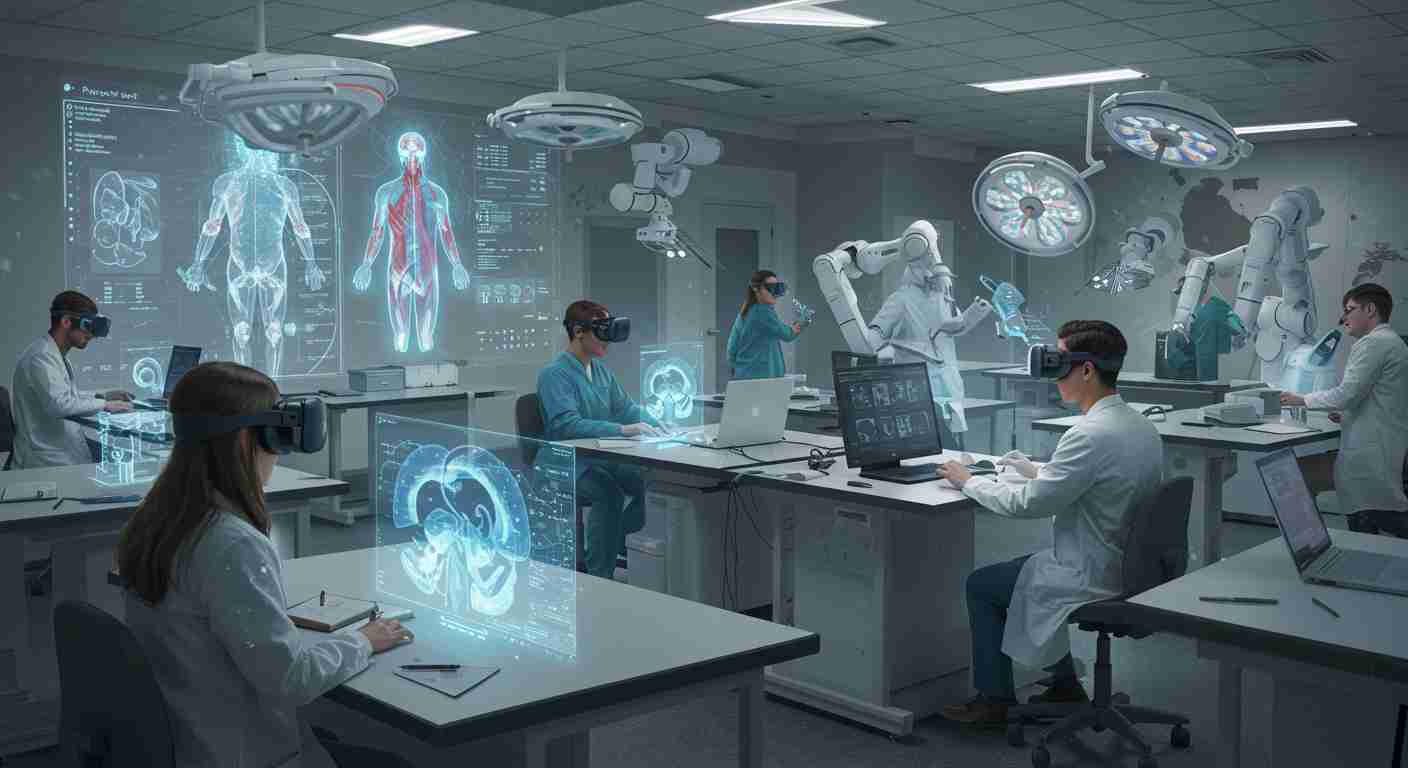
Consider, for instance, the Jump Simulation Center at the University of Illinois Urbana-Champaign, a facility frequently utilized by CI MED students. It features full-size mannequins capable of simulating a wide range of medical conditions, as well as advanced AI/VR tools that provide immersive and interactive learning experiences. Students can practice their clinical skills in a safe and controlled environment, honing their diagnostic abilities and refining their treatment strategies without putting real patients at risk. The editor thinks this is one effective means.
But what do the faculty and students themselves think about this novel approach? According to the original news piece, Chancellor Robert J. Jones believes that CI MED embodies the spirit of interdisciplinary collaboration, training students to be innovators capable of designing technology-driven solutions. Feedback from students often echoes this sentiment, emphasizing the value of learning alongside engineers and computer scientists, gaining insights and perspectives that would be unavailable in a traditional medical setting. As Dara Nafiu, BS, CI MED Class of 2024, said, this combined training will be valuable in residency programs.
Of course, CI MED isn’t operating in a vacuum. The broader trend of integrating engineering principles into medical education is gaining momentum across the country, as evidenced by programs like the Texas A&M Intercollegiate School of Engineering Medicine’s ENMED program. As highlighted in a 2022 RSNA article, these “physicianeers” and “physician-innovators” are poised to revolutionize healthcare by leveraging their unique skillsets to address pressing medical challenges.
Furthermore, augmented reality (AR) is emerging as a potent tool for engineering education, as detailed in a Frontiers in Virtual Reality review article. AR applications enhance visualization, interaction, and student engagement, offering immersive learning experiences that can deepen understanding of complex concepts. While AR adoption in medical education is still in its early stages, its potential for transforming the way doctors are trained is undeniable.
This burgeoning field faces its fair share of hurdles. Successfully merging two distinct disciplines requires careful planning, effective communication, and a willingness to bridge cultural divides. However, the potential rewards – a new generation of physician-innovators capable of tackling the grand challenges facing healthcare – make the effort more than worthwhile. The editor has high expectations for its graduates.
AI and Data Science Integration in Medical Training: Enhancing Reliability and Preparing Future Physicians
Now, let’s pivot to an increasingly critical aspect of modern medicine and CI MED’s pioneering curriculum: the integration of artificial intelligence (AI) and data science. We’re not just talking about using AI to schedule appointments; we’re talking about fundamentally changing how doctors diagnose, treat, and even prevent disease. But with great power comes great responsibility, and that’s why CI MED places such a strong emphasis on the responsible and reliable application of these technologies.
One of the biggest challenges in deploying AI in healthcare is ensuring its reliability. AI “hallucinations,” where algorithms confidently generate false or misleading information, are a real concern. Imagine an AI-powered diagnostic tool confidently misdiagnosing a patient – the consequences could be devastating! That’s why researchers at institutions like the UTSA School of Data Science are actively working on methods to reduce these hallucinations and improve the accuracy of AI in medical contexts.
As reported by UTSA Today, researchers are developing AI models capable of fact-checking themselves by creating Causal Knowledge Graphs (CKGs), which organize information from trusted medical sources. This allows AI to recognize connections between medical concepts, leading to more accurate and reliable answers. In essence, they’re teaching AI to think more critically and to ground its responses in verifiable evidence.
But it’s not just about making AI more reliable; it’s also about training future physicians to be critical consumers of AI outputs. Doctors need to understand the limitations and biases of AI algorithms, and they need to be able to critically evaluate the information that AI provides. As Shauna Overgaard, PhD, from the Mayo Clinic Center for Digital Health, emphasizes in a Medscape article, doctors must maintain autonomy and skepticism when using AI, advocating for critical evaluation of AI outputs, understanding the data used for predictions, and recognizing the limitations of algorithms. It’s about augmenting human intelligence, not replacing it.
This emphasis on data science training is echoed by experts across the medical education landscape. Peter Steel, MD, from Weill Cornell Medical School in New York City, argues that data science should become a core component of medical school curricula, including fundamental knowledge of data analytics, machine learning, and understanding the biases inherent in AI. This will enable doctors to critically interpret AI outputs and cross-check them with their clinical judgment. CI MED seems to be ahead of the curve here, integrating these principles from the outset.
Beyond improving diagnostic accuracy and treatment planning, AI also holds immense potential for improving healthcare accessibility and reducing disparities. AI-powered tools can be deployed in underserved communities to provide remote monitoring, personalized health advice, and early detection of diseases. As Salvatore Viscomi, CEO and cofounder of Carna Health, points out in a Forbes article, integrating affordable and accessible digital health technologies can significantly improve outcomes for patients with chronic kidney disease (CKD), particularly in marginalized communities.
However, it’s crucial to ensure that these technologies are deployed equitably and ethically. As a commentary published by the CDC emphasizes, AI models are often trained on data that doesn’t adequately represent racial and ethnic minority groups, leading to biased outcomes that can exacerbate existing health disparities. That’s why it’s so important to collect data from diverse populations, develop AI with explainable outcomes, and continuously monitor AI systems for biased results.
CI MED’s commitment to addressing healthcare disparities aligns perfectly with this vision. By training physician-innovators who are not only skilled in AI and data science but also deeply aware of the ethical and social implications of these technologies, the college is helping to build a future where healthcare is more accessible, more equitable, and more effective for all. The editor believes it’s a step in the right direction.
Addressing Healthcare Accessibility Disparities Through Technology and Interdisciplinary Collaboration
CI MED’s dedication extends beyond the theoretical application of technology; it’s deeply rooted in addressing real-world healthcare inequities. A significant focus is on using technology to bridge gaps in access and outcomes, ensuring that advancements benefit all segments of the population, not just the privileged few.
The Digital Health Care Equity Framework (DHEF), spearheaded by researchers at the Johns Hopkins Bloomberg School of Public Health, provides a structured approach to embedding equity into every stage of digital health solution development and implementation. This framework recognizes that the “digital divide” is more than just about internet access; it’s about tailoring technologies to meet the diverse needs of all patients, regardless of their background, literacy, or access to resources.
As Dr. Elham Hatef articulated, the DHEF offers a systematic way to assess and improve equity in digital healthcare tools. It’s designed for a wide array of stakeholders – healthcare developers, vendors, health systems, and policymakers – to intentionally address equity throughout the entire lifecycle of a digital health solution, from its initial planning stages to its long-term maintenance and assessment.
One of the framework’s key strengths lies in its emphasis on addressing “digital determinants of health.” These encompass a wide range of factors, from infrastructure challenges like limited broadband access in rural communities to individual barriers such as low digital literacy among older adults. By tackling these underlying issues, the DHEF aims to create a more level playing field for all patients, regardless of their socioeconomic status or geographic location.
Another crucial aspect of CI MED’s approach is interdisciplinary collaboration, particularly between engineering and medicine. This synergy is driving innovation in medical technology and significantly improving patient safety. The UMass Amherst nurse-engineer team, for example, was honored with an ANA Innovation Award for inventing a new IV pole designed to minimize medication errors. Karen Giuliano, nursing co-director of the Elaine Marieb Center for Nursing and Engineering Innovation, along with her colleagues, combined their expertise to address a very real and pressing clinical challenge.
This novel IV pole, which features an adjustable crossbar for hanging infusions, automatically maintains the required height differential between the IV pump and the medication container. This simple yet ingenious design improves medication delivery efficiency and reduces the need for manual adjustments, thereby minimizing the risk of potentially dangerous infusion errors. The editor believes such a project can change the world.
Interdisciplinary research, however, isn’t without its challenges. A 2019 Frontiers in Medicine article points out potential communication issues and difficulties in credit allocation. Researchers may struggle to justify the increased time and resources required for collaborative projects. However, the benefits, such as the generation of new knowledge and exposure to diverse methodologies, often outweigh these challenges.
Successful interdisciplinary projects often rely on mutual respect, trust, and a shared commitment to the common goal. The creation of arterio-venous fistulas for hemodialysis access and the development of blood-resistant biodegradable surgical glue serve as prime examples of how interdisciplinary teams can solve long-standing unmet medical needs. In these cases, experts from different fields – surgeons, engineers, material scientists – collaborated to develop innovative solutions that significantly improved patient outcomes.
CI MED recognizes the importance of fostering this collaborative spirit from the outset. By bringing together students and faculty from diverse disciplines, the college is creating an environment where innovation can flourish and where the next generation of healthcare leaders can learn to work together to solve the complex challenges facing medicine today. The editor believes that’s its most crucial mission.
Simulation in Medical Education: Enhancing Skills and Confidence for Future Clinicians
Finally, let’s consider the vital role of simulation in medical education, a domain where CI MED is actively integrating cutting-edge approaches to hone the skills and bolster the confidence of future clinicians. Simulation-based training, encompassing everything from virtual reality environments to high-fidelity mannequins, offers a safe and controlled setting for students to practice essential clinical procedures and decision-making without putting real patients at risk.
One area where simulation is proving particularly valuable is in cardiac auscultation training. Traditionally, medical students learn to identify heart sounds and murmurs through bedside teaching and interactions with real patients. However, these opportunities have been significantly curtailed by the pandemic, prompting a surge in the use of virtual simulation. A Cureus article explores the effectiveness of virtual simulation-based training for improving cardiac auscultatory skills among post-graduate trainees during this era. The study likely investigates how virtual simulation can serve as a substitute or supplement to traditional methods, focusing on the acquisition and retention of cardiac auscultation skills.
But is virtual simulation as effective as the real thing? A Frontiers in Medicine study compared traditional high-fidelity (manikin-based) simulation with virtual high-fidelity simulations, finding no significant difference in the overall effectiveness of HFS between the two methods. This suggests that virtual simulations can be a valuable tool for developing practical and soft skills in medical students, preparing them for challenging clinical situations.
Beyond cardiology, simulation is also making inroads in other medical specialties. A BMC Medical Education study evaluated the impact of a simulation-based education (SBE) workshop on medical students’ ophthalmology skills and confidence. The workshop utilized standardized patients, free-to-use simulators, and low-cost eye models to teach eye anatomy, physiology, pathologies, and essential skills. The results showed that students significantly improved in confidence, interest, and knowledge immediately after the workshop, with gains largely sustained three months later. This underscores the potential of simulation-based ophthalmology education in producing well-trained clinicians and improving primary ocular care.
The broader implications of integrating virtual simulation into medical education are significant, particularly in light of ongoing challenges posed by the pandemic and the increasing availability of sophisticated simulation technologies. As medical schools adapt to the changing landscape, virtual simulation offers a flexible and scalable solution for delivering high-quality training in essential clinical skills. Moreover, it allows for standardized and repeatable training scenarios, ensuring that all students receive a consistent and comprehensive educational experience. The editor sees the vast possibilities that simulation could unlock in medical education.
Reference:
- Carle Illinois College of Medicine Receives LCME Accreditation
- Engineering-Based Medical Training: The Catalyst for a Health Care Revolution
- Augmented Reality in Engineering Education: Enhancing Learning and Application
- School of Data Science Faculty Improve AI Reliability in Medical Field
- Prescribing AI: All Docs Need More Tech Training
- Bridging The Gap: Tackling Healthcare Disparities In Chronic Kidney Disease
- Health Equity and Ethical Considerations in Using Artificial Intelligence in Public Health and Medicine
- Bridging the Digital Divide in Health Care: A New Framework for Equity
- UMass Amherst Nurse-Engineer Team Honored for Inventing IV Pole Designed to Improve Patient Safety
- Driving Medical Innovation Through Interdisciplinarity: Unique Opportunities and Challenges
- Teaching Cardiac Auscultation: Effectiveness of Virtual Simulation-Based Training in the COVID-19 Era
- Comparative Study: Traditional vs. Virtual High-Fidelity Simulations in Medical Education
- Evaluation of a Simulation-Based Ophthalmology Education Workshop for Medical Students: A Pilot Project