
(This article reports on news from August 2025.)
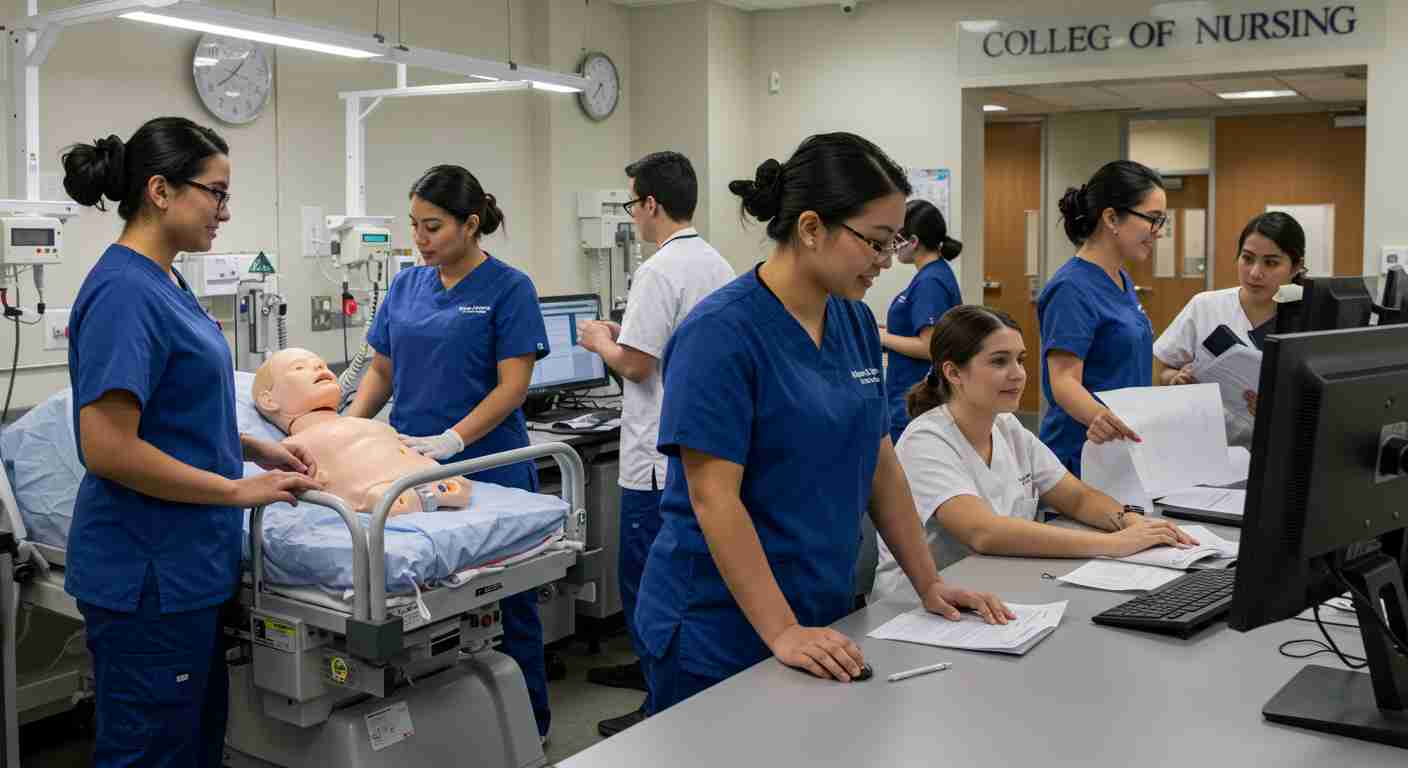
The University of Florida College of Nursing began the fall 2025 semester with its largest undergraduate class ever. On August 21, 2025, 226 Bachelor of Science in Nursing (BSN) students started classes, including 85 newly created seats, which the college described as a 60% increase in enrollment in one year. With the new class, UF’s BSN enrollment across its traditional, accelerated and RN-to-BSN tracks reached 722 students (UF College of Nursing, August 20, 2025; UF News, August 25, 2025).
The college tied the expansion directly to Florida’s nursing shortage. “This is a defining moment in our college’s history,” said Karen Reed, associate dean for academic affairs for undergraduate education. Dean Shakira Henderson added: “Expanding our student body does not mean lowering the bar.”
How UF paid for the expansion
Much of the growth was supported by Florida’s Linking Industry to Nursing Education (LINE) program, which the Florida Legislature created in 2022. LINE grants must be matched by a health care partner.
- March 2025: UF received $3 million: $1.5 million from LINE, awarded by the State University System Board of Governors, and a $1.5 million match from UF Health. The money paid for 50 scholarships in the 15-month Accelerated BSN (ABSN) program, lab upgrades at the Gainesville and Jacksonville campuses (open labs, virtual reality labs and simulation equipment), more lab staff, faculty recruitment and retention, and student support programs (UF Health, March 20, 2025).
- Later in 2025: the college’s largest LINE award to date, $3.3 million ($1.68 million from the state plus a matching $1.68 million from UF Health), funded scholarships for 53 ABSN students in Jacksonville and Gainesville and upgrades to the Kirbo Innovation and Learning Laboratory, including simulation mannequins, more hospital beds and an expanded control room that will let faculty run up to seven simulations at once (Gator Nurse, January 6, 2026).
The ABSN scholarships cover tuition and books but come with a 36-month work commitment, including a 12-month residency, as a full-time registered nurse at a UF Health facility. UF Health said only Florida residents were eligible for the earlier round of LINE scholarships, so international students should not expect to receive them.
The nursing shortage behind the news
- Florida: the Florida Hospital Association counted more than 16,000 nursing vacancies in September 2024, down from 58,000 in 2022, but projects a shortage of about 59,000 to 60,000 nurses by 2035 (UF Health; UF College of Nursing).
- Nationwide: the federal Health Resources and Services Administration (HRSA) projects an 8% shortage of registered nurses in 2028, narrowing to 3% (about 108,960 full-time-equivalent RNs) by 2038. The gap is far larger outside cities: 11% in nonmetropolitan areas versus 2% in metropolitan areas in 2038 (HRSA, Nurse Workforce Projections, 2023–2038).
- Jobs and pay: in May 2025, 3,379,720 RNs earned a median of $97,550 a year (BLS OEWS, May 2025). The Bureau of Labor Statistics projects RN employment to grow 6% from 2025 to 2035, with about 180,800 openings a year (BLS Occupational Outlook Handbook).
How UF’s BSN tracks work
- Traditional BSN: an upper-division program. Applicants must complete 60 credits, including all general education and pre-professional nursing prerequisites (such as anatomy and physiology, microbiology and statistics), by the end of the spring semester before admission, with an overall GPA and pre-professional GPA of at least 3.0 and no prerequisite grade below C. Applicants apply through NursingCAS, write essays and take the HESI A2 exam. Because of classroom and clinical space limits, not all qualified applicants are admitted (UF College of Nursing: Traditional BSN). The cohort that started in August 2025 is the Class of 2027.
- Accelerated BSN: for students who already hold a bachelor’s degree in another field, with a GPA of at least 3.0 in the last 60 credits of that degree. The program takes 15 months, starts in May and runs on the Gainesville and Jacksonville campuses.
- RN to BSN: for nurses who are already licensed and want a bachelor’s degree.
For context, UF’s nursing program ranks No. 12 in the U.S. News 2027 undergraduate nursing ranking, and UF ranks No. 34 among national universities (Forward Pathway US Colleges Ranking).
What this means for international students
- Very few international nursing graduates. UF awarded 247 bachelor’s degrees in nursing in 2025, and only one went to an international student (IPEDS completions). Across the university, 1,088 of 36,573 undergraduates were international students in fall 2025.
- Cost. International undergraduates pay out-of-state rates: $25,694 tuition plus $2,965 in required fees for 2025–26, plus about $12,120 for on-campus housing and food (IPEDS; see Forward Pathway’s University of Florida profile). The state-funded LINE scholarships described above were limited to Florida residents.
- Licensure. To work as a registered nurse, graduates need a license from the state where they will work, which means finishing an approved program and passing the NCLEX-RN exam (BLS; NCSBN).
- Work after graduation. Nursing is not on the DHS STEM Designated Degree Program list, so F-1 graduates generally get 12 months of OPT, with no 24-month STEM extension (Study in the States). U.S. immigration authorities have long held that most staff RN jobs are not H-1B “specialty occupations” because they do not normally require a bachelor’s degree, although some specialized roles and advanced practice positions such as nurse practitioners and nurse anesthetists can qualify (Littler, summarizing USCIS policy). Talk to your international student office or an immigration attorney before you commit to a U.S. nursing degree.
For a broader guide to BSN programs, licensure and careers, see Forward Pathway’s article on U.S. nursing education.
Latest: an even larger class in fall 2026
A year later, the growth continued. In the week of August 10, 2026, UF’s College of Nursing welcomed a 312-student Traditional BSN cohort, the Class of 2028, which the college called the largest Traditional BSN class in its history (UF College of Nursing, August 11, 2026). The college also expanded clinical training to UF Health St. Johns in fall 2025 (Gator Nurse).
References
- UF College of Nursing welcomes record number of students this fall – UF College of Nursing, August 20, 2025
- UF expands nursing enrollment to address state’s workforce shortages – UF News, August 25, 2025
- UF Nursing secures $3 million to expand Florida’s nurse workforce – UF Health, March 20, 2025
- College of Nursing marks a season of growth and firsts – Gator Nurse, January 6, 2026
- Welcome, Gator Nursing students – UF College of Nursing, August 11, 2026
- Traditional BSN – UF College of Nursing
- Nurse Workforce Projections, 2023–2038 – HRSA
- Registered Nurses – BLS Occupational Outlook Handbook
- Registered Nurses, May 2025 – BLS Occupational Employment and Wage Statistics
- USCIS Policy Memo Provides Guidance on Use of H-1B Petitions for Nursing Positions – Littler
- University of Florida – Forward Pathway school profile (IPEDS admissions, enrollment, completions and cost data)
- US Colleges Ranking – Forward Pathway