
“Experiential learning” is the term U.S. colleges use for learning by doing: internships, co-ops, undergraduate research, service-learning, study abroad, client projects and similar experiences that take students outside the lecture hall. Many universities now count these experiences toward degrees, list them on transcripts or require at least one. This guide explains the main types, gives examples of how one university uses them, and covers what international students on F-1 visas should check before signing up.
What counts as experiential learning
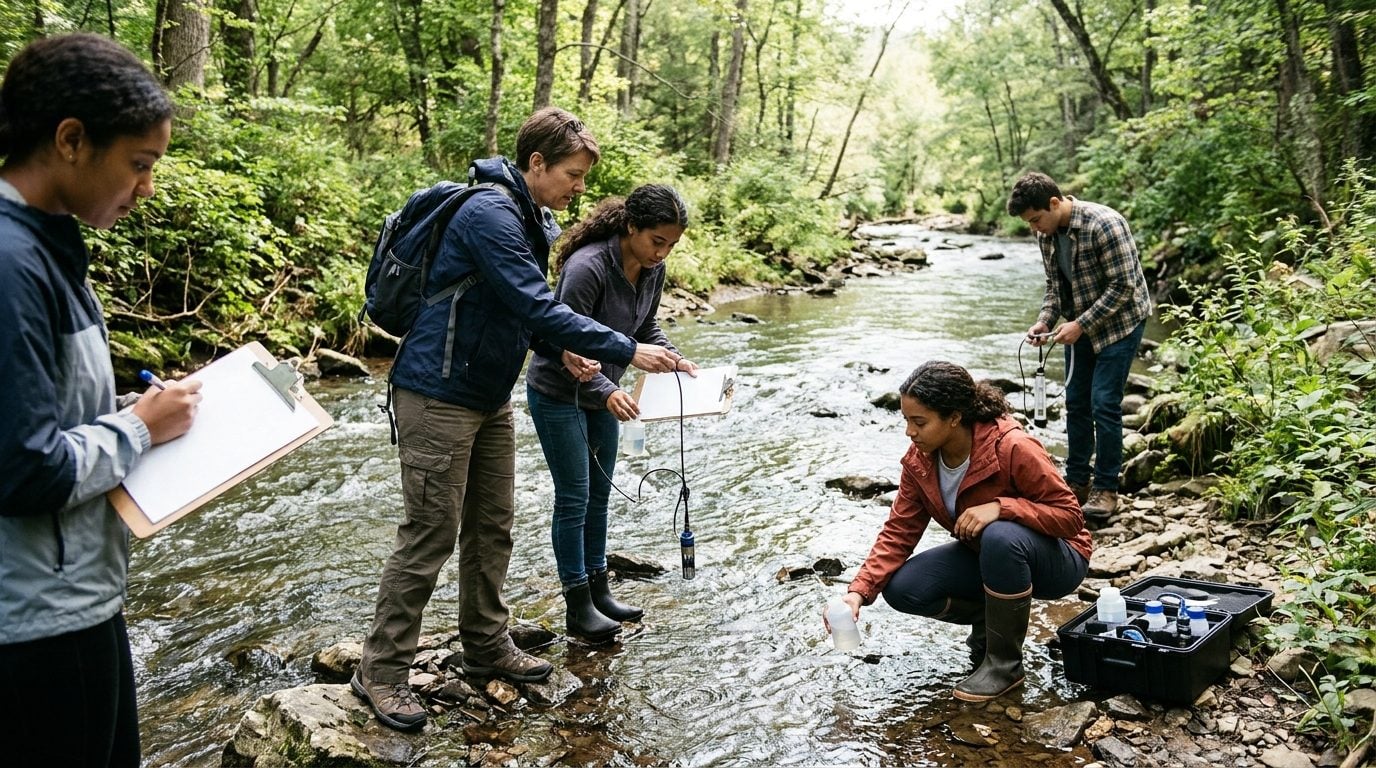
Purdue University offers a useful definition: experiential education is “a planned pedagogy centering on an authentic experience” designed “to strengthen students’ knowledge, skills, and abilities, paired with student reflection.” In other words, it is planned, involves real work or real settings, and includes structured reflection afterward. Purdue groups these experiences into seven types (Purdue Office of Experiential Education):
| Type | Examples |
|---|---|
| Work-integrated learning | Internships, co-ops, clinical placements |
| Travel-based learning | Study abroad, faculty-led trips, virtual exchange |
| Undergraduate research and scholarly projects | Mentored research that adds new knowledge or creative work |
| Service-learning | Organized community service tied to course content, followed by reflection |
| Client-based applied projects | Producing a deliverable for a business or community client |
| Scenario-based learning | Simulations, role plays, case competitions |
| Engaged campus experiences | Campus leadership roles, on-campus jobs |
Purdue counts co-curricular activities as experiential education when they include all three elements, whether or not they carry academic credit (Purdue Experiential Education FAQ).
An example: Penn State’s spring break 2025
A May 2025 Penn State photo story shows how many forms these experiences can take in a single week. During spring break 2025, Penn State students (Penn State News, May 19, 2025):
- Service trips: through Alternative Breaks, University Park students did hurricane relief in Asheville, North Carolina, rebuilding homes, planting more than 140 saplings and packing about 700 food bags for schoolchildren; students from the Scranton and Altoona campuses did service projects in Puerto Rico.
- Embedded courses abroad: a Bellisario College of Communications international reporting course (COMM 402) traveled to Almaty, Kazakhstan, one of three embedded reporting trips that spring along with Bulgaria and Mexico City; Arabic students practiced their language in Egypt; an entrepreneurship course visited companies in Taipei, including TSMC.
- Professional study tours: Penn State Harrisburg MBA finance students met with firms in London, including Barclays and Lloyd’s of London; a management course from World Campus and the Schuylkill campus studied the aluminum and renewable energy company Hydro in Copenhagen.
- Field research: a biology course (BIOL 483) did fieldwork at the Key Largo Marine Research Laboratory in the Florida Keys, analyzing environmental DNA from jellyfish.
Several of these trips were part of credit-bearing courses: the course provides the preparation and reflection, and the trip provides the experience.
How to find opportunities
- Career center: internships, co-ops and employer-sponsored projects.
- Undergraduate research office: faculty research positions, summer research programs and research courses for credit.
- Education abroad office: semester programs, short faculty-led courses and spring break trips.
- Community engagement or service-learning office: service-learning courses and alternative break trips.
- Your department: capstone projects, practicums, case competitions and client projects are often listed only in departmental course catalogs.
What international students should check
- Off-campus work needs authorization. An internship or co-op with an off-campus employer during your degree normally requires Curricular Practical Training (CPT), which your DSO authorizes in SEVIS before you start. CPT is generally available after one full academic year of study, and the training must be an integral part of your curriculum (8 CFR 214.2(f)(10)(i)). Guidance that SEVP sent to schools in August 2026 says CPT should be approved only when the training is required of all students in that degree program, not merely as an elective, so check your school’s current CPT policy early (SEVP Broadcast Message 2608-01).
- On-campus roles are simpler. Paid research assistant positions and campus jobs count as on-campus employment, limited to 20 hours a week while school is in session (Study in the States). Unpaid research for course credit is part of your studies.
- Travel abroad and re-entry. Before a study-abroad trip, ask your international office what you need to re-enter the United States, such as a current travel signature on your I-20 and a valid visa.
- Volunteering. Short service projects organized by your school are normally fine. Be careful with unpaid “internships” at outside organizations that look like regular jobs, and ask your DSO before you begin.
References
- Purdue University: Types of Experiential Education
- Purdue University: Experiential Education FAQ
- Penn State News: Photos: Penn State students gain knowledge, serve others during spring break (May 19, 2025)
- eCFR: 8 CFR 214.2(f), F-1 students
- SEVP Broadcast Message 2608-01 (August 12, 2026)
- Study in the States: Working in the United States