
Swarthmore College enrolled 24 new transfer students this fall, and 12 of them came from community colleges, the most in the college’s history. But the transfer door at the most selective U.S. colleges is narrow and can close without warning: in fall 2024, Swarthmore admitted no transfer applicants at all. According to U.S. Department of Education data for 2024, 19 of 26 top-30 liberal arts colleges enrolled fewer than 5 new transfer students for every 100 first-time freshmen. Top-50 public universities, by contrast, all took at least 10.
For international students the picture depends heavily on money. Some top colleges will not admit international transfer students who need financial aid; others offer aid but weigh financial need in admission decisions. And most international transfers to top-50 private universities are concentrated at just six schools.
Key takeaways
- Swarthmore’s fall 2026 transfer class had 24 students, 12 from community colleges, up from 6 community college transfers in 2025, according to the student newspaper The Phoenix.
- Swarthmore received 371 transfer applications for fall 2024 and admitted none, citing space concerns; for fall 2025 it admitted 42 of 421 applicants, about 10.0%.
- In 2024, the 26 top-30 liberal arts colleges in our analysis enrolled 645 new transfer students combined, fewer than 25 per school on average.
- International students made up 17.4% of the 9,520 new transfer students at top-50 private universities in 2024, but six schools accounted for 1,178 of the 1,659, about seven in 10.
- Harvard, Yale, Princeton, MIT and Stanford enrolled 22 international transfer students combined in 2024.
Why Swarthmore is taking more community college transfers
According to a Nov. 5, 2026, report in The Phoenix, Swarthmore College has set yield targets for community college transfers: a target of five in 2025, when six enrolled, and a target of 10 in 2026, when 12 enrolled. The college’s Swarthmore Forward strategic plan calls for it to “admit an annual cohort of up to 20-25 transfer students from community colleges” without growing the overall student body.
“The college’s transfer student admissions policy has not changed,” Jim Bock, vice president and dean of admissions, wrote to The Phoenix. The increase comes from outreach: Swarthmore representatives have visited an average of 12 to 15 community colleges a year recently, compared with three to four a year between 2016 and 2019. The college has also partnered with the Transfer Scholars Network, an Aspen Institute program that collects nominations of high-achieving, lower-income community college students and shares them with four-year colleges that have high graduation rates.
The school’s Common Data Set shows how small and unstable the opening is:
- Fall 2024: 371 transfer applicants, 0 admitted. The college noted it could not admit transfer applicants that year because of space concerns.
- Fall 2025: 421 applicants, 42 admitted, 19 enrolled, an admit rate of about 10.0%. First-year applicants that year: 12,995 applied, 977 admitted, about 7.5%.
- Fall 2026: 24 transfers enrolled, 12 from community colleges (The Phoenix’s figures; the 2026–27 Common Data Set has not been published).
A transfer admit rate slightly above the first-year rate does not mean transferring is easier. The applicant pool is only about 400 people, most of whom already have college grades, and the number of seats depends on how much space opens up as students leave or take time off. As 2024 showed, those seats can disappear entirely.
How many transfer students do top colleges enroll?
Federal data do not report transfer applications or admissions by school; those numbers are only in each school’s Common Data Set. They do report how many new transfer students enroll each fall. Forward Pathway used 2024 data to compute new transfer students per 100 first-time freshmen at the U.S. News 2027 top 50 national universities (51 schools with ties) and top 30 liberal arts colleges. We excluded three service academies, which do not take ordinary transfers, and Swarthmore, which enrolled none that year, leaving 26 liberal arts colleges.
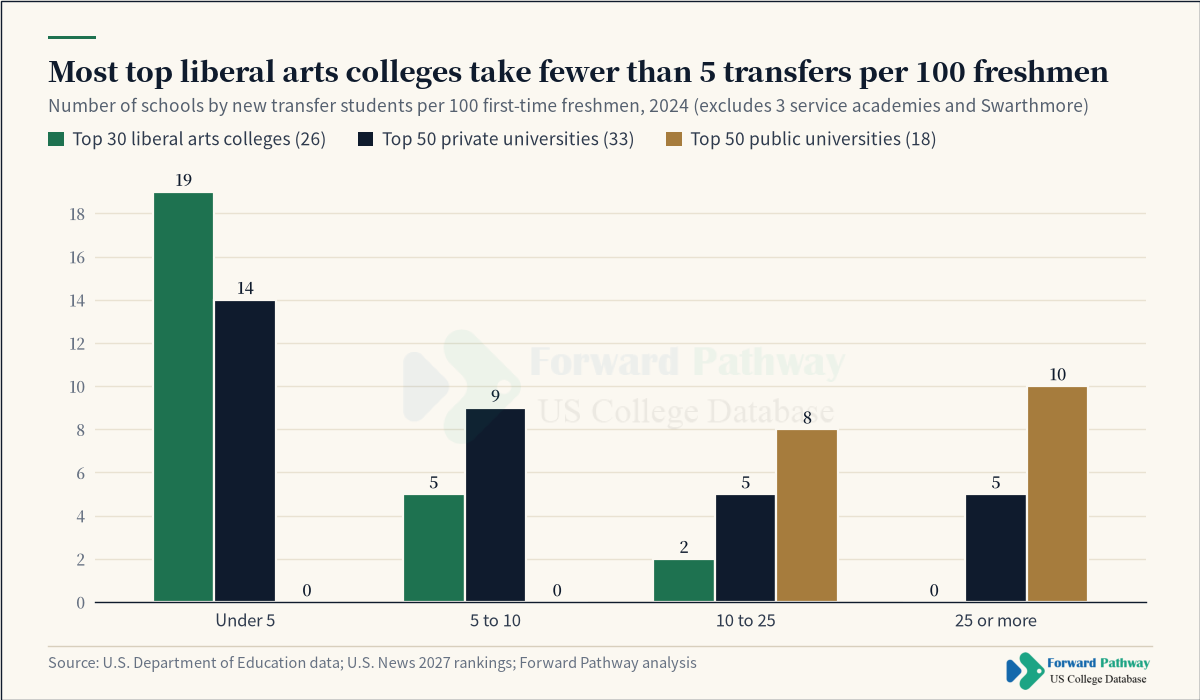
- Top liberal arts colleges barely use transfers to fill seats. 19 of 26 took fewer than 5 per 100 freshmen, and none took 25 or more. Together they enrolled 645 new transfers.
- Top private universities split. 14 of 33 took fewer than 5, but 5 took 25 or more. Combined: 63,598 first-time freshmen and 9,520 new transfers, about 15 per 100.
- Top public universities are the big transfer destinations. All 18 took at least 10 per 100 freshmen, 10 took 25 or more, and the group averaged about 31.
| Liberal arts college (2024) | First-time freshmen | New transfers | International transfers | Transfers per 100 freshmen |
|---|---|---|---|---|
| Williams College | 547 | 6 | 1 | 1.1 |
| Bowdoin College | 507 | 7 | 0 | 1.4 |
| Wellesley College | 583 | 15 | 0 | 2.6 |
| Pomona College | 436 | 22 | 2 | 5.0 |
| Wesleyan University | 825 | 48 | 5 | 5.8 |
| Amherst College | 480 | 31 | 5 | 6.5 |
| University of Richmond | 841 | 90 | 4 | 10.7 |
| Barnard College | 718 | 147 | 76 | 20.5 |
Source: U.S. Department of Education data; Forward Pathway analysis. Swarthmore that year had 427 first-time freshmen and 0 transfers, matching its Common Data Set. Barnard is the outlier: 76 of its 147 new transfers were international students.
| National university (2024) | First-time freshmen | New transfers | International transfers | Transfers per 100 freshmen |
|---|---|---|---|---|
| Harvard University | 1,641 | 13 | 0 | 0.8 |
| Yale University | 1,554 | 23 | 1 | 1.5 |
| Princeton University | 1,407 | 34 | 1 | 2.4 |
| Massachusetts Institute of Technology | 1,098 | 28 | 15 | 2.6 |
| Stanford University | 1,693 | 56 | 5 | 3.3 |
| University of Chicago | 1,726 | 229 | 113 | 13.3 |
| Cornell University | 3,525 | 503 | 29 | 14.3 |
| University of California-Berkeley | 6,272 | 2,725 | 233 | 43.4 |
| Columbia University in the City of New York | 1,558 | 710 | 221 | 45.6 |
| University of California-Los Angeles | 6,610 | 3,834 | 344 | 58.0 |
Source: U.S. Department of Education data; Forward Pathway analysis. Federal data count each institution as a whole, without separating its undergraduate colleges, and do not distinguish community college transfers from four-year transfers.
Princeton enrolled no transfer students from 2015 through 2017 in federal data, restarted in 2018 with 9, and enrolled 34 in 2024. Its transfer page says it particularly encourages applications from students from lower-income backgrounds, community college students and U.S. military veterans, and that students may not transfer for higher standing than fall of junior year.
On admit rates, Cornell’s 2025–26 Common Data Set shows 7,381 transfer applicants for fall 2025, 864 admitted and 625 enrolled, about 11.7%, close to Swarthmore’s 10.0%. Other schools’ transfer admit rates have to be checked in each school’s own Common Data Set.
Can international students transfer into top U.S. colleges?
At top private universities, international students are not underrepresented among transfers. In 2024 they were 1,659 of 9,520 new transfer students at the top 50 private universities, or 17.4%, higher than their 13.8% share of first-time freshmen. At the top 50 public universities they were 10.0% of new transfers. Over the past decade the two groups moved in opposite directions.
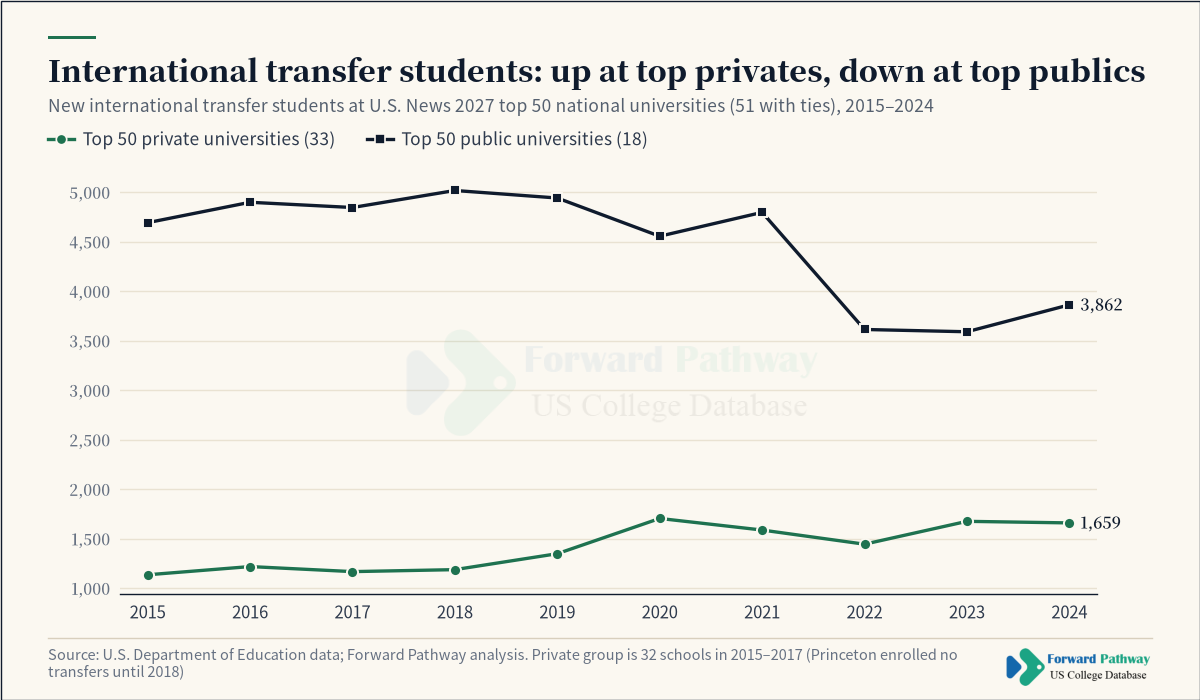
The private-university total is highly concentrated. Northeastern University enrolled 315 international transfers in 2024, New York University 231, Columbia 221, Boston University 175, the University of Southern California 123 and the University of Chicago 113. Those six account for 1,178, about seven in 10. Harvard, Yale, Princeton, MIT and Stanford together enrolled 22. Liberal arts colleges look the same: the top 30 enrolled 121 international transfers in 2024, and Barnard alone had 76; the other 25 colleges had 45 combined.
Whether an international student can transfer often comes down to financial aid, and policies differ widely:
- Swarthmore: “International transfer students who require financial aid to attend are not eligible for transfer,” its transfer page says. Transfer aid is limited to U.S. citizens, permanent residents and certain undocumented or DACA students.
- Pomona: International transfer applicants can receive aid that meets 100% of demonstrated need, but Pomona is need-aware for international applicants, and they must apply for aid when they apply for admission.
- Cornell: Admission for international students is need-aware. For fall 2027 entry, the international transfer aid deadline is March 15, 2027.
The University of California is more open. In UC’s fall 2025 transfer admissions data compiled by Forward Pathway, UC Berkeley admitted about 25.0% of international transfer applicants versus about 21.7% of all applicants; UCLA admitted about 26.4% and 22.8%. (Counts summed across ethnic groups run slightly below UC’s published totals, so we use them only to compare rates.)
What this means for transfer applicants
Swarthmore’s push, like Princeton’s, is aimed mainly at lower-income U.S. students, and Swarthmore’s transfer aid is closed to international students. It helps international students only at the margins. Some practical points:
- Treat elite colleges as reaches. Top-30 liberal arts colleges enroll about two dozen transfers a year on average, and a school can take none in a given year. Public universities remain the higher-volume path.
- Check aid rules first if you are international. At Swarthmore you must pay full cost; at Pomona and Cornell you can apply for aid, but asking for it is weighed in admission. Your budget should shape your list.
- College grades and professors matter most. Swarthmore asks for high school and college transcripts, a Transfer College Report, a midterm report if you are enrolled, and two academic evaluations, at least one from a recent college instructor. Test scores and an alumni interview are optional.
- Count credits and time. Swarthmore will not transfer more than four semesters of coursework, about 16 Swarthmore courses, and its registrar’s guide for transfer students says a Swarthmore degree requires four semesters of full-time study at the college, two of them in the senior year. Pomona accepts at most 16 course credits and admits transfers as sophomores or juniors. Princeton caps entry at fall of junior year. Depending on how many credits transfer, starting at a community college can stretch a bachelor’s degree past four years.
- Deadlines fall in spring for fall entry. Pomona’s fall 2027 transfer deadline is Feb. 15, 2027; Princeton’s is March 9; Swarthmore’s is April 1. Swarthmore and Princeton release decisions in mid-May.
- F-1 students must transfer their SEVIS record. According to Study in the States, you must contact the designated school official at the new school within 15 days of the program start date on your new Form I-20.
Frequently asked questions
How many community college transfers did Swarthmore enroll in 2026?
Twelve of its 24 new transfer students in fall 2026 came from community colleges, the most in the college’s history, according to The Phoenix on Nov. 5, 2026. In 2025 it enrolled six. Its strategic plan aims for up to 20 to 25 community college transfers a year.
How many transfer students do top liberal arts colleges accept?
Very few. In 2024 federal data, 26 top-30 liberal arts colleges (excluding service academies and Swarthmore) enrolled 645 new transfers combined, and 19 enrolled fewer than 5 per 100 first-time freshmen. Williams College enrolled 6.
Is it easier to get into an elite college as a transfer than as a freshman?
Not necessarily. Swarthmore’s fall 2025 transfer admit rate was about 10.0% versus 7.5% for first-years, and Cornell’s was about 11.7%. But transfer slots are few and unstable: Swarthmore admitted none of its 371 transfer applicants for fall 2024.
Can international transfer students get financial aid at top colleges?
It depends on the school. Swarthmore does not admit international transfers who need aid. Pomona meets 100% of demonstrated need for international transfers but is need-aware and requires the aid application with the admission application. Cornell is need-aware for international students, with a March 15, 2027, aid deadline for fall 2027 transfers.
Which top universities enroll the most international transfer students?
In 2024, Northeastern (315), NYU (231), Columbia (221), Boston University (175), USC (123) and the University of Chicago (113) enrolled 1,178 of the 1,659 international transfers at top-50 private universities. Among top-50 publics, UCLA enrolled 344 and UC Berkeley 233.
Sources
- The Phoenix: Swarthmore Embraces Community College Transfer Students in Keeping With Swarthmore Forward Strategic Plan (Nov. 5, 2026)
- Swarthmore College Common Data Set 2025-2026
- Swarthmore College Common Data Set 2024-2025
- Swarthmore College: Apply as a Transfer Student
- Pomona College: Transfer Applicants
- Princeton University: Transfer Students
- Princeton University: Transfer Application Dates & Deadlines
- Cornell University Common Data Set 2025-26
- Cornell University Financial Aid: First-Year and Transfer Students — International
- Aspen Institute: Transfer Scholars Network
- Study in the States: Instructions for Transferring to Another School as an F-1 Student