
The University of Florida’s Strategic AI Investment: A National Pioneer
Hello there, your lifestyle editor here! Today, let’s embark on a journey to the heart of artificial intelligence innovation at the University of Florida (UF). Life’s too short to ignore the groundbreaking advancements happening right in our backyard, and UF’s commitment to AI is nothing short of transformative.
In May 2020, UF made a bold move, becoming the first university in the United States to acquire the cutting-edge NVIDIA DGX A100 system. This wasn’t just about getting the latest tech; it was a strategic leap toward establishing UF as a national epicenter for AI research, education, and economic development. Think of it as UF planting a flag, signaling its intention to lead the charge in the AI revolution.
“AI is poised to transform how we work with information, address challenges, and make discoveries,” declared UF President Kent Fuchs at the time. It’s a sentiment that resonates even more profoundly today. The vision was clear: to integrate AI across every facet of the university, from curriculum to research, preparing students and faculty alike to navigate and shape an AI-driven future.
The scope of UF’s AI initiative is truly impressive. Imagine a university not just dabbling in AI, but fully embracing it. The plan included hiring 100 new faculty members specifically focused on AI. But here’s the hidden gem: UF also aimed to equip 500 existing faculty members across various disciplines with the tools and knowledge to integrate AI into their teaching and research. That’s right, from agriculture to zoology, the aim was to have AI woven into the very fabric of the university.
Charlie Boyle, vice president and general manager of DGX systems at NVIDIA, perfectly captured the essence of this collaboration: “The NVIDIA DGX A100 will help UF bring AI training, inference, and data science into every field of study.” It’s about democratizing AI, making it accessible and applicable to a wide range of disciplines. With the DGX A100 consolidating the performance of an entire data center into a single system, researchers could now process data in minutes that previously would have taken years. Life’s too short to wait years for results, isn’t it?
The initial acquisition of the NVIDIA DGX A100 was more than just a tech upgrade; it was a catalyst for a broader transformation. UF Provost Joe Glover emphasized that AI was already reshaping fields like medicine, engineering, and business. The goal was to position UF as a global leader in developing an AI-savvy workforce, ready to tackle the challenges and opportunities of tomorrow.
To kick things off, in April 2020, nearly 600 faculty and researchers participated in an AI Retreat. Can you imagine that? Hundreds of bright minds brainstorming how to integrate AI across academic curricula, explore workforce partnerships, and elevate UF’s national research profile. The energy must have been electric!
Now, you might be wondering, why all this fuss about AI in higher education? Well, consider this: universities are increasingly recognizing the need to equip students with AI skills to meet future workforce demands. Higher education institutions are investing in AI-related programs to equip students with valuable skills and attract prospective students amidst enrollment concerns. This move is driven by predictions indicating a significant reliance on AI in the future American workforce. In fact, approximately 100 universities have already initiated some form of AI credential. Some, like the University of Pennsylvania, offer specific AI degrees, while others, like our very own UF, are integrating AI education into a myriad of disciplines. UF’s early adoption of AI technology and its comprehensive integration strategy have positioned it as a pioneer in this rapidly evolving landscape.
Since 2020, UF has made significant strides in its AI journey, and the acquisition of the DGX A100 was just the beginning. Treat yourself by reading on as we delve deeper into how this initial investment has paved the way for even greater advancements and solidified UF’s place as a leader in the world of artificial intelligence.
NVIDIA DGX A100: Technical Specifications, Evolution, and Impact on UF’s AI Capabilities
Now, let’s dive into the heart of the matter: the NVIDIA DGX A100 itself. Your lifestyle editor is here to break down the tech in an accessible way. The DGX A100 isn’t just a piece of hardware; it’s a powerhouse designed to accelerate AI development and research. Imagine consolidating the computing power of an entire data center into a single, sleek system. That’s precisely what the DGX A100 achieves.
At its core, the DGX A100 features eight NVIDIA A100 Tensor Core GPUs. These aren’t your run-of-the-mill graphics cards; they’re specialized processors designed to handle the complex calculations required for AI and machine learning. Each A100 GPU boasts a staggering 54 billion transistors, all packed into an 826 square millimeter chip. Think of it as fitting the population of a small country onto a tiny piece of silicon!
But raw power is only part of the equation. The DGX A100 also boasts impressive memory capacity. It comes equipped with 320GB of memory, allowing it to handle massive datasets and complex AI models with ease. This is crucial for researchers working on cutting-edge projects that require processing vast amounts of information quickly and efficiently.
To ensure seamless communication between the GPUs, the DGX A100 utilizes NVIDIA’s NVSwitch interconnect fabric. This technology provides a blistering 600 GB/s of bandwidth, allowing the GPUs to share data at lightning speed. It’s like having a superhighway for data, ensuring that information flows smoothly and without bottlenecks.
And let’s not forget the interconnectivity. The DGX A100 features nine Mellanox ConnectX-6 HDR 200Gb per second network interfaces. These interfaces enable the system to connect to high-speed networks, allowing researchers to access and share data with collaborators around the world.
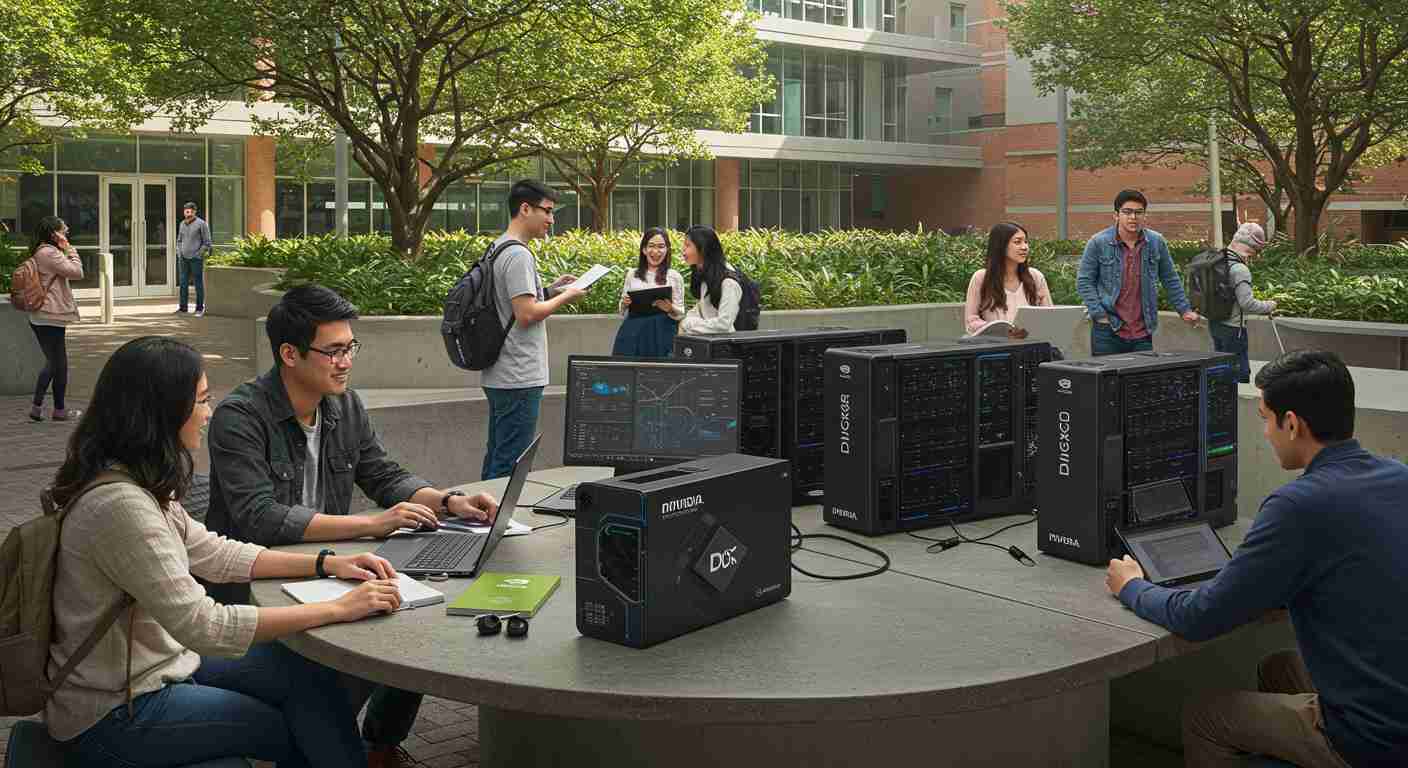
All of this culminates in a system that delivers a mind-boggling 5 petaflops of AI performance. To put that into perspective, a petaflop is equal to one quadrillion calculations per second. It’s a level of processing power that was once only dreamed of, now available to UF researchers.
Interestingly, AMD also played a role in the DGX A100’s architecture. While NVIDIA designed the GPUs, the system also incorporates two 64-core AMD Epyc 7742 processors, bringing the total core count to 128 cores and 256 threads running at 3.4 GHz. These processors provide the necessary horsepower to handle the system’s overall workload, ensuring that everything runs smoothly and efficiently. As Charlie Boyle, VP and GM for DGX systems at NVIDIA, noted, the AMD EPYC processors provide high performance and support for PCIe Gen4, enabling NVIDIA to create the world’s most powerful AI system.
Now, here’s a hidden gem: the DGX A100 has evolved since its initial release. NVIDIA introduced the DGX Station A100 with upgraded 80 GB A100 Tensor Core GPUs. This upgrade doubled the memory capacity of each GPU, providing a total of 320 GB of capacity. This enhanced version also fully supports MIG (Multi-Instance GPU protocol) and 3rd Gen NVLink, offering 200 GB/s bidirectional bandwidth between any GPU pair and 3x faster interconnect speeds than PCIe Gen 4. It’s like upgrading from a sports car to a Formula 1 racer – faster, more powerful, and more efficient.
So, how has all this tech enhanced UF’s AI capabilities? The DGX A100 has accelerated data processing, enabling researchers to analyze massive datasets in a fraction of the time it would have previously taken. It has also facilitated the training of complex AI models, allowing researchers to develop more sophisticated algorithms and solutions.
Perhaps most importantly, the DGX A100 has enabled advanced research projects across a wide range of disciplines. From developing new medical treatments to predicting climate change impacts, UF researchers are using the DGX A100 to tackle some of the world’s most pressing challenges.
This brings us to the next stage in UF’s AI evolution: the transition from the original HiPerGator to HiPerGator AI 2.0. This upgrade represents a significant leap forward in UF’s supercomputing capabilities. It’s about building on the foundation laid by the DGX A100 and pushing the boundaries of what’s possible with AI. More on that later, but for now, remember that the NVIDIA DGX A100 is more than just a machine; it’s a catalyst for innovation and discovery at the University of Florida. Treat yourself to the thought that UF is at the forefront of this technological revolution!
UF’s AI Faculty Hiring and Curriculum Integration: Building an AI-Ready Workforce
Now, as your lifestyle editor, let’s delve into how UF is building its AI dream team and reshaping its curriculum to prepare students for the future. Because, let’s face it, life’s too short to be left behind in the AI revolution!
UF’s strategic faculty hiring initiative is a cornerstone of its AI ambitions. The goal? To recruit not just any faculty, but top-tier talent capable of driving AI innovation across various fields. Remember that initial plan to hire 100 AI-focused faculty members? Well, that was just the beginning. These individuals are not only experts in their respective domains but also possess a deep understanding of AI and its potential applications.
But the initiative goes even further. UF recognizes that AI is not a standalone discipline; it’s a tool that can enhance and transform virtually every field of study. That’s why the university has made a concerted effort to integrate AI across its entire curriculum, from engineering and medicine to agriculture and the humanities. It’s about creating a generation of graduates who are not just AI specialists but also AI-savvy professionals in their chosen fields.
And speaking of building on success, let’s not forget the ‘Faculty 500’ initiative. Announced a few years prior, this ambitious program aimed to hire 500 new faculty members to enhance UF’s status as a top public research institution. The results have been nothing short of remarkable. The initiative not only bolstered UF’s research capabilities but also contributed to a more diverse and vibrant academic community. The UF College of Arts, for instance, strategically increased faculty numbers, leading to a significant increase in diversity within the college.
But integrating AI into the curriculum isn’t without its challenges. Developing new AI and data science courses requires significant resources, including funding, expertise, and infrastructure. UF has invested heavily in these areas, creating state-of-the-art facilities and attracting top faculty to develop and deliver cutting-edge AI education.
To illustrate this broader trend, let’s take a peek at what’s happening at the University of Central Florida (2025 USNews Ranking: 121) (UCF). UCF recently launched its own faculty hiring initiative to meet the growing demand for engineers and computer scientists, with a focus on areas such as AI, aerospace, and advanced manufacturing. This demonstrates the widespread recognition among universities that investing in AI expertise is essential for staying competitive and meeting the needs of the future workforce.
But what about aligning AI education with industry demands? UF is actively working to ensure that its AI curriculum is relevant and responsive to the needs of employers. The university collaborates with industry partners to identify the skills and knowledge that are most in-demand, and it incorporates these insights into its courses and programs. This helps to ensure that UF graduates are well-prepared for careers in AI-related fields, whether they’re working as data scientists, machine learning engineers, or AI consultants.
The impact of UF’s AI education extends far beyond the classroom. The university is actively integrating AI into diverse fields such as medicine, engineering, and agriculture. In the field of medicine, for example, UF researchers are using AI to develop new diagnostic tools, personalized treatment plans, and more effective drug therapies. In engineering, AI is being used to design more efficient and sustainable infrastructure, while in agriculture, it’s being used to optimize crop yields and reduce environmental impact.
Ultimately, UF’s AI faculty hiring and curriculum integration efforts are about building an AI-ready workforce that can drive innovation and solve some of the world’s most pressing challenges. It’s about empowering students with the skills and knowledge they need to succeed in an AI-driven world.
HiPerGator AI 2.0 and AI Applications: Personalized Medicine, Climate Change, and Beyond
Alright, your lifestyle editor is back, and today we’re diving headfirst into the exciting world of HiPerGator AI 2.0! This isn’t just an upgrade; it’s a quantum leap in UF’s supercomputing capabilities. Imagine taking the already impressive HiPerGator and cranking it up to eleven – that’s HiPerGator AI 2.0 for you.
So, what makes HiPerGator AI 2.0 so special? Well, for starters, it’s powered by the NVIDIA DGX SuperPOD, featuring the latest Blackwell GPUs. This means it’s not just fast; it’s blazing fast. We’re talking about a machine that’s projected to be seven to ten times faster than the existing HiPerGator cluster! That’s like going from a bicycle to a rocket ship. UF is among the first higher education institutions globally to host an NVIDIA Blackwell-powered AI supercomputer. How cool is that?
This upgrade isn’t just about bragging rights, though. It’s about providing UF researchers with the tools they need to tackle some of the world’s most complex problems. Chris Malachowsky, a UF alum and NVIDIA co-founder, puts it perfectly: “Adopting an NVIDIA DGX SuperPOD powered by Blackwell will provide UF with the AI supercomputing infrastructure needed to address critical global challenges.”
One of the key applications supported by HiPerGator is GatorTron. Developed in partnership with NVIDIA, GatorTron analyzes anonymized medical records to train supercomputers to generate simulated medical records. Think of it as creating a digital twin of the healthcare system, allowing researchers to test new treatments and therapies without putting real patients at risk. From this, GatorTronGPT was developed, a new medical AI tool, similar to ChatGPT, poised to revolutionize AI-driven healthcare solutions. With over 60% of UF’s massive annual research budget allocated to projects utilizing HiPerGator, you know this machine is central to UF’s research mission.
But AI isn’t just about medicine; it’s also about addressing climate change. Now, here’s where things get interesting. There’s a growing debate about AI’s role in combating climate change. Some, like Bill Gates and Jeff Bezos, argue that AI can help us track deforestation, predict extreme weather, and optimize energy consumption. However, others point out that the energy consumption of AI data centers is a significant problem in itself. These data centers consume massive amounts of electricity, often powered by fossil fuels, undermining climate pledges made by major tech companies.
Even though companies are using AI to improve energy efficiency in data centers, these efforts may be insufficient to offset the overall increase in energy demand. The EU estimates that data centers could consume over 3% of all energy used in the bloc by 2039 if current trends continue. It’s a complex issue with no easy answers, but one thing is clear: we need to find ways to make AI more energy-efficient if we want it to be a true solution to the climate crisis.
On a brighter note, AI is also making waves in precision oncology. Researchers are using AI and machine learning to analyze multi-dimensional data, including multiomic, spatial pathology, and radiomic data, to revolutionize cancer diagnostics and therapeutic strategies. AI algorithms can transform medical imaging data into quantifiable variables, serving as noninvasive prognostic and predictive biomarkers for treatment response. From optimizing conventional treatments like surgery and radiotherapy to personalizing immunotherapies, AI is helping to improve outcomes and address health equality.
Of course, there are limitations and ethical considerations to keep in mind. Data bias, model transparency, and regulatory compliance are all critical issues that need to be addressed. Data privacy and inter-institutional collaboration are also essential, with federated learning emerging as a solution for multi-institutional collaboration without compromising patient privacy. Despite these concerns, the convergence of AI and ML in precision oncology holds immense promise for the future of cancer care.
So, as HiPerGator AI 2.0 comes online, it’s not just about faster processing speeds and bigger datasets; it’s about using AI to make a real difference in the world. From personalized medicine to climate change, the possibilities are endless. Just remember to enjoy the little things while we’re at it, like a good cup of coffee and a sunset. After all, life’s too short not to!
The Future of AI at UF and in Higher Education: Challenges, Opportunities, and Ethical Considerations
In conclusion, UF stands at the vanguard of AI innovation in higher education, bolstered by strategic investments and groundbreaking research. However, the path forward presents challenges. Data bias in AI models, the need for model transparency, and adherence to evolving regulations are crucial considerations for UF and other institutions. Ethical implications, particularly in sensitive fields like healthcare and climate change, demand careful scrutiny. Collaborative efforts between academia, industry, and government are paramount to fostering responsible AI innovation. Looking ahead, UF is poised to expand AI applications in personalized medicine, pioneer AI-driven climate solutions, and cultivate AI entrepreneurship. Ultimately, the integration of AI into higher education and society necessitates lifelong learning and adaptation, ensuring that we harness AI’s potential while mitigating its risks. As your lifestyle editor, I encourage you to embrace lifelong learning, for life’s too short to be left behind.
Reference:
- UF becomes first U.S. university to acquire cutting-edge NVIDIA DGX A100 system, advancing its artificial intelligence initiative
- AMD Unveils Nvidia DGX A100 Specs in Formal Announcement
- NVIDIA Announces DGX Station A100 With Upgraded 80 GB A100 Tensor Core GPUs
- UF’s Employment Boost: ‘Faculty 500,’ Five Years Later
- UCF Launches Bold Faculty Hiring Initiative to Meet Growing Demand for Engineers, Computer Scientists
- Colleges Increasingly Embrace AI Offerings to Attract Students and Enhance Skills
- University of Florida Receives HiPerGator AI 2.0 Supercomputer
- How AI is Fueling the Climate Crisis, Not Solving It
- Convergence of AI and ML Techniques in Precision Oncology: A 2025 Overview