
Since May 7, 2025, state driver’s licenses and ID cards that are not REAL ID-compliant are no longer accepted at U.S. airport security checkpoints or for entry to certain federal facilities. This guide explains, as of November 2026, which IDs work for domestic flights, what happens if you show up without one, and what international students should carry.
What REAL ID is
REAL ID is a federal security standard for state-issued driver’s licenses and ID cards, created after the 9/11 Commission recommended stronger identity documents. A compliant card has a star and/or flag marking, or is labeled “Enhanced.” REAL ID (or an acceptable alternative) is required to board domestic flights and to visit certain federal facilities (TSA: REAL ID).
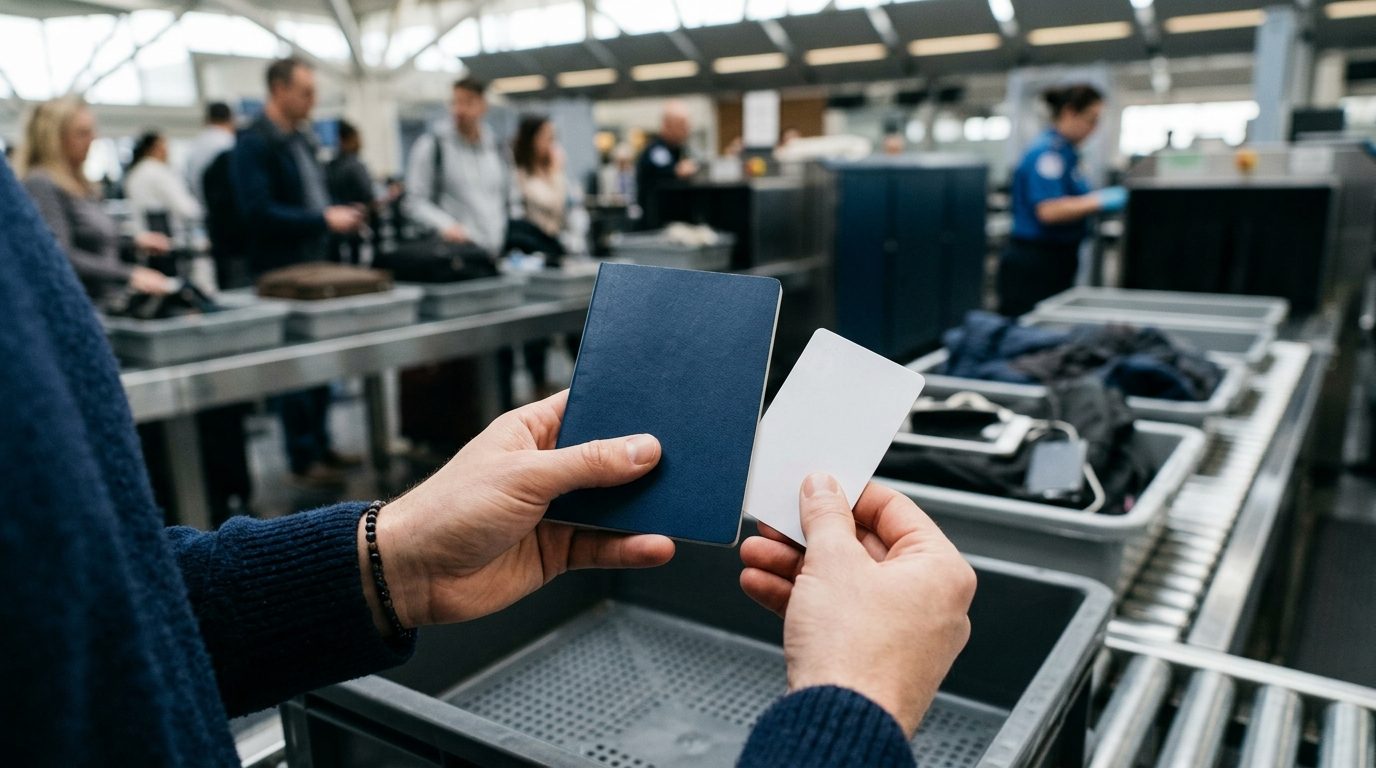
IDs TSA accepts at the checkpoint
The full list includes (TSA: Acceptable identification):
- State-issued REAL ID-compliant driver’s licenses or ID cards, and Enhanced Driver’s Licenses or Enhanced ID cards
- Mobile driver’s licenses from approved states, if based on a REAL ID or enhanced card
- Foreign government-issued passport
- USCIS Employment Authorization Card (I-766)
- Permanent resident card and border crossing card
- U.S. passport and U.S. passport card
- DHS trusted traveler cards (Global Entry, NEXUS, SENTRI, FAST)
- U.S. Department of Defense ID, HSPD-12 PIV card, TWIC, Merchant Mariner Credential and Veteran Health Identification Card
- Photo ID from a federally recognized Tribal Nation, and Canadian provincial driver’s licenses or Indian and Northern Affairs Canada cards
Other rules on the same TSA page:
- TSA accepts the IDs above for up to two years after they expire.
- A temporary (paper) driver’s license is not acceptable.
- TSA does not require ID for travelers under 18 on domestic flights, though airlines may have their own rules.
- Some digital IDs (Apple Digital ID, Clear ID, Google ID pass and Samsung ID with CLEAR) are accepted as part of TSA testing.
No acceptable ID? The $45 ConfirmID fee
Since Feb. 1, 2026, travelers who arrive without an acceptable ID can pay a $45 fee to use TSA ConfirmID, which TSA uses to try to verify identity. TSA announced the fee on Dec. 1, 2025, and said the fee covers a 10-day travel period and urged travelers to pay online before traveling; if TSA cannot verify a traveler’s identity, the traveler is not allowed into the checkpoint (TSA press release; TSA). Paying is not a substitute for bringing an ID: each payment covers only a 10-day period, and TSA warns the process can cause delays.
REAL ID is not TSA PreCheck
REAL ID is about the identity document. TSA PreCheck and Global Entry are trusted-traveler programs that speed up screening for pre-approved travelers; PreCheck members still have to show an acceptable ID. TSA PreCheck is open to U.S. citizens, U.S. nationals and lawful permanent residents, so international students on F-1 or J-1 visas generally cannot enroll (TSA PreCheck FAQ).
What international students should do
- Carry your passport. A valid foreign passport is on TSA’s list, so you do not need a REAL ID to fly domestically. Keep your I-20 or DS-2019 handy as well, since you will need it for international travel and re-entry.
- Getting a state license or ID. If you want a REAL ID-compliant driver’s license or ID card, states can issue one to people in temporary lawful status, but the card must be marked as temporary or limited-term and cannot be valid beyond your authorized stay, or more than one year if your stay has no fixed end date (as with “duration of status”). Renewal requires showing that your status continues, verified through DHS’s SAVE system (6 CFR 37.21). Document requirements vary by state, so check your state DMV’s REAL ID page before your appointment.
- Do not rely on a paper temporary license. If you have just applied and only have the paper version, fly with your passport.
- Employment authorization card. Students on OPT who have their EAD (Form I-766) can use it as TSA identification.