
Selective universities have added seats over the past decade, but nowhere near as fast as applications have grown. Across the 51 universities in the top 50 of the 2027 U.S. News national ranking (ties included), U.S. Department of Education data show the combined first-year class grew 16.5% from 2014 to 2024, while applications rose 77.5%. The combined admission rate fell from 27.3% to 19.3%. Nearly all of the growth came at public universities; the 33 private schools in the group kept their classes almost flat, and their combined admission rate fell to 9.3%.
The question is back in the news because Johns Hopkins University said on Nov. 17, 2026, that it will study enlarging its undergraduate body. As of Nov. 19, 2026, the university has not announced a target size or a timeline.
Key takeaways
- The 51 top-50 universities enrolled 187,111 first-year students in 2024, up 26,470 (16.5%) from 160,641 in 2014. Applications rose from 1,736,837 to 3,082,633 (77.5%).
- Public universities accounted for 23,789 of the 26,470 added seats. The 18 publics grew their first-year classes 23.9%; the 33 privates grew theirs 4.4%.
- 48 of the 51 schools had a lower admission rate in 2024 than in 2014. The combined private-school rate fell from 18.9% to 9.3%.
- From 2015 to 2024, the 18 publics added 21,455 full-time first-year students, but only 361 more international first-year students; the international share fell from 10.2% to 8.7%.
- Johns Hopkins enrolled 1,389 first-year students in 2024, 5.5% fewer than in 2014, while its applications rose 86.6% and its admission rate fell from 16.1% to 6.4%.
What Johns Hopkins announced
Johns Hopkins has formed an advisory committee of faculty, staff and students to assess what a larger undergraduate population would require, including academic programs, housing, student services and financial aid. The committee begins its work this fall and is expected to make recommendations in the spring semester. According to the student newspaper The Johns Hopkins News-Letter, the move follows through on the university’s “Ten for One” strategic framework, published in 2023. Hopkins enrolled 6,354 undergraduates in fall 2025, a number the paper says has stayed roughly the same for about 15 years, and 1,478 first-year students entered this fall in the Class of 2030.
“Every year, we turn away thousands of highly qualified and talented applicants who we know could thrive at Hopkins,” David Phillips, vice provost for admissions and financial aid, told the paper.
Two other reports from the same week point the same way. The University at Buffalo said on Nov. 18, 2026, that a record 47,612 students applied for fall 2026 and 5,484 first-year students enrolled, 470 (9.4%) more than the year before. At Tulane University of Louisiana, The Tulane Hullabaloo reported more than 30,000 total applications as of Nov. 6, compared with just over 14,000 at the same point last year, and said early action applications had more than doubled.
Have top U.S. universities expanded enrollment?
We took the 51 schools in the top 50 of the U.S. News 2027 national universities ranking and added up their applications, admits and enrolled first-year students for each year from 2014 to 2024.
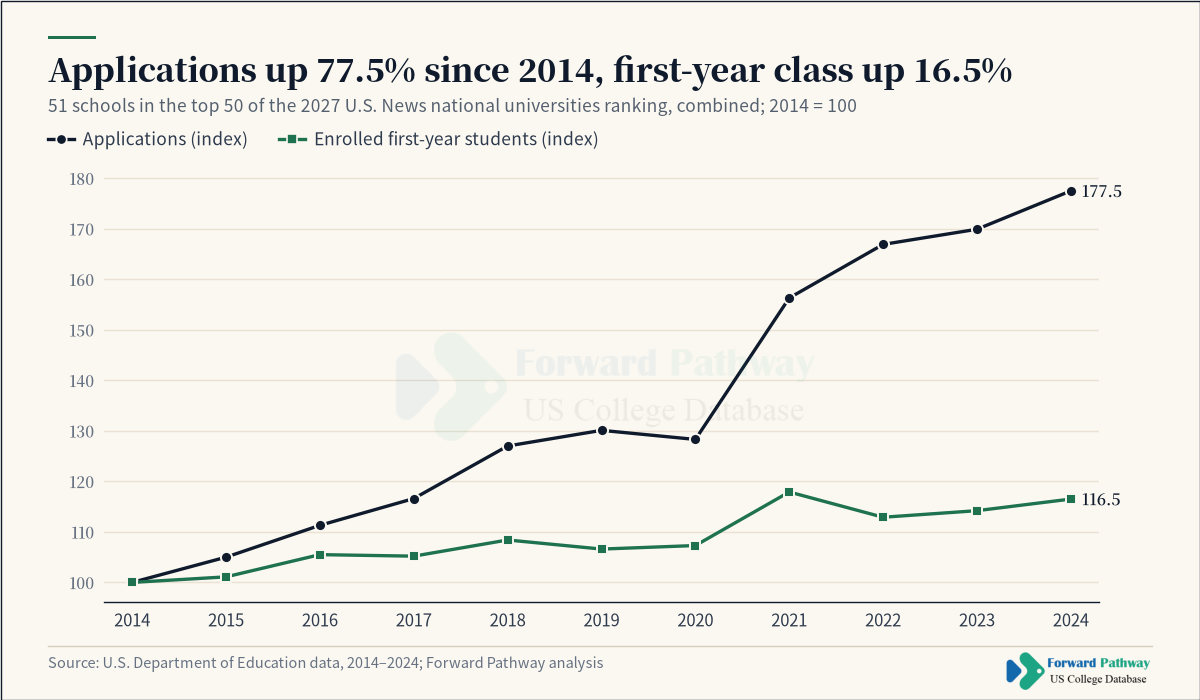
No school in the group grew its first-year class as fast as its applications. Only three schools had a higher admission rate in 2024 than in 2014: Ohio State University-Main Campus, the University of California-Davis and the University of Rochester.
The split between public and private schools is sharp:
- 18 public universities: first-year enrollment rose from 99,706 to 123,495 (23.9%); applications rose 92.1%; the combined admission rate fell from 36.7% to 28.9%.
- 33 private universities: first-year enrollment rose from 60,935 to 63,616 (4.4%); applications rose 64.4%; the combined admission rate fell from 18.9% to 9.3%, less than half its 2014 level.
Which schools grew their first-year classes the most
| School | First-year students, 2024 | First-year growth, 2014–2024 (%) | Application growth, 2014–2024 (%) | Admission rate, 2014 (%) | Admission rate, 2024 (%) |
|---|---|---|---|---|---|
| University of California-San Diego | 7,330 | 48.9 | 83.1 | 33.3 | 26.7 |
| University of Maryland-College Park | 5,818 | 40.0 | 128.0 | 47.9 | 44.8 |
| Georgia Institute of Technology-Main Campus | 3,836 | 36.6 | 131.0 | 33.4 | 14.1 |
| University of Wisconsin-Madison | 8,514 | 35.9 | 159.0 | 56.9 | 45.2 |
| Ohio State University-Main Campus | 9,607 | 35.7 | 98.0 | 53.0 | 60.6 |
| Tufts University | 1,801 | 33.5 | 80.5 | 17.2 | 11.5 |
| University of Illinois at Urbana-Champaign | 9,008 | 29.9 | 105.9 | 59.0 | 42.4 |
| Rutgers University-New Brunswick | 8,191 | 27.7 | 114.8 | 60.5 | 58.1 |
Table 1. The eight U.S. News 2027 top-50 universities with the largest first-year enrollment growth, 2014–2024. Admission rate = admits ÷ applications. Source: U.S. Department of Education data; Forward Pathway analysis.
Seven of the eight are public. The one private school is Tufts University. The University of California-San Diego added 2,408 first-year seats, yet its admission rate still fell from 33.3% to 26.7%. The Georgia Institute of Technology-Main Campus (Georgia Tech) grew its class 36.6%, but applications rose 131.0% and its admission rate dropped from 33.4% to 14.1%. Of the eight, only Ohio State became easier to get into. Growing the class did not, for most of these schools, make admission less competitive.
Which schools enroll fewer first-year students than in 2014
| School | First-year students, 2024 | First-year growth, 2014–2024 (%) | Application growth, 2014–2024 (%) | Admission rate, 2014 (%) | Admission rate, 2024 (%) |
|---|---|---|---|---|---|
| Georgetown University | 1,575 | -0.2 | 34.0 | 17.3 | 12.9 |
| Harvard University | 1,647 | -0.4 | 57.5 | 6.0 | 3.6 |
| University of Pennsylvania | 2,395 | -1.2 | 81.9 | 10.4 | 5.4 |
| California Institute of Technology | 218 | -3.5 | 112.4 | 8.8 | 2.6 |
| New York University | 5,666 | -4.2 | 118.1 | 35.4 | 9.2 |
| Johns Hopkins University | 1,389 | -5.5 | 86.6 | 16.1 | 6.4 |
| Northeastern University | 2,759 | -6.3 | 97.6 | 32.2 | 5.2 |
| University of Rochester | 1,317 | -8.3 | 22.7 | 36.4 | 40.1 |
| Boston University | 3,268 | -16.5 | 45.4 | 34.5 | 11.1 |
Table 2. The nine U.S. News 2027 top-50 universities that enrolled fewer first-year students in 2024 than in 2014 (all private). Source: U.S. Department of Education data; Forward Pathway analysis.
Johns Hopkins is on this list. It enrolled 1,470 first-year students in 2014 and 1,389 in 2024, while applications grew from 24,590 to 45,895 and its admission rate fell from 16.1% to 6.4%. The steepest declines in admission rate were at Northeastern University (32.2% to 5.2%), New York University (35.4% to 9.2%) and Boston University (34.5% to 11.1%). All three enroll smaller first-year classes than they did a decade ago.
Will admission rates go up if colleges expand?
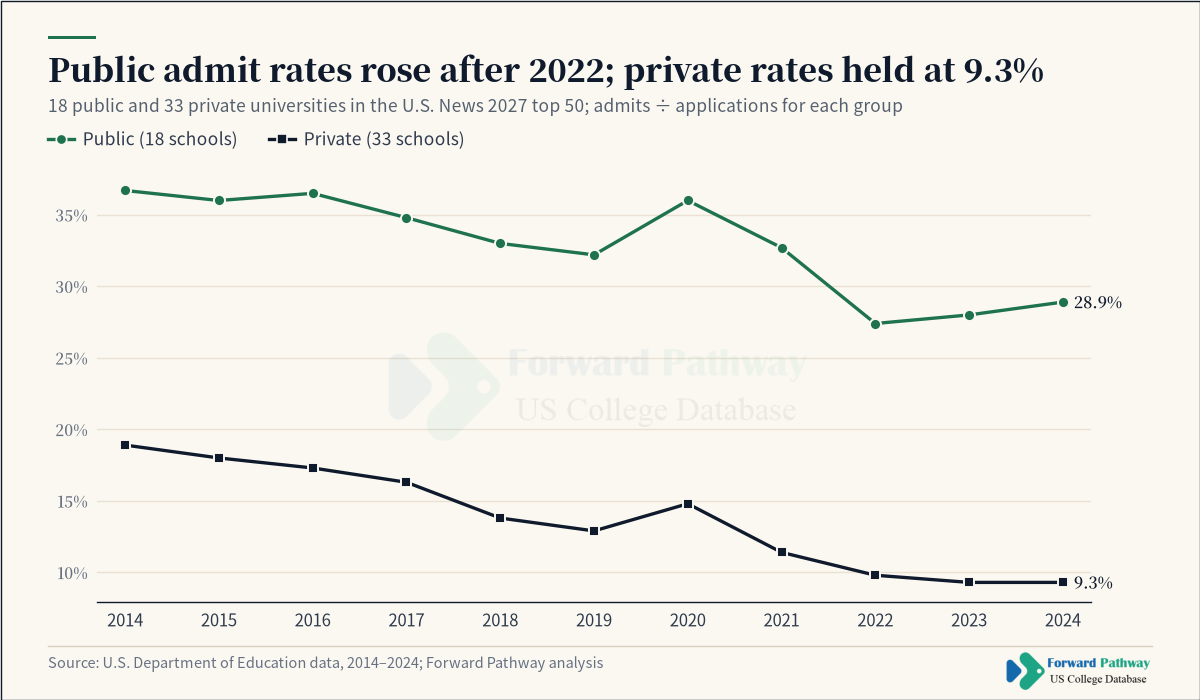
The public group’s rate bottomed out at 27.4% in 2022 and rose in each of the next two years, to 28.9% in 2024. The private group’s rate was 9.3% in both 2023 and 2024, with no rebound.
Yale’s expansion shows why. Yale University opened two new residential colleges, Pauli Murray and Benjamin Franklin, in 2017. Yale News reported that admissions aimed for a class of 1,550, a 15% increase from previous years. Federal data show Yale’s first-year class grew from 1,361 in 2014 to 1,554 in 2024, but applications rose 85.9% over the same period, and the admission rate fell from 6.3% to 3.9%.
A rough calculation for Hopkins: in 2024 it admitted 2,954 students and enrolled 1,389, so about 47% of admitted students enrolled. Adding about 10% to the class, or 150 students, would take roughly 319 more offers. With applications held at 45,895, the admission rate would rise only from 6.4% to about 7.1%. Over 2014–2024, Hopkins applications rose 86.6%. A bigger class would ease competition a little; it would not bring private-school admission rates back to where they were a decade ago.
Do new seats go to international students?
Federal data count international (nonresident) students separately. Looking at full-time, first-time undergraduates, we compared 2015 and 2024 at the same 51 schools.
| Group | International first-year students, 2015 | International first-year students, 2024 | International share, 2015 (%) | International share, 2024 (%) | Change in full-time first-year students, 2015–2024 |
|---|---|---|---|---|---|
| Public (18 schools) | 10,321 | 10,682 | 10.2 | 8.7 | 21,455 |
| Private (33 schools) | 7,771 | 8,782 | 12.9 | 13.9 | 2,964 |
| Total (51 schools) | 18,092 | 19,464 | 11.2 | 10.4 | 24,419 |
Table 3. International students among full-time, first-time undergraduates at the U.S. News 2027 top 50. Source: U.S. Department of Education data, 2015 and 2024; Forward Pathway analysis.
The public universities added 21,455 full-time first-year students but only 361 international ones, and the international share dropped from 10.2% to 8.7%. UC San Diego is the clearest case: full-time first-year enrollment rose from 5,286 to 7,317, while international first-year students fell from 1,284 to 805.
State policy explains part of this. In a Jan. 27, 2026, report to the California Legislature, the University of California Office of the President said state funding has been used to reduce nonresident undergraduates (out-of-state and international) at Berkeley, Los Angeles and San Diego and enroll more California residents in their place. Nonresident shares at those campuses were 19.4%, 18.7% and 19.6% in 2025–26, and UC estimated it would need an additional $32.9 million in state support to replace another 902 nonresident undergraduates with residents in 2026–27. At flagship publics, new seats are mainly for in-state students, and that is unlikely to change soon.
Private universities moved the other way. They added only 2,964 full-time first-year students, but 1,011 more international ones, raising the international share from 12.9% to 13.9%. International applicants have not been squeezed out at private schools, but the total number of seats has barely moved.
What this means for applicants
Students applying this year for fall 2027: The Hopkins committee will not report until the spring, and any expansion would first need housing, faculty and financial aid in place, so it would affect later classes at the earliest. Build this year’s list and early decision or early action plans on current admission data, not on expansion headlines. At a school where applications suddenly double, a class that stays the same size means a lower admission rate. Tulane is an example: it enrolled between 1,647 and 2,027 first-year students each year from 2014 to 2024, and its admission rate fell from 28.0% to 14.0%.
Read expansion as a signal, not a promise: Most of the growth in seats over the past decade was at large public universities, and those seats went mainly to in-state students. International and out-of-state applicants should check how a public university admits nonresidents and whether their intended major is admitted separately or capped. Buffalo shows a different pattern: federal data show its first-year class grew from 3,519 in 2014 to 4,265 in 2024 while its admission rate rose from 57.8% to 74.2%, so a larger class came with easier admission.
Look for the admission rate that applies to you: A school’s overall rate mixes in-state applicants, early rounds and other groups. The rate an international applicant faces can be very different. The school’s Common Data Set reports applicants, admits and enrollees, and is a starting point for a more specific estimate.
Frequently asked questions
How many more students will Johns Hopkins admit?
As of Nov. 19, 2026, Johns Hopkins has not announced a target size or timeline. A new advisory committee of faculty, staff and students begins work this fall to assess housing, academic programs, student services and financial aid, and is expected to make recommendations in the spring semester. Hopkins enrolled 6,354 undergraduates in fall 2025.
Are top U.S. colleges increasing class sizes?
Yes, but much more slowly than applications are growing. U.S. Department of Education data show the 51 universities in the U.S. News 2027 top 50 enrolled 187,111 first-year students in 2024, up 16.5% from 160,641 in 2014, while applications rose 77.5% and the combined admission rate fell from 27.3% to 19.3%.
Which top universities have grown their freshman classes the most?
Mostly public universities. From 2014 to 2024, first-year enrollment grew 48.9% at UC San Diego, 40.0% at the University of Maryland-College Park, 36.6% at Georgia Tech, 35.9% at the University of Wisconsin-Madison and 35.7% at Ohio State. Among private schools, Tufts grew the most, at 33.5%.
Will acceptance rates at elite private colleges go up if they expand?
Not by much. The 33 private universities in the top 50 grew their first-year classes only 4.4% from 2014 to 2024, and their combined admission rate fell from 18.9% to 9.3%. Using Hopkins’s 2024 numbers, adding 150 students with no change in applications would raise its admission rate from 6.4% to about 7.1%.
Do international students benefit when colleges expand?
Not at the public universities. From 2015 to 2024, the 18 public universities in the top 50 added 21,455 full-time first-year students but only 361 international ones, and the international share fell from 10.2% to 8.7%. At the 33 private universities, international first-year enrollment rose by 1,011 and the share rose from 12.9% to 13.9%.
Sources
- Johns Hopkins to explore potential growth in undergraduate enrollment (Johns Hopkins Hub, Nov. 17, 2026)
- The University forms an advisory committee to expand undergraduate enrollment (The Johns Hopkins News-Letter, November 2026)
- UB again meets enrollment goals (University at Buffalo, Nov. 18, 2026)
- Tulane sees over 100% increase in early action applications for class of 2031 (The Tulane Hullabaloo, Nov. 11, 2026)
- Larger first-year class arrives on campus (Yale News, Aug. 24, 2017)
- 2025-26 resident and nonresident undergraduate enrollment report to the Legislature (University of California Office of the President, Jan. 27, 2026)
- U.S. Department of Education admissions and enrollment data, 2014–2024; U.S. News 2027 national universities ranking