
Public universities in the United States are graduating far more students on time than they did a decade ago, but the gap between schools is still wide. In U.S. Department of Education data, the four-year graduation rate at all public universities rose from 29.7% in 2008 to 46.6% in 2024. At the top of the U.S. News 2027 rankings, though, 14 of the top 100 schools in the 2024 data graduated fewer than 60% of their freshmen within four years. At two of them, it was under one-third.
On Nov. 17, 2026, the University of Central Florida (UCF) received the 2026 Excellence in Student Success Award from the Association of Public and Land-grant Universities (APLU) and reported a four-year graduation rate of 68.1%, up from 40.4% a decade ago. For any family paying full price, and especially for international students who pay out-of-state tuition and must keep their F-1 status, a fifth year is a real cost. That cost can be $40,000 to $80,000 at the public universities we checked.
Key takeaways
- The four-year graduation rate at U.S. public universities rose from 29.7% in 2008 to 34.1% in 2014 and 46.6% in 2024, with no year-over-year decline in federal data from 2008 to 2024.
- Of 148 public universities with at least 2,000 freshmen in both the 2014 and 2024 data, 145 improved their four-year rate, by an average of 13.8 percentage points. Florida International University gained the most, 35.6 points.
- International students at public universities had a four-year graduation rate of 54.1% in the 2024 data, compared with 46.6% for all freshmen. At private nonprofits, the figures were 58.4% and 54.6%.
- Fourteen U.S. News 2027 top-100 schools had four-year rates below 60% in the 2024 data, including Harvard (55.7%), Stanford (50.8%) and Yale (57.5%). Their drop mainly reflects 2020–21 leaves of absence.
- At eight public universities we priced, one more year of out-of-state tuition, housing, food, books and other costs ranges from $39,634 to $78,166.
What UCF and Towson reported
UCF’s announcement puts its four-year graduation rate at 68.1%, compared with 40.4% a decade earlier. Paige Borden, the university’s chief analytics officer, described two phases: “UCF’s four-year graduation rate has been on an upward trajectory, gaining 14 percentage points between 2015 and 2022,” and “Beginning in 2023-24, we turbocharged that momentum, gaining another 14 percentage points through 2026.” First-year retention rose from 89% in 2015 to 93.4% in 2025, and the average time to degree fell from 4.4 years to four years.
One of the tools is simple. For students approaching graduation, nightly analytics flag potential problems with remaining requirements and the graduation review, and staff contact those students to fix them and register for needed courses. UCF says similar checks extend to students in their first three years.
A week earlier, Maryland’s Towson University published a progress report on its 2020-2030 Strategic Plan. It listed a current four-year graduation rate of 47.1% and a 2030 goal of 51%, and announced a new Finish in Four initiative. Towson notes that the 47.1% is based on federal data for students who entered in 2018.
The two numbers are not measured the same way. Federal graduation rates follow first-time, full-time freshmen and are published years after they enroll, so the latest 2024 data cover students who started in 2018. Towson’s 47.1% matches the 2024 federal figure. UCF’s 68.1% is the school’s own figure for a more recent class that federal data do not yet cover. In the federal data, UCF’s four-year rate was 40.1% in 2014 and 54.8% in 2024. Much of the gain UCF describes since 2023–24 will not show up in federal data for several more years.
How four-year graduation rates changed nationally
Forward Pathway used U.S. Department of Education data from 2008 to 2024 to add up, school by school, how many first-time, full-time freshmen earned a bachelor’s degree within four years, divided by the size of each entering class.
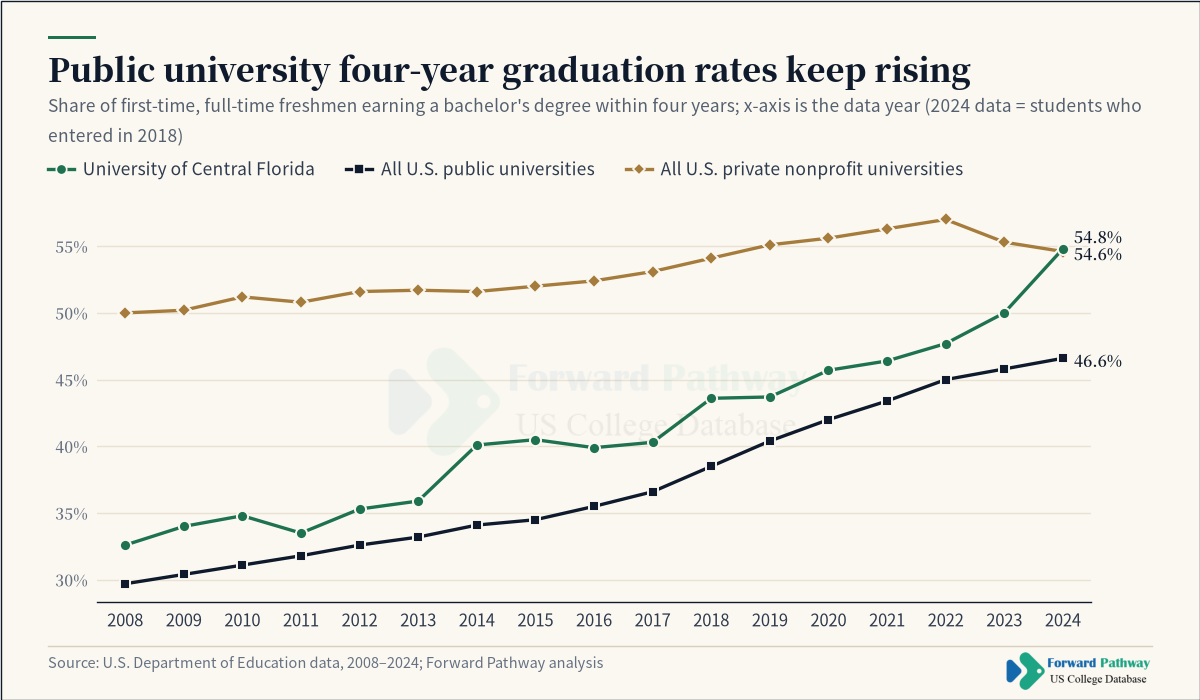
Three patterns stand out. Public universities improved every year, from 29.7% in 2008 to 46.6% in 2024. The gains were broad: 145 of 148 large public universities improved between the 2014 and 2024 data, by an average of 13.8 points. UCF’s 14.7-point gain was close to that average. Private nonprofit universities slipped from 57.0% in the 2022 data to 54.6% in 2024, which is linked to pandemic-era leaves at some highly selective schools, as shown below.
These are the large public universities with the biggest gains. The 10th and 11th places are tied, so both are listed.
| University | 4-year rate, 2014 data (%) | 4-year rate, 2024 data (%) | Change (points) | 6-year rate, 2024 data (%) |
|---|---|---|---|---|
| Florida International University | 23.6 | 59.2 | 35.6 | 74.4 |
| Florida Atlantic University | 17.1 | 49.6 | 32.6 | 62.6 |
| Boise State University | 12.1 | 41.4 | 29.3 | 59.3 |
| San Jose State University | 9.5 | 37.0 | 27.5 | 69.2 |
| San Diego State University | 29.4 | 56.3 | 26.8 | 76.4 |
| University of South Florida | 38.7 | 65.4 | 26.7 | 76.8 |
| Georgia Institute of Technology | 37.0 | 63.6 | 26.6 | 94.0 |
| Wayne State University | 10.8 | 36.0 | 25.2 | 58.4 |
| California Polytechnic State University, San Luis Obispo | 36.1 | 61.2 | 25.1 | 86.4 |
| California State University, Fullerton | 13.9 | 39.0 | 25.0 | 70.2 |
| University of North Carolina at Charlotte | 25.0 | 50.1 | 25.0 | 69.0 |
| University of Central Florida (for comparison) | 40.1 | 54.8 | 14.7 | 78.0 |
Three of the top six are in Florida: Florida International University, Florida Atlantic University and the University of South Florida. The first metric in Florida’s performance-based funding law for state universities is “the 4-year graduation rate for first-time-in-college students” (Florida Statutes, Section 1001.92), so the number directly affects state funding. The table also shows that a big gain is not the same as a high rate. San Jose State and Wayne State each gained more than 25 points but still graduated only about a third of freshmen in four years in the 2024 data.
Which top-ranked colleges have low four-year graduation rates?
We matched federal graduation rates against the U.S. News 2027 rankings. Among the top 100, 14 schools had a four-year rate below 60% in the 2024 data:
| University | U.S. News 2027 rank | 4-year rate, 2022 data (%) | 4-year rate, 2024 data (%) | 6-year rate, 2024 data (%) |
|---|---|---|---|---|
| Rochester Institute of Technology | 95 | 29.2 | 28.2 | 71.5 |
| Drexel University | 80 | 30.6 | 30.5 | 78.2 |
| University of Illinois Chicago | 95 | 39.6 | 41.7 | 61.6 |
| Rutgers University–Newark | 73 | 39.2 | 41.9 | 63.8 |
| Rutgers University–Camden | 95 | 45.2 | 47.4 | 66.7 |
| New Jersey Institute of Technology | 85 | 48.4 | 48.8 | 72.8 |
| University of California, Merced | 69 | 43.9 | 50.5 | 68.7 |
| Stanford University | 5 | 72.8 | 50.8 | 91.9 |
| Harvard University | 3 | 86.8 | 55.7 | 97.6 |
| University of Missouri | 95 | 54.9 | 55.7 | 74.9 |
| Yale University | 4 | 88.1 | 57.5 | 95.7 |
| University of Iowa | 100 | 55.4 | 58.2 | 74.6 |
| Florida International University | 100 | 48.6 | 59.2 | 74.4 |
| Howard University | 73 | 60.8 | 59.5 | 70.0 |
These schools fall into three groups.
Co-op schools: a later finish is often planned
Rochester Institute of Technology and Drexel University graduate only about 30% of freshmen in four years, but more than 70% within six. Both are built around paid cooperative education. Drexel’s co-op guide lists a five-year plan for students who do two or three co-ops and a four-year plan for one co-op, and says there are no tuition charges for co-op experiences. RIT’s computer engineering program requires four blocks (48 weeks) of co-op. Northeastern University, ranked 42nd and also known for co-op, has no four-year rate in the federal data. A low four-year rate at these schools does not mean students fail to finish. It does mean an extra year of living costs, and for international students, an extra year in the U.S. on a student visa.
Harvard, Stanford and Yale: a pandemic dip
Harvard University‘s four-year rate was 86.8% in the 2022 data, 65.8% in 2023 and 55.7% in 2024. Stanford University fell from 72.8% to 50.8% and Yale University from 88.1% to 57.5%, while all three kept six-year rates above 90%. The classes in the 2023 and 2024 data were midway through college in 2020–21. The Harvard Crimson reported that about 340 first-year students deferred enrollment that year and more than a thousand other students took leaves of absence. For these schools, the 2022 data and earlier are a better guide to normal patterns.
Other public universities: the numbers to watch
At the University of Illinois Chicago, Rutgers University–Newark, the University of Missouri and the University of Iowa, four-year rates ranged from about 42% to 58% and six-year rates from about 62% to 75%, with little change between the 2022 and 2024 data. All are in the U.S. News 2027 top 100, yet more than four in 10 of their freshmen did not finish within four years in the 2024 data.
Do international students graduate on time?
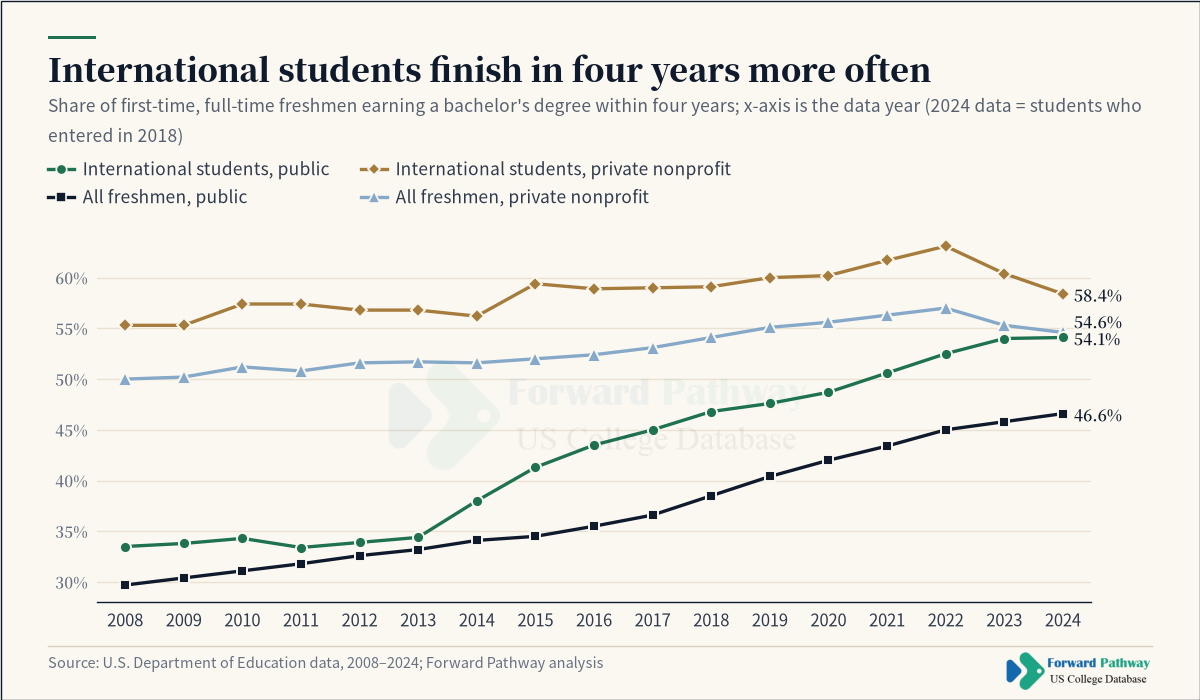
Federal graduation data report international students separately, but not by country. In the 2024 data, international students at public universities had a four-year graduation rate of 54.1%, 7.5 points above the 46.6% for all freshmen. At private nonprofits, the figures were 58.4% and 54.6%. The public-university rate for international students was 38.0% in the 2014 data, so it rose 16.1 points in a decade. Even so, nearly half of international students at public universities did not graduate within four years.
How much does a fifth year of college cost?
The table below adds out-of-state tuition and fees, on-campus room and board, and books and other expenses, using each school’s published prices for the latest academic year in the 2024 federal cost data. It is a rough estimate of one extra year. International students usually pay out-of-state rates at public universities, and the budgets schools use for the I-20 typically add items such as health insurance, so actual costs are likely higher.
| University | Out-of-state tuition and fees ($) | On-campus room and board ($) | Books and other expenses ($) | Total ($) |
|---|---|---|---|---|
| Florida International University | 18,964 | 13,080 | 7,590 | 39,634 |
| University of Central Florida | 22,467 | 12,452 | 6,430 | 41,349 |
| Towson University | 29,820 | 16,260 | 4,742 | 50,822 |
| University of Iowa | 33,371 | 12,920 | 5,016 | 51,307 |
| University of Illinois Chicago | 29,884 | 16,500 | 7,426 | 53,810 |
| University of Missouri | 36,056 | 13,700 | 4,508 | 54,264 |
| Rutgers University–Newark | 36,762 | 16,074 | 5,876 | 58,712 |
| University of California, Merced | 49,823 | 21,445 | 6,898 | 78,166 |
At these schools, a fifth year costs roughly $40,000 to $80,000, plus a year’s delay in starting work or graduate school.
For F-1 students, there is also an immigration step. The Form I-20 has a program end date. The Department of Homeland Security’s Study in the States site explains that a student who needs more time must request an extension from the school’s designated school official (DSO) before that date. Accepted reasons include changes of major or research topic, unexpected research problems and documented illnesses. Delays caused by academic probation or suspension do not qualify, and requests made after the end date are not granted. A student who does not finish or extend in time will have their SEVIS record terminated.
A DHS final rule published July 17, 2026, would replace “duration of status” for F-1 students with admission tied to the I-20 end date, so extensions would require a Form I-539 filing with U.S. Citizenship and Immigration Services. As of Nov. 18, 2026, the rule is on hold under a nationwide preliminary injunction a federal court issued on Sept. 14, and the current rules still apply (AIP report). If the rule takes effect later, taking longer to graduate would involve more paperwork.
What applicants should do
- Compare the four-year and six-year rates. If they are more than 20 points apart, find out why. A co-op program is listed in the school’s program descriptions. If there is no co-op, ask about course availability, access to high-demand majors and the rules for changing majors. The 2024 public-university average of 46.6% is a useful baseline.
- Skip the pandemic years at highly selective schools. For Harvard, Stanford, Yale and similar schools, the 2022 data and earlier reflect normal patterns better than the 2023 and 2024 data.
- Budget for a possible fifth year. If a school’s four-year rate is in the 40% to 50% range, a reserve of $40,000 to $80,000 based on the table above is a prudent cushion.
- Plan courses from the first year. Map out four years of courses, check your degree audit every term and register early for courses that fill up. If you might need more time, talk to your DSO well before the I-20 end date. Students on academic probation should act early, because probation and suspension are not valid grounds for an extension.
Frequently asked questions
What is UCF’s four-year graduation rate?
UCF reported a four-year graduation rate of 68.1% on Nov. 17, 2026, up from 40.4% a decade earlier. U.S. Department of Education data for 2024, which cover students who entered in 2018, show 54.8%. The school’s figure covers a newer class that federal data do not yet include.
What is the average four-year graduation rate at U.S. public universities?
Forward Pathway’s analysis of U.S. Department of Education data puts it at 46.6% in 2024, up from 34.1% in 2014 and 29.7% in 2008. Private nonprofit universities averaged 54.6% in 2024.
Why did Harvard’s, Stanford’s and Yale’s four-year graduation rates drop?
The classes in the 2023 and 2024 data were midway through college in 2020–21, when about 340 Harvard first-year students deferred and more than a thousand other students took leaves of absence, according to The Harvard Crimson. Harvard’s four-year rate fell from 86.8% in the 2022 data to 55.7% in 2024, while its six-year rate was 97.6%.
Why is Drexel’s four-year graduation rate so low?
Drexel and RIT are co-op schools. Drexel students who complete two or three co-ops follow a five-year plan, and RIT’s computer engineering degree requires 48 weeks of co-op. Their four-year rates were 30.5% and 28.2% in the 2024 data, but their six-year rates were 78.2% and 71.5%.
Can an F-1 student extend the I-20 to finish a degree?
Yes, if the DSO approves an extension before the I-20 program end date and the delay is due to a change of major or research topic, unexpected research problems or a documented illness. Delays caused by academic probation or suspension do not qualify, according to the Department of Homeland Security’s Study in the States site.
Sources
- UCF Earns APLU Student Success Award (University of Central Florida, Nov. 17, 2026)
- Towson University strategic plan progress (Towson University, Nov. 12, 2026)
- Florida Statutes 1001.92: State University System Performance-Based Incentive
- Drexel University: How Co-op Works
- RIT: Computer Engineering BS
- Mind the Gap: Harvard Students Pursue New Adventures Away from Campus (The Harvard Crimson, Dec. 11, 2020)
- Study in the States: I Am Not Going to Finish My Program on Time. What Should I Do?
- Court Temporarily Blocks Rule Ending “Duration of Status” for International Students (AIP, Sept. 17, 2026)
- U.S. Department of Education graduation rate data, 2008–2024, and institutional cost data, 2024; U.S. News 2027 rankings; Forward Pathway analysis