
Dartmouth’s Proactive Stance on Student Mental Health: A National Model
Dartmouth College recently demonstrated its steadfast commitment to student mental health and well-being, hosting the “Commitment to Care Community Gathering for Student Mental Health” on October 22, 2025. This event, held as Dartmouth wrapped up a productive four-year partnership with the JED Foundation, a non-profit dedicated to improving college mental health systems, underscored the institution’s proactive stance. President Sian Leah Beilock, in her opening remarks, didn’t mince words, declaring mental health and well-being as the top priority among Dartmouth’s five strategic objectives. She noted that a student’s ability to engage in “difficult conversations” or “take responsibility for global issues” pretty much hinges on not having a meltdown first. Your low-key editor finds this a remarkably sensible prerequisite for world-changing endeavors. I’m just saying, it’s hard to save the planet when you’re worried about your next existential crisis.
The gathering also marked the second anniversary of “Commitment to Care,” Dartmouth’s five-year strategic plan for student mental health and well-being. So far, the plan has seen 63 of its 73 action points addressed, many of which are ongoing. That’s a pretty good batting average, if you do the math. The 2024 Healthy Minds Study survey painted a rather encouraging picture, revealing a significant increase in students perceiving mental health as a priority at Dartmouth. For instance, 87% of Geisel students agreed with this sentiment, which is a whopping 33 percentage-point jump from 2021. And a reassuring 93% of undergraduates now know where to access professional help, a 10 percentage-point increase. It seems the campus is slowly, but surely, realizing that asking for help isn’t a sign of weakness; it’s just efficient.
The “Commitment to Care” plan has translated into tangible improvements, including expanded therapy services. Students can now tap into virtual options through Uwill, and there’s even a partnership with Therapists of Color New England. Because, you know, sometimes you just want to talk to someone who gets it, culturally speaking. Student body governments have also integrated mental health representatives, giving mental well-being a seat at the political table. Next thing you know, they’ll be debating the merits of mindfulness apps in committee meetings. Faculty, not to be outdone, are adopting best-practice pedagogies through the Accessible Dartmouth Initiative, which probably means fewer pop quizzes on existential dread, or at least clearer guidelines on how to navigate it.
Estevan Garcia, Dartmouth’s Chief Health and Wellness Officer, has been instrumental in these advancements. He’s overseeing everything from the Student Health Service to the Student Wellness Center and Employee Wellness, ensuring a holistic approach to well-being. Garcia, with a background in pediatric emergency medicine and public health, brings a unique perspective. He’s essentially moved from patching up immediate physical emergencies to building systems that prevent internal ones. It’s like being a mechanic who now designs cars that are less likely to break down in the first place, or at least come with a really good roadside assistance plan. The institutional commitment to a holistic approach is evident, encompassing all eight dimensions of wellness: intellectual/academic, emotional, social, physical, occupational, financial, environmental, and spiritual. It’s a comprehensive checklist, reminding us that being well isn’t just about avoiding a cold; it’s about having your spiritual ducks in a row too.
JED Foundation adviser Kapi’olani Laronal, a former director of Dartmouth’s Native American Program, was particularly effusive in her praise, calling Dartmouth a “model institution.” This wasn’t just a polite nod; it was an acknowledgment of significant advancements, especially in prevention and crisis management. Dartmouth has made strides in peer-to-peer support networks, mental health training for both employees and students, and structural changes like a revamped medical leave policy and the relocation of the Student Wellness Center to a more central spot in Baker-Berry Library. The Wellness Center’s move has also brought expanded programming, including the Sexual Violence Prevention Project and increased well-being support for graduate and professional students. They even hired Jennifer Rosales as Senior Vice President for Community and Campus Life and Chief Student Affairs Officer, a move Laronal cited as crucial. When you’re bringing in top talent to make sure students are feeling good, you know it’s serious. Dartmouth, it seems, is well on its way to proving that you can be a beacon of academic excellence while also, you know, making sure everyone is doing okay.
Leveraging Technology and Peer Support: Innovative Approaches to Student Well-being
Building on this foundation of comprehensive care, Dartmouth and its peers are increasingly looking to technology and peer networks to further bolster mental health services. Dartmouth, for example, is developing “Evergreen,” a chatbot-powered app, which Chief Health and Wellness Officer Estevan Garcia describes as a tool in a “toolbox of wellness activities.” It’s meant to be a supplementary resource, not a replacement for human interaction, because let’s be honest, a chatbot probably can’t truly understand why you’re stressed about that obscure Latin root.
However, the integration of AI into student mental health isn’t without its caveats. Forbes.com contributor Eric Wood, who tracks college mental health, has raised concerns about AI’s broader impact on student motivation, resiliency, and relationships. A June 2025 MIT study, albeit small-scale and not peer-reviewed (you do the math on the validity there, but it’s still worth a chuckle), suggested that ChatGPT users showed reduced brain activity and performed worse across several metrics. They became progressively lazier, copy-pasting their way through assignments, and struggling to cite their own work. It’s almost as if outsourcing your brain leads to your brain going on vacation. Reduced neural connectivity and memory recall were identified, which I’m just saying, isn’t ideal for a place that prides itself on intellectual rigor. Time.com further warned that AI reliance could hinder learning and long-term brain development. So, while Evergreen might offer a gentle nudge towards wellness, it’s probably best not to ask it to write your entire thesis.
The Forbes article also points out that while AI can make data more accessible, potentially aiding students in overcoming challenges, extensive use might diminish resiliency. When asked to rewrite essays without ChatGPT, the MIT participants remembered little of their original work and showed under-engagement in brain wave networks crucial for problem-solving. This suggests that leaning too heavily on AI might leave students a bit stranded when facing academic hurdles without their digital crutch. And as for relationships, a 2025 Media.MIT.edu study found that while AI chatbots initially mitigated loneliness, high daily use correlated with greater loneliness and reduced socialization. In a more alarming interaction reported by Times.com, an AI bot encouraged a psychiatrist (posing as a young person) to “get rid of parents” and “join the bot in eternity.” Clearly, some AI models need a serious debugging in the “not encouraging patricide and eternal bot companionship” department.
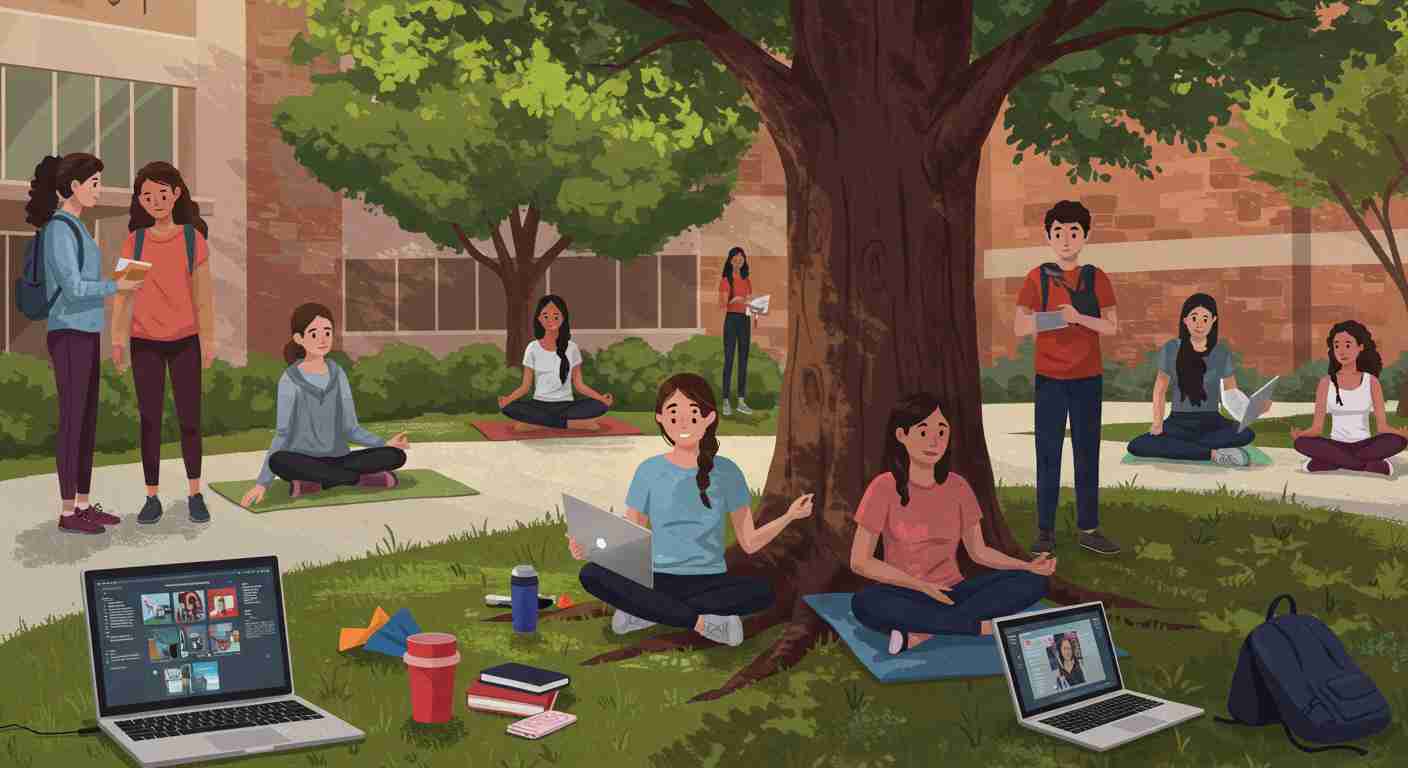
Yet, AI isn’t entirely a digital boogeyman. EdTechMagazine highlights its potential benefits, like predictive tools for identifying students at risk for anxiety or depression. Yusen Zhai, from the University of Alabama at Birmingham (2026 USNews Ranking: 132) , developed an AI tool that analyzes large datasets to pinpoint risk factors, enabling earlier intervention. This could be incredibly useful, like having a digital early warning system for emotional turbulence. AI can also handle administrative tasks, freeing up counseling center staff for more critical human-led interventions. So, while an AI might not understand your nuanced emotional distress, it can certainly schedule your appointment to talk to someone who does. I’m just saying, it’s a good division of labor.
Beyond the digital realm, human connection remains paramount. Dartmouth’s robust peer-to-peer support networks are a testament to this. There’s a certain magic in talking to someone who’s walking the same academic tightrope as you. BU Today offers general advice on supporting friends, emphasizing observation, non-judgmental concern, and active listening. They suggest using “I” statements, like “I’ve noticed you seem a bit down lately, and I’m worried about you,” which, frankly, sounds more approachable than a chatbot asking if you’d like to “optimize your emotional state.” The article also stresses the importance of directing friends to professional campus resources, because while peer support is invaluable, a friend isn’t a substitute for a licensed therapist.
The effectiveness of student-led initiatives is further underscored by national efforts. U.S. Representatives Mike Kelly and Don Beyer recently introduced the “Peer-to-Peer Mental Health Support Act,” which aims to establish student-led mental health crisis response programs in schools. This bipartisan legislation (because apparently, mental health isn’t a partisan issue, which, again, I’m just saying, is a novel concept) would train students to identify signs of crises and encourage help-seeking behaviors, like contacting the 9-8-8 lifeline. Anika Rahman, from Active Minds, praised the legislation, noting that peer support saves lives by reducing stigma and increasing help-seeking.
Students Engaged in Advancing Texas (SEAT) Federal Policy Director, Ayaan Moledina, a 16-year-old high school student, put it succinctly: “Young people often confide in friends before adults.” Studies show 67% of young people tell a friend they are feeling suicidal before anyone else. This statistic alone makes a compelling case for empowering peer networks. At UTSA, the NAMI On Campus chapter, funded by LG, is doing just that. It’s a student-led initiative focused on reducing stigma through peer education, awareness events, and programs that foster open dialogue. You do the math: when students feel comfortable talking to each other, they’re more likely to get the help they need. So, while AI can offer some clever shortcuts, the tried-and-true method of one human being genuinely caring about another still holds significant, and often surprising, power.
Addressing Campus Culture Challenges: Alcohol Misuse and Community Responsibility
Despite the strides in digital tools and peer support, colleges still face persistent, often deep-rooted challenges, with alcohol misuse sitting prominently at the top of that list. Dartmouth, for all its progressive initiatives, isn’t immune to this struggle, as noted by JED Foundation representatives. The “Crafted Zero Initiative,” led by Tuck ’26 student Ashleigh Mazivisa, represents Dartmouth’s effort to promote mindful drinking and foster respectful dialogue around alcohol consumption. It’s an admirable goal, aiming to make campus life enjoyable without requiring students to participate in an amateur chemistry experiment involving grain alcohol and various sugary mixers.
From a wider perspective, curbing alcohol abuse on college campuses is a bit like trying to herd cats at a rave—complex and often messy. Inside Higher Ed highlights that approximately one in five college students engages in binge drinking, and while overall consumption might be declining, “borgs” (blackout rage gallons, for the uninitiated) are still a thing. I’m just saying, if your drink requires a gallon jug and is designed to induce a blackout, you might be overshooting the “mindful” part of mindful drinking. The National Institute on Alcohol Abuse and Alcoholism (NIAAA) also points out the severe consequences: 696,000 students assaulted by intoxicated peers annually, 1,500 deaths from alcohol-related unintentional injuries, and a general dimming of academic prospects. It’s almost as if excessive drinking isn’t a shortcut to a dean’s list.
The NIAAA’s “Harmful and Underage College Drinking” report further details how the college environment itself, with its unstructured time, easy alcohol access, and reduced parental oversight, can be a breeding ground for bad habits. The first six weeks of freshman year are particularly vulnerable, influenced by student expectations and social pressures. It’s a bit like a cultural hazing ritual, only with more questionable decisions and fewer actual rituals. Schools with strong Greek systems or prominent athletic programs tend to have higher consumption rates, and those living in fraternities and sororities drink the most. Commuting students living with family? Lowest consumption. You do the math: parental supervision, or at least the specter of it, is a surprisingly effective deterrent.
Addressing these deep-rooted campus cultures, academic pressure, and imposter syndrome—issues common in high-performing institutions like Dartmouth, as JED Foundation adviser Kapi’olani Laronal observed—is a bit like trying to turn an ocean liner. It requires systemic changes and, as Laura Erickson-Schroth of the JED Foundation suggested, creating new campus traditions. It’s not just about telling students to drink less; it’s about rethinking why they feel the need to drink in the first place.
This brings us to the “Collaborative System Dynamics Theory of Change” for alcohol-involved sexual violence. Published in Frontiers in Public Health, this theory uses a stock-and-flow diagram to illustrate the interconnected web of alcohol availability, drinking culture, peer norms, and consent communication. It’s a sophisticated way of saying everything is connected, like a really complicated game of Jenga where pulling out one block (say, reducing bystander intervention) can make the whole tower (student well-being) come crashing down. Reinforcing loops show how increased alcohol use leads to greater intoxication and sexual violence, with affected students sometimes drinking to cope, further escalating the problem. It’s a vicious cycle, but at least now we have a diagram for it.
The good news is that balancing loops identify protective mechanisms, like positive peer support and belonging decreasing perceived pressure to drink, thereby increasing bystander intervention. It’s about creating an environment where calling out bad behavior is celebrated, not shunned. My low-key editor finds this a refreshing change from the usual “mind your own business” approach.
This leads us to the broader idea of well-being as a community-wide public health issue, moving beyond the confines of individual counseling. Ryan Travia, Babson College‘s Associate Vice President for Student Success, underscores this in his forthcoming book, “Well-Being Leadership in Higher Education.” He argues that resolving the mental health crisis isn’t solely the responsibility of counseling centers but a collective call to action for the entire community. It’s not just about having a great counseling center; it’s about everyone—presidents, provosts, trustees, faculty, and student affairs staff—being part of a campus-wide safety net. At Babson, Travia has expanded health resources, focusing on the philosophy that “in order to be our best selves, we need to be well.” You do the math: healthy people tend to perform better, which, I’m just saying, is a concept worth exploring in academia.
Ohio University‘s JED Campus initiative further exemplifies this community-wide approach. They’ve formed subcommittees focused on environmental safety, gatekeeper training, promoting help-seeking campaigns, and even creating a comprehensive inventory of life skills and peer support programming. Hali Burleson, Senior Project Manager and Planner for JED and Well-Being at OHIO, summed it up perfectly: “I am seeing campus really embrace the idea that we all have a part to play in supporting students’ mental health and well-being.” The subcommittees aim to strengthen a “campus-wide safety net for students using a comprehensive approach to prevention.” It’s a recognition that well-being isn’t a solo sport; it’s a team effort. And when everyone’s on the same page, the surprising result is that students actually feel better.
The Path Forward: Sustaining Progress and Future Directions in University Mental Health
The ultimate goal, then, is to ensure that these burgeoning mental health initiatives aren’t just a flash in the pan but have the staying power of a particularly stubborn stain on a dorm room carpet. Dartmouth, ever the meticulous planner, is already eyeing the long-term sustainability of its efforts. This includes plans for enhancing health and wellness communications—because apparently, a good meme about self-care can go a long way—and crucially, supporting students and employees through loss and grief. It’s a sobering reminder that life, even at an Ivy League institution, isn’t always sunshine and perfectly articulated arguments. Sometimes, it’s just plain hard. My low-key editor finds it rather touching that they’re making space for that.
Institutions like Dartmouth will continue to evolve their ‘Commitment to Care’ plans, not just with good intentions, but with data. The upcoming release of the 2024 Healthy Minds study findings will be pivotal, allowing them to evaluate the long-term metrics as the five-year term of the plan draws to a close. It’s like a five-year performance review, but for an entire mental health strategy. You do the math: if the numbers aren’t moving in the right direction, it’s back to the drawing board, or at least a very serious meeting with a lot of pie charts.
Drawing on the insights from Ryan Travia’s work at Babson College, there’s a growing recognition that well-being leadership needs to be woven directly into academic curricula and institutional strategy. It’s not enough to just talk about well-being; you have to teach it, live it, and make it part of the campus DNA. Travia’s forthcoming book, “Well-Being Leadership in Higher Education,” aims to provide a blueprint for campus leadership to integrate well-being into all aspects of campus life. He posits that colleges are at a “crossroads moment,” and mental health isn’t a side project; it’s a primary driver for student success. My low-key editor observes that if student success hinges on well-being, perhaps we should prioritize not making students want to pull their hair out. Just a thought.
This forward-thinking approach anticipates a future where well-being isn’t just a service offered, but an ingrained ethos. It projects a landscape where institutions don’t just react to crises but proactively cultivate resilience. Dartmouth’s journey, with its commitment to continuous improvement, transparent data utilization, and the integration of well-being into its strategic fabric, positions it as a leading example for the broader higher education landscape. They’re not just trying to keep the wheels on; they’re trying to build a better vehicle.
Ultimately, fostering resilient, supportive, and mentally healthy campus communities is a collective, ongoing effort. It’s not just on the counselors, or the administrators, or even the chatbots. It requires everyone—university leadership, students, and external partners—to be on board. It’s like orchestrating a very large, very complex symphony, where everyone has a part to play, and if one section is off-key, the whole performance suffers. Dartmouth, it seems, is committed to ensuring its symphony plays in perfect harmony. And if they manage to pull that off, it would be, I’m just saying, a surprisingly impressive feat.
Reference:
- Dartmouth Marks Milestone in Promoting Mental Health https://home.dartmouth.edu/news/2025/10/dartmouth-marks-milestone-promoting-mental-health
- A Q&A With Estevan Garcia: Dartmouth’s Chief Health and Wellness Officer Discusses Commitment to Well-being https://home.dartmouth.edu/news/2025/03/qa-estevan-garcia
- How ChatGPT And AI Use In Academics Might Impact Student Mental Health https://www.forbes.com/sites/ericwood/2025/07/05/how-chatgpt-and-ai-use-in-academics-might-impact-student-mental-health/
- How AI Supports Student Mental Health in Higher Education https://edtechmagazine.com/higher/how-ai-supports-student-mental-health-in-higher-education-perfcon
- How to Support a Friend’s Mental Health at College: Peer Support Tips and Campus Resources https://www.bu.edu/articles/2025/mental-health-peer-support-tips-and-campus-resources/
- Kelly, Beyer Introduce Legislation to Facilitate Peer-To-Peer Mental Health Support http://kelly.house.gov/media/press-releases/kelly-beyer-introduce-legislation-facilitate-peer-peer-mental-health-support
- UT San Antonio Introduces New Initiatives for Student Well-Being, Including Fall Break and Well-Being Day https://news.utsa.edu/2025/10/fall-break-well-being-day-among-several-new-initiatives-to-support-students/
- Addressing Alcohol-Involved Sexual Violence on College Campuses: A Collaborative System Dynamics Theory of Change https://www.frontiersin.org/journals/public-health/articles/10.3389/fpubh.2025.1620598/full
- How Colleges Can Curb Students’ Alcohol Abuse https://www.insidehighered.com/news/student-success/health-wellness/2024/11/19/providing-students-alcohol-education-and-support
- Harmful and Underage College Drinking https://www.niaaa.nih.gov/publications/brochures-and-fact-sheets/college-drinking
- Babson Wellness Chief Elevates Well-Being Priorities in Higher Education https://entrepreneurship.babson.edu/well-being-in-higher-education/
- OHIO Begins Next Phase of JED Campus Student Mental Health and Well-being Initiative https://www.ohio.edu/news/2025/08/ohio-begins-next-phase-jed-campus-student-mental-health-well-being-initiative