
Several U.S. universities announced new artificial intelligence degrees between Nov. 10 and Nov. 19, 2026. Most of them start in 2027. The undergraduate AI major they are joining is still very small. U.S. Department of Education data show that American colleges awarded just 221 bachelor’s degrees in artificial intelligence in 2025. More than half of those came from two schools. Before applying to one of the new programs, students should check three things. Is the degree’s program code on the federal STEM list? Does the program sit inside an established computer science department? And how do students get into the major, or switch out of it?
The new programs come from Clemson University, Missouri University of Science and Technology, Illinois Institute of Technology, Florida Atlantic University and the University of South Florida. They range from a full engineering-style AI bachelor’s to a liberal arts degree about AI’s effects on society.
Key takeaways
- U.S. colleges awarded 221 bachelor’s degrees in artificial intelligence (program code 11.0102, first majors only) in 2025. That was up from 115 in 2024 and 1 in 2016, according to U.S. Department of Education data.
- The Massachusetts Institute of Technology (85) and Carnegie Mellon University (38) together awarded 123 of the 221 AI bachelor’s degrees in 2025. That is more than half of the national total.
- International students earned 39 of those 221 degrees (17.6%), about twice their 8.5% share of all computer and information sciences bachelor’s degrees.
- Master’s degrees are a different market. In 2025, schools awarded 1,566 AI master’s degrees, and international students earned 916 of them (58.5%).
- Artificial intelligence (11.0102) is on the DHS STEM Designated Degree Program List. Interdisciplinary and arts-based AI degrees qualify for the STEM OPT extension only if the school files them under a code on that list.
Which colleges announced new AI degrees for 2027?
The new degrees fall into three groups.
Standalone AI bachelor’s degrees
Clemson announced on Nov. 16 that its School of Computing will launch a B.S., an M.S. and a Ph.D. in artificial intelligence in fall 2027. The South Carolina Commission on Higher Education has approved all three programs. All three will be taught in person on the main campus. The bachelor’s degree requires 123 credit hours. It combines programming, mathematics and statistics with courses in AI, business, ethics and human-centered design. The master’s requires 30 credit hours and no thesis. Ph.D. students who enter with a bachelor’s degree need at least 70 credit hours (Clemson News).
The University of Missouri Board of Curators voted unanimously on Nov. 19 to approve a bachelor’s degree in AI at Missouri S&T. The school calls it “the first standalone undergraduate AI degree offered in Missouri.” The program still needs review by the Missouri Coordinating Board for Higher Education and is planned for fall 2027. It is 120 credit hours and sits in the computer science department. The school will add six new courses. The core covers programming, algorithms, machine learning, data science, databases and cybersecurity. Missouri S&T expects about 110 students within five years of launch (Missouri S&T News).
AI paired with another field
Illinois Tech already has a standalone B.S. in Artificial Intelligence, which it launched in 2019. Its new announcement expands an “AI+” lineup. The featured pathways are Physics, Astrophysics, Biochemistry, Game Design and Experiential Media, and Business Administration, each “with Artificial Intelligence.” The school also added two nine-credit undergraduate certificates, AI Fluency and AI Management. The release does not give a start date (Illinois Tech).
The University of South Florida announced on Nov. 10 a B.S. in Computer Science and Anthropology and a B.S. in Computer Science and Economics. Each is a single 120-credit degree offered jointly by the Bellini College of Artificial Intelligence, Cybersecurity and Computing and the College of Arts and Sciences. Both start in fall 2027 (USF).
AI as a social science
Florida Atlantic’s Board of Trustees approved a Bachelor of Arts in Technology, AI and Society. The Dorothy F. Schmidt College of Arts and Letters will offer the 120-credit degree, which is expected to start in spring 2027. According to the student newspaper UPress, it focuses on the ethical, social, cultural and political effects of AI rather than programming and engineering. It has three concentrations: Digital Storytelling and Creative Media; Technology, Governance and Policy; and Digital Identity and Social Systems. It aims at careers such as public relations, policy analysis and market research. FAU projects 10 students in the first year and 50 by the fifth (UPress).
All of these degrees have “AI” in the name, but the coursework differs a lot. Standalone degrees suit students who are strong in math and want machine learning engineering jobs or graduate school. The paired degrees fit students already set on physics, economics or biochemistry who want serious computing skills. FAU’s degree is closer to communications or public policy, for students interested in how technology is governed rather than how it is built.
How many students earn AI degrees in the U.S.?
The Department of Education gives artificial intelligence its own program code, 11.0102. Counting first majors only, here is how many bachelor’s degrees U.S. colleges awarded under that code from 2016 to 2025. No school awarded one from 2011 to 2015. In 2010, one school awarded six.
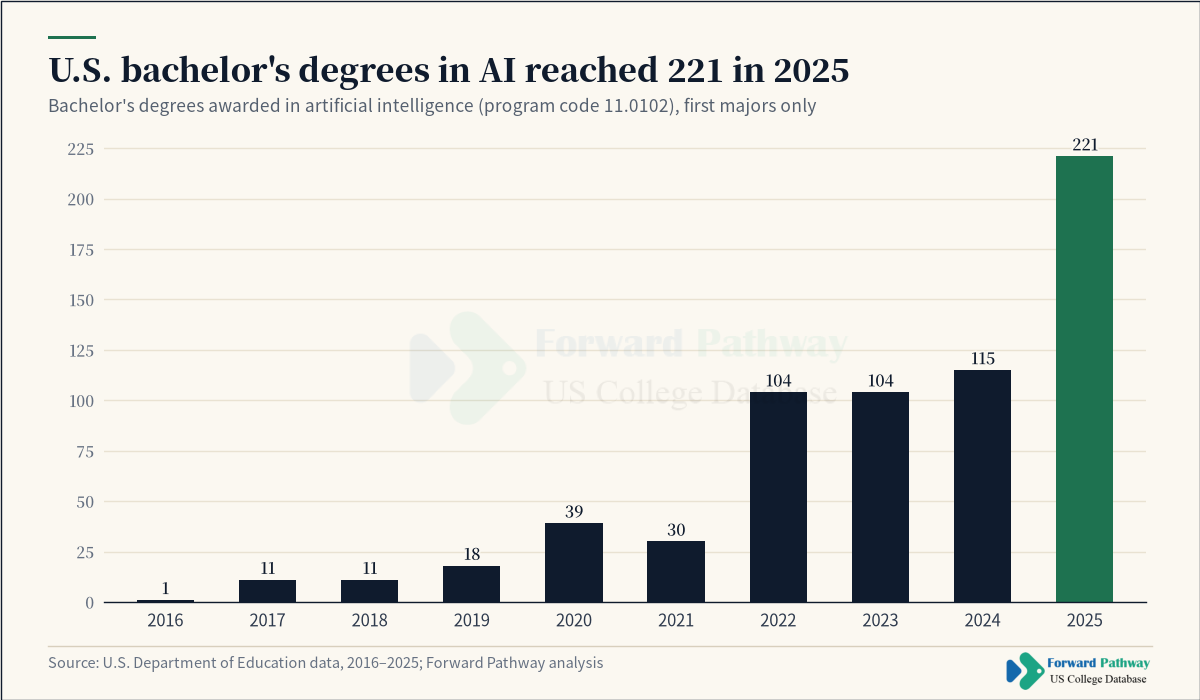
The 221 degrees in 2025 came from 23 schools. That same year, U.S. colleges awarded 140,495 bachelor’s degrees across all computer and information sciences programs (codes beginning with 11). AI was 0.16% of that total. International students, meaning students in the U.S. on temporary visas, earned 8.5% of computing bachelor’s degrees overall, but 17.6% of AI bachelor’s degrees.
The degrees are also concentrated. MIT and Carnegie Mellon alone account for more than half:
| School | AI bachelor’s degrees, 2025 | Earned by international students, 2025 |
|---|---|---|
| Massachusetts Institute of Technology | 85 | 14 |
| Carnegie Mellon University | 38 | 10 |
| Illinois Institute of Technology | 15 | 6 |
| Full Sail University | 10 | 0 |
| Colby College | 10 | 1 |
| State University of New York at Plattsburgh | 7 | 1 |
| University of Massachusetts Dartmouth | 6 | 0 |
| Other 16 schools combined | 50 | 7 |
| U.S. total | 221 | 39 |
Source: U.S. Department of Education data, 2025; Forward Pathway analysis. First majors only; schools that awarded at least one degree. Carnegie Mellon announced its AI bachelor’s in May 2018 and described it as “the first offered by a U.S. university” (CMU News). MIT students have been able to declare major 6-4, Artificial Intelligence and Decision Making, since fall 2022 (MIT EECS).
At the master’s level, international students earn most of the degrees. In 2025, 58 schools awarded 1,566 master’s degrees in AI, and international students earned 916 of them (58.5%).
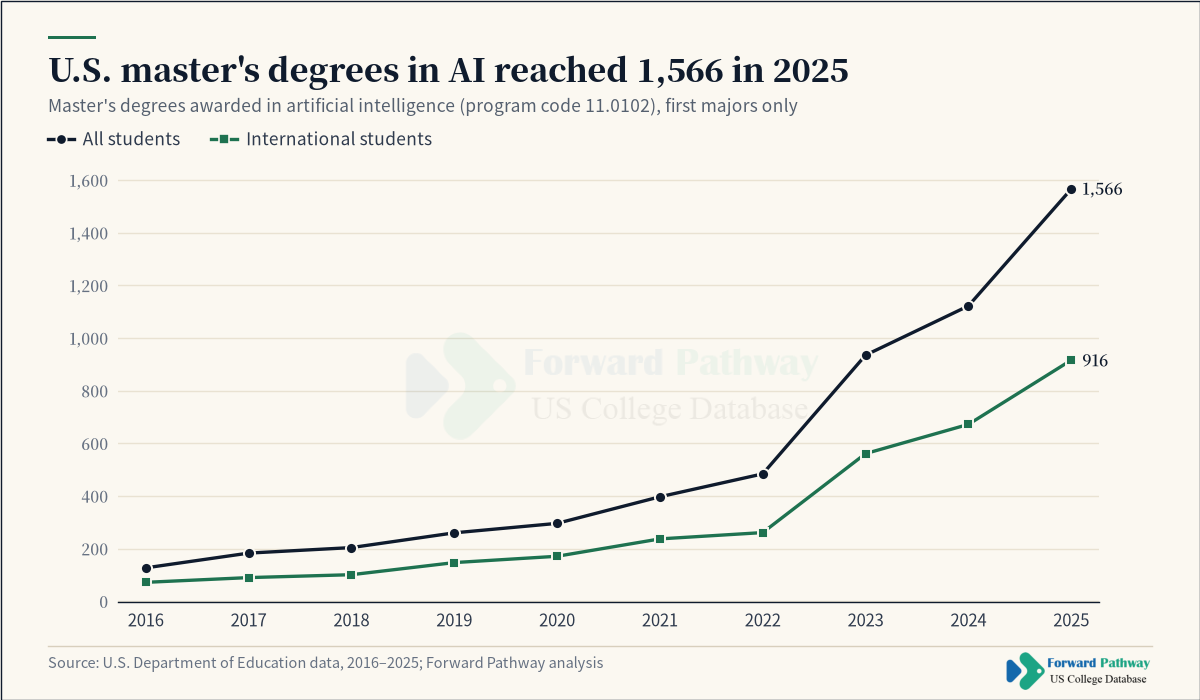
These numbers have two limits. Many colleges teach AI as a concentration or minor within computer science, and those graduates are counted as computer science majors. That means more undergraduates study AI than the 221 figure suggests. Federal data also do not break international students out by country.
Does an AI degree qualify for STEM OPT?
F-1 graduates get 12 months of Optional Practical Training. If their degree is on the Department of Homeland Security’s STEM Designated Degree Program List, they can apply for a 24-month STEM OPT extension, for up to three years in total. Eligibility depends on the program code the school assigns to the degree, not on the degree’s name. The list, updated July 22, 2024, covers four entire code families: engineering (14), biological sciences (26), mathematics and statistics (27) and physical sciences (40). Other families, including computer sciences (11), interdisciplinary studies (30), social sciences (45) and business (52), qualify only code by code (DHS STEM list).
Here is how the new degrees line up with the list:
- Artificial intelligence (11.0102), computer science (11.0701) and computer and information sciences, general (11.0101) are all on the list. Standalone AI degrees housed in computing departments, like Clemson’s and Missouri S&T’s, qualify if they are filed under these codes.
- Paired degrees depend on the exact code. The list includes economics and computer science (30.3901), linguistics and computer science (30.4801) and data science (30.7001). It does not include anthropology (45.0201) or business administration and management (52.0201). Whether USF’s computer science and anthropology degree or Illinois Tech’s business administration with AI qualifies depends on the code each school files.
- Arts-based AI degrees need the closest check. Public reports on FAU’s B.A. do not give its program code. Codes such as science, technology and society (30.1501) are not on the STEM list. A degree filed under a code like that would not qualify for the extension.
To check, email the school’s international student office and ask for the degree’s program code, or look for the school’s published list of STEM-designated majors. Then match the code against the DHS list. Applicants should also know that, as of Nov. 20, 2026, the OPT fee rule DHS proposed on Oct. 8 is still a proposal and has not taken effect. It would charge $70,000 for initial OPT and $30,000 for each later OPT period (Federal Register). For that reason, OPT length should not be the only factor in choosing a major.
How to judge a brand-new AI major
New programs have no graduates yet, so there are no job outcomes or salaries to compare. Applicants can look at the school itself and the program’s foundations:
| School | U.S. News 2027 national rank | Undergraduate admission rate, 2024 (%) | International share of undergraduates, fall 2024 (%) | New offering |
|---|---|---|---|---|
| Clemson University | 80 | 38.3 | 0.9 | B.S., M.S. and Ph.D. in AI |
| Missouri University of Science and Technology | 191 | 72.5 | 3.2 | B.S. in AI |
| Illinois Institute of Technology | 121 | 54.9 | 17.7 | AI+ pathways, two certificates |
| Florida Atlantic University | 191 | 66.1 | 3.1 | B.A. in Technology, AI and Society |
| University of South Florida | 100 | 43.2 | 7.9 | B.S. in Computer Science and Economics; and Anthropology |
Source: U.S. Department of Education data, 2024 (admission rate is first-time undergraduates admitted divided by applicants; international share is fall undergraduate enrollment); U.S. News & World Report 2027 rankings. Admission rates are schoolwide, and popular majors are often harder to get into.
Except for Illinois Tech, international students are less than 10% of undergraduates at each of these schools, and less than 1% at Clemson. International applicants should ask the international office how many bachelor’s graduates it processes for OPT and STEM OPT each year.
Four questions matter most:
- Which department runs it? Clemson’s and Missouri S&T’s new degrees sit inside existing computer science departments, so most courses and faculty come from established programs. Illinois Tech already has AI graduates: 15 AI bachelor’s degrees and 111 computer science bachelor’s degrees in 2025, according to federal data.
- How much math and programming is required? Compare the core with the school’s computer science major. Check whether linear algebra, probability and statistics, algorithms and machine learning are required. This determines whether graduates can go straight into technical jobs or computing graduate programs.
- How do you get in? At Carnegie Mellon, students first have to be admitted to the School of Computer Science. They can declare the AI major in the spring of their first year, and students from other CMU colleges can transfer in only after sophomore year (CMU School of Computer Science). Some schools admit directly to the major. Others require students to declare after enrolling, and small programs may cap transfers.
- Can you get out? If the curriculum changes or the fit is wrong, ask whether you can move to computer science without adding a year.
For high school seniors, a new AI major is not a shortcut. With only 221 AI bachelor’s degrees awarded nationwide in 2025, graduate schools and employers are still getting to know the credential, and computer science remains the more flexible choice. For students who are genuinely interested, the safest AI degree is housed in a computing department, requires heavy math and carries a STEM-listed code. Current undergraduates can often add an AI minor, certificate or research project to a computer science major, which is usually less risky than switching majors. For those aiming at graduate school, studying computer science, math or statistics as an undergraduate and then earning an AI master’s remains the established path, and it is the level where international students already earn most AI degrees.
Frequently asked questions
Is an artificial intelligence bachelor’s degree STEM-eligible for OPT?
It depends on the program code the school assigns. Artificial intelligence (11.0102) and computer science (11.0701) are both on the DHS STEM Designated Degree Program List (updated July 22, 2024). Graduates with those codes can apply for a 24-month STEM OPT extension after their 12 months of OPT. Interdisciplinary or arts-based AI degrees filed under codes not on the list do not qualify.
Which colleges are launching new AI degrees in 2027?
Announced in November 2026: Clemson University’s B.S., M.S. and Ph.D. in AI (state-approved, fall 2027); Missouri S&T’s B.S. in AI (pending state coordinating board review, planned for fall 2027); the University of South Florida’s B.S. in Computer Science and Economics and B.S. in Computer Science and Anthropology (fall 2027); and Florida Atlantic University’s B.A. in Technology, AI and Society (expected spring 2027). Illinois Tech expanded its AI+ pathways but did not give a start date.
How many students graduate with an AI bachelor’s degree each year in the U.S.?
U.S. Department of Education data show 221 bachelor’s degrees in artificial intelligence (first majors only) awarded in 2025 by 23 schools, up from 115 in 2024. MIT awarded 85 and Carnegie Mellon 38. International students earned 39.
Should I major in AI or computer science?
AI bachelor’s degrees made up only 0.16% of computing bachelor’s degrees in 2025, so computer science is still the more widely recognized degree. If you choose AI, look for a program housed in a computing department, with required linear algebra, statistics, algorithms and machine learning, a STEM-listed code, and clear rules for entering and leaving the major.
What share of AI master’s degrees go to international students?
In 2025, international students earned 916 of the 1,566 AI master’s degrees awarded in the U.S. (58.5%), according to U.S. Department of Education data. In 2016 they earned 72 of 127.
Sources
- Clemson University to launch three new degree programs in artificial intelligence (Clemson News, Nov. 16, 2026)
- Curators approve Missouri S&T to offer state’s first bachelor’s degree in AI (Missouri S&T News)
- Illinois Tech expands AI education to prepare grads for next-generation careers (Illinois Tech)
- AI on the syllabus, higher costs on the table at FAU’s Board of Trustees meeting (UPress, Nov. 18, 2026)
- Bellini College interdisciplinary majors to pair computer science with anthropology and economics programs (USF, Nov. 10, 2026)
- DHS STEM Designated Degree Program List (updated July 22, 2024)
- Optional Practical Training Fees, proposed rule (Federal Register, Oct. 8, 2026)
- Carnegie Mellon launches undergraduate degree in artificial intelligence (CMU News, May 10, 2018)
- B.S. in Artificial Intelligence (CMU School of Computer Science)
- 6-4: Artificial Intelligence and Decision Making (MIT EECS)
- U.S. Department of Education data: degrees awarded, 2016–2025; admissions and enrollment, 2024