
A federal court has blocked the Department of Homeland Security’s August restrictions on Curricular Practical Training (CPT), but that has not reopened CPT at every college. As of Nov. 21, 2026, New York University and the University of Illinois at Urbana-Champaign have resumed approving CPT. Brown University still has CPT for F-1 undergraduates “indefinitely suspended,” and Stanford’s CPT page still says it has paused applications not required for degree completion. Harvard and UCLA say they are still reviewing the ruling. For F-1 students, whether an internship can go ahead now depends on their own school’s written guidance, not on the headlines.
The split follows two rulings issued a day apart by the U.S. District Court for the District of Massachusetts. On Nov. 16, Judge F. Dennis Saylor IV vacated the DHS rule that would have ended “duration of status” (D/S) for F and J students. On Nov. 17, Judge Julia E. Kobick stayed two SEVP broadcast messages from August that had narrowed CPT. The rulings carry different legal weight, and neither one makes a school approve a student’s work authorization.
Key takeaways
- The D/S rule (91 Fed. Reg. 44976) was vacated by a final judgment on Nov. 16, 2026. F-1 students stay on D/S and do not need to file extension applications with USCIS.
- The CPT ruling of Nov. 17, 2026, is a preliminary order. It stays SEVP’s Aug. 12 and Aug. 24 broadcast messages nationwide while the case goes on, but CPT still has to be authorized by each school’s designated school official (DSO).
- Of the six major universities in our table, two (NYU and UIUC) have resumed CPT approvals. Brown and Stanford still restrict it, and Harvard and UCLA are reviewing. Together, the four schools that have not resumed enrolled 5,954 international undergraduates and 15,671 international graduate students in fall 2024, according to U.S. Department of Education data.
- Undergraduates are hit hardest because few bachelor’s programs require an internship of every student. Of the 1,176,001 active international student records in SEVIS in November 2026, 356,099 (30.3%) were at the bachelor’s level.
- In 2024, 130,586 students received CPT work authorization, according to ICE’s SEVIS by the Numbers report. That count can include the same student more than once.
What the two court rulings do, and how they differ
Duration of status: a final judgment vacating the rule
DHS published a final rule on July 17, 2026, that would have replaced D/S with a fixed admission period tied to the I-20 end date and capped at four years. Judge Saylor issued a nationwide preliminary injunction on Sept. 14 that kept the rule from taking effect. On Nov. 16, in Presidents’ Alliance on Higher Education and Immigration v. DHS (No. 26-13799-FDS), he granted the plaintiffs’ motion for summary judgment, denied the government’s, and ordered that the rule “is hereby VACATED pursuant to the Administrative Procedure Act.”
The court also decided a question it had left open in September. It held that the rule’s limits on academic mobility, including on transfers, changes of program, and enrolling at the same or a lower degree level, are not “reasonably related” to the nature or purpose of the F-1 visa program. “The statute simply does not grant DHS such broad and open-ended authority to undermine the F-1 visa program,” the judge wrote. He rejected DHS’s request to send the rule back to the agency without vacating it, noting that “the current regime has existed for decades, and the Final Rule has not gone into effect.”
In practice, nothing changes for students. Brown University‘s international office told students that “Duration of status remains in place” and that they “do not need to file an extension application with USCIS.” The government can appeal to the First Circuit. According to NAFSA’s case page, the appeals court on Nov. 13 granted the government’s request to hold its appeal of the September injunction in abeyance for 30 days, and that appeal may now become moot. As of Nov. 21, 2026, we found no public record of an appeal of the final judgment.
CPT: a stay and a preliminary injunction, not a final ruling
In Association of American Universities v. DHS (No. 1:26-cv-14520-JEK), Judge Kobick granted two forms of interim relief:
- A nationwide stay. SEVP’s broadcast messages of Aug. 12 and Aug. 24, 2026, “may not be enforced or applied pending judicial review.” The judge reasoned that the plaintiffs represent hundreds of institutions and that a party-specific order would cause confusion.
- A preliminary injunction for the plaintiffs’ members. DHS and the other defendants may not enforce the broadcasts’ reading of 8 CFR 214.2(f)(10)(i) against members of AAU, NAFSA, the Presidents’ Alliance, and the Association of Independent Colleges and Universities in Massachusetts, “including their members’ employees and students,” both going forward and for approvals made before the broadcasts.
The judge declined two other requests: ordering the government to rescind adverse actions already taken, and requiring it to send written notice to all SEVP-certified schools. The government can appeal.
The court found that the plaintiffs are likely to win their argument that SEVP acted arbitrarily. Since 1991, the order notes, the government had treated elective training taken for academic credit as CPT. The August broadcasts reversed that without acknowledging the change, requiring that training be mandatory for all students in a degree program. But the ruling only restores the old rules. It does not authorize anyone to work. Under the regulation, a DSO still has to approve CPT and record the employer and dates in SEVIS and on the I-20. Schools could always choose to approve only some kinds of CPT, and the injunction does not make them approve elective, for-credit internships. That is why schools have reacted so differently.
Which schools have resumed CPT after the injunction?
| School | CPT policy as of Nov. 21, 2026 | International undergraduates (fall 2024) | International share of undergraduates (fall 2024) | International graduate students (fall 2024) |
|---|---|---|---|---|
| New York University | Resumed prior guidelines | 7,611 | 26.2% | 11,591 |
| University of Illinois at Urbana-Champaign | Resumed two types of CPT | 5,533 | 14.9% | 7,817 |
| Brown University | Undergraduate CPT suspended; reviewing ruling | 1,069 | 13.5% | 1,401 |
| Stanford University | CPT not required for degree still paused | 965 | 12.2% | 3,825 |
| Harvard University | Reviewing; guidance unchanged | 1,346 | 15.2% | 6,667 |
| University of California-Los Angeles | Reviewing | 2,574 | 7.7% | 3,778 |
Enrollment figures are from U.S. Department of Education data for fall 2024. “International” means students on temporary visas who are not U.S. citizens or permanent residents. Graduate counts include professional degree students. School policies come from university websites and campus newspapers listed under Sources.
Resumed. New York University‘s Office of Global Services emailed students on Nov. 17 that the university would “return to using its longstanding guidelines for processing CPT requests,” Washington Square News reported. Internships that are not degree requirements can be approved again. After August, NYU had stopped approving requests that did not meet the new standard, but it did not revoke CPT it had already granted. The same day, International Student and Scholar Services at the University of Illinois at Urbana-Champaign said that while the injunction is in effect it will issue CPT that is “an integral part of the student curriculum and pursuant to a class with a formal work component,” and CPT “directly related to student thesis topic and proposed research area.” At the much smaller University of Wisconsin-Oshkosh, Brent Blahnik, director of global engagement and international student services, emailed students on Nov. 16, a day before the CPT ruling. He wrote that a student who enrolls in a relevant course, and whose faculty member confirms the work is “meaningfully integrated into your academic program,” “may be eligible for CPT authorization following an individualized review.”
Still restricted. Brown’s CPT page says that “Curricular Practical Training options for F-1 undergraduate students are indefinitely suspended.” The suspension covers CPT based on optional professional tracks, independent study courses, and optional semester-away programs such as Brown in Washington. Only six master’s programs remain eligible: PRIME, Data Science, Public Affairs, Teaching, Urban Education Policy, and Public Health. A note dated Nov. 17 says the office is “reviewing the Court’s decision and consulting with University leadership on next steps.” The policy itself has not changed. Stanford University‘s Bechtel International Center still says, as of Nov. 21, that “Stanford has paused, until further notice, all CPT applications that are not required for degree completion.” Stanford’s Nov. 17 notice on D/S told students that “no action is required,” The Stanford Daily reported, but it did not mention CPT.
Reviewing. Harvard University spokesperson Jason Newton told The Harvard Crimson that “the University is reviewing the ruling to understand its potential implications for Harvard’s programs.” Harvard College, Harvard Medical School, Harvard Law School, the Graduate School of Arts and Sciences, and the Graduate School of Design do not currently offer CPT. At the University of California-Los Angeles (UCLA), a spokesperson told the Daily Bruin that “UCLA is assessing the implications of the court’s ruling” and that the Dashew Center for International Students and Scholars “will provide updated guidance to international students as soon as it is available.”
Brown, Stanford, and Harvard are members of the plaintiff groups, so the injunction covers them. Keeping CPT restricted is their own decision. The four schools that have not resumed CPT had 5,954 international undergraduates and 15,671 international graduate students in fall 2024. NYU and UIUC together had 13,144 and 19,408. Those are totals of international students, not counts of CPT users.
Why undergraduates lose the most
The August broadcasts limited CPT to training required of every student in the degree program. Many master’s programs have a required internship, practicum, or co-op, which is why Brown kept six of them eligible. Few bachelor’s degrees make an internship a graduation requirement for everyone. Brown’s undergraduate suspension rests on that point, and Harvard College does not currently offer CPT. If a school does not go back to its earlier practice, its F-1 undergraduates essentially lose CPT as a way to do off-campus internships while enrolled.
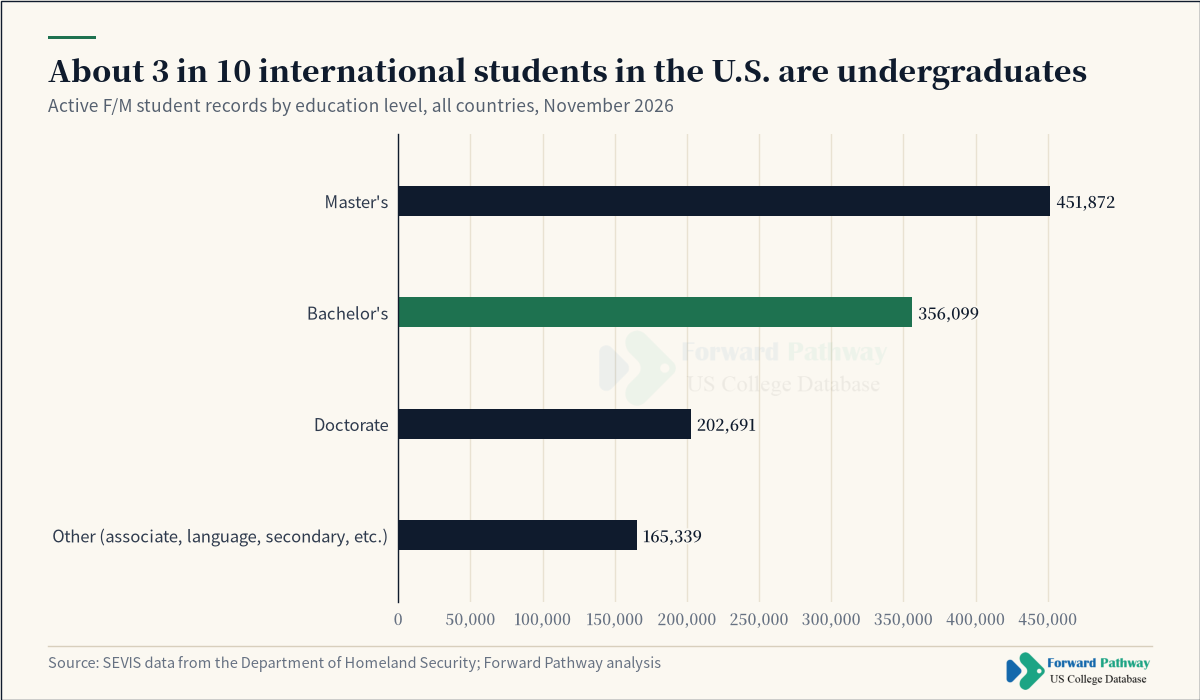
SEVIS data from the Department of Homeland Security show 1,176,001 active international student records in November 2026. Of these, 451,872 (38.4%) were at the master’s level, 356,099 (30.3%) at the bachelor’s level, and 202,691 (17.2%) at the doctoral level. The share of undergraduates varies widely by country. Among the 217,063 students from China, 67,636 (31.2%) were undergraduates. Among the 311,403 from India, the largest sending country, only 35,910 (11.5%) were. Students from countries that send many undergraduates are the most exposed to campus-by-campus CPT decisions.
CPT is a large pipeline. ICE’s 2024 SEVIS by the Numbers report counted 130,586 CPT authorizations in 2024, 0.4% fewer than in 2023, compared with 194,554 OPT approvals. The largest corporate employers of CPT students were Amazon (3,205), Tesla (1,118), and Google (880), followed by Microsoft, NVIDIA, and Meta.
D/S, CPT, and OPT fees: what is settled and what is not
- Duration of status: The most settled of the three. The rule is vacated. What could still change it: an appeal and a stay from the First Circuit.
- CPT: The federal reinterpretation is on hold, but only on a preliminary basis, and each school decides for itself. Students at neighboring schools can face different answers in the same month.
- OPT fees: On Oct. 8, DHS proposed charging schools $70,000 for a first OPT recommendation and $30,000 for each later one. Comments closed on Nov. 9. As of Nov. 21, 2026, the proposal is not final and not in effect.
The three issues are connected. When a school stops approving CPT, students tend to use pre-completion OPT for summer internships, which uses up part of their 12 months of OPT. Twelve months or more of full-time CPT, on the other hand, makes a student ineligible for post-completion OPT. Internship plans now need to take all three into account.
What F-1 students should check now
- Look for guidance dated after Nov. 17. Check your international office’s latest written notice. If your school has resumed CPT, apply through its normal process. If it has not, the court ruling alone does not allow you to start an internship.
- Do not start work before authorization. Stanford’s earliest winter-quarter CPT start date is Dec. 12, 2026. No matter what an employer says, wait until your DSO approves CPT and it appears on page 2 of your I-20.
- Master’s students: Ask whether your program makes an internship a requirement for all students. If it does, CPT was available even under the August broadcasts. If not, ask whether and when your school will resume elective, for-credit CPT, and keep the reply in writing.
- Students with approved CPT: Do not extend dates or change employers on your own. Any change needs a new authorization.
- Students in Day 1 CPT programs: The injunction mainly restores elective, for-credit CPT. The graduate-program exception that Day 1 CPT relies on still requires the training to actually be part of the curriculum, so the risk has not disappeared. If your program or CPT is canceled, or your SEVIS record is at risk, contact your DSO and an immigration attorney right away.
- Doctoral and long-program students: With the D/S rule vacated, there is no need to file an I-539. Your DSO extends your I-20 in SEVIS as before. Before traveling over winter break, check that the travel signature on your I-20 is current.
Frequently asked questions
Does the CPT injunction mean my school has to approve my CPT?
No. The Nov. 17, 2026, order stays SEVP’s Aug. 12 and Aug. 24 broadcast messages. It does not authorize any student to work. CPT still has to be approved by your school’s DSO and recorded on your I-20. Each school decides whether to resume elective, for-credit CPT. NYU and UIUC have resumed it. Brown and Stanford have not, as of Nov. 21.
Is duration of status still in effect for F-1 students?
Yes. On Nov. 16, 2026, the U.S. District Court for the District of Massachusetts vacated the DHS final rule (91 Fed. Reg. 44976) in a final judgment. Students remain on D/S, do not need to file extension applications with USCIS, and can transfer or change programs under the existing rules. The government can appeal to the First Circuit. As of Nov. 21, no appeal of the final judgment had been made public.
Can Brown University undergraduates get CPT now?
Not yet. Brown’s CPT page still says CPT for F-1 undergraduates is “indefinitely suspended.” Only six master’s programs are eligible: PRIME, Data Science, Public Affairs, Teaching, Urban Education Policy, and Public Health. A Nov. 17 note says Brown is reviewing the court’s decision with university leadership.
Which universities have resumed CPT after the court ruling?
As of Nov. 21, 2026, New York University has returned to its longstanding CPT guidelines, and the University of Illinois at Urbana-Champaign has resumed CPT tied to courses with a formal work component and CPT directly related to a student’s thesis or research. Stanford still pauses CPT not required for degree completion. Harvard and UCLA are reviewing the ruling.
Is the injunction permanent?
No. The CPT order is a preliminary injunction and stay that lasts while the case continues, and the government can appeal. The D/S decision is a final judgment, but it can also be appealed.
Sources
- Presidents’ Alliance on Higher Education and Immigration v. DHS, No. 26-13799-FDS (D. Mass.): Memorandum and Order on Cross-Motions for Summary Judgment (Nov. 16, 2026)
- Association of American Universities v. DHS, No. 1:26-cv-14520-JEK (D. Mass.): Memorandum and Order on Plaintiffs’ Motion for a Preliminary Injunction and Stay of Agency Action (Nov. 17, 2026)
- NAFSA: Duration of Status final rule litigation
- NAFSA: CPT litigation
- 8 CFR 214.2 (Legal Information Institute, Cornell Law School)
- ICE: 2024 SEVIS by the Numbers Report
- Brown University ISSS: Curricular Practical Training
- Brown University ISSS: Federal Court Vacates DHS Duration of Status Final Rule (Nov. 17, 2026)
- Washington Square News: NYU resumes CPT applications after judge halts ICE restrictions on international students (Nov. 20, 2026)
- University of Illinois ISSS: Preliminary Injunction Issued in Curricular Practical Training (CPT) Lawsuit (Nov. 17, 2026)
- Stanford Bechtel International Center: Curricular Practical Training (CPT)
- The Stanford Daily: Federal judges block two Trump administration restrictions on international students (Nov. 19, 2026)
- The Harvard Crimson: Federal Judge Temporarily Blocks Restriction on Student Work Authorizations (Nov. 19, 2026)
- Daily Bruin: Judge temporarily blocks limits on international students’ work authorizations (Nov. 18, 2026)
- The Advance-Titan: UWO international students to stay after federal court vacated DHS final ruling (Nov. 18, 2026)