
The New School has not decided whether to close all or most programs at Eugene Lang College of Liberal Arts and The New School for Social Research. President Joel Towers wrote to the university on Nov. 25, 2026, that “final decisions affecting the university will not be taken before the end of this semester” and that “no action will be taken that will impede your ability to complete your studies.” The student newspaper reports that a board vote expected on Dec. 2 has been pushed to January. As of Nov. 26, 2026, the outcome is open.
For international students the stakes are high. In fall 2024, international students made up 38.1% of The New School’s enrollment and 48.6% of its graduate students, according to U.S. Department of Education data. Students on F-1 visas whose programs may be affected should get written answers about their own degree path now and keep a transfer plan in reserve, because a gap in enrollment can end their SEVIS record.
Key takeaways
- The New School projected a $48 million deficit for the year ending June 2026, its third straight year with a structural deficit above $30 million, according to a Nov. 17, 2025, message from the president.
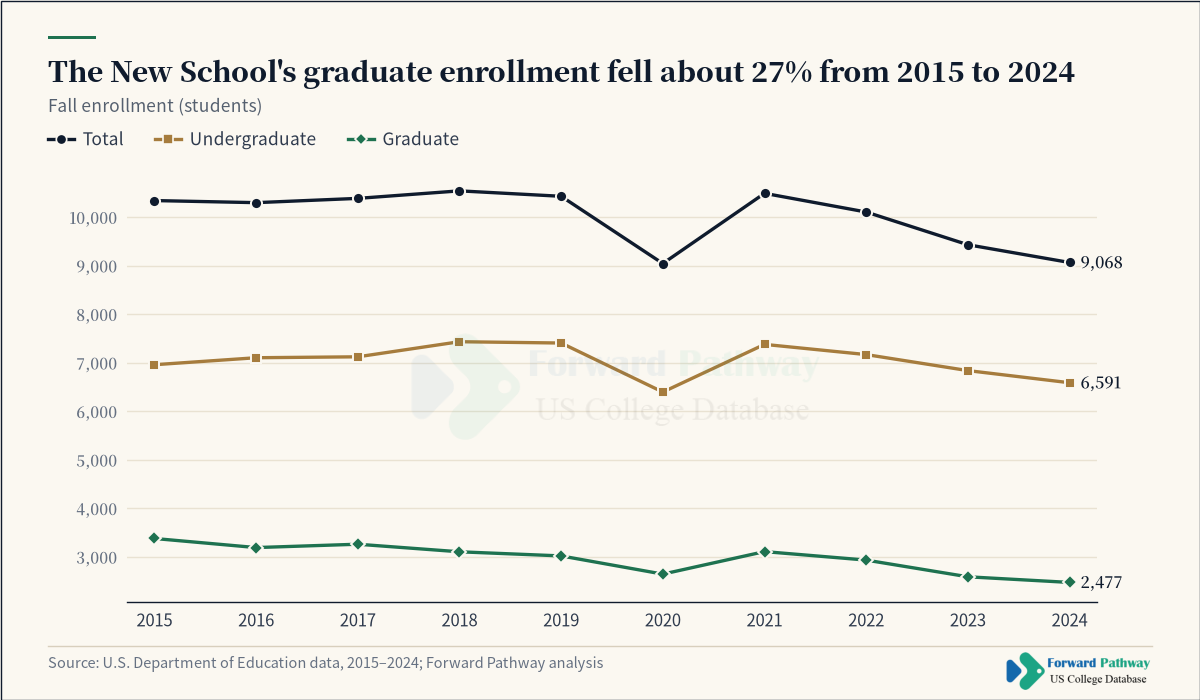
- Total fall enrollment fell from 10,344 in 2015 to 9,068 in 2024 (about 12%); graduate enrollment fell from 3,382 to 2,477 (about 27%).
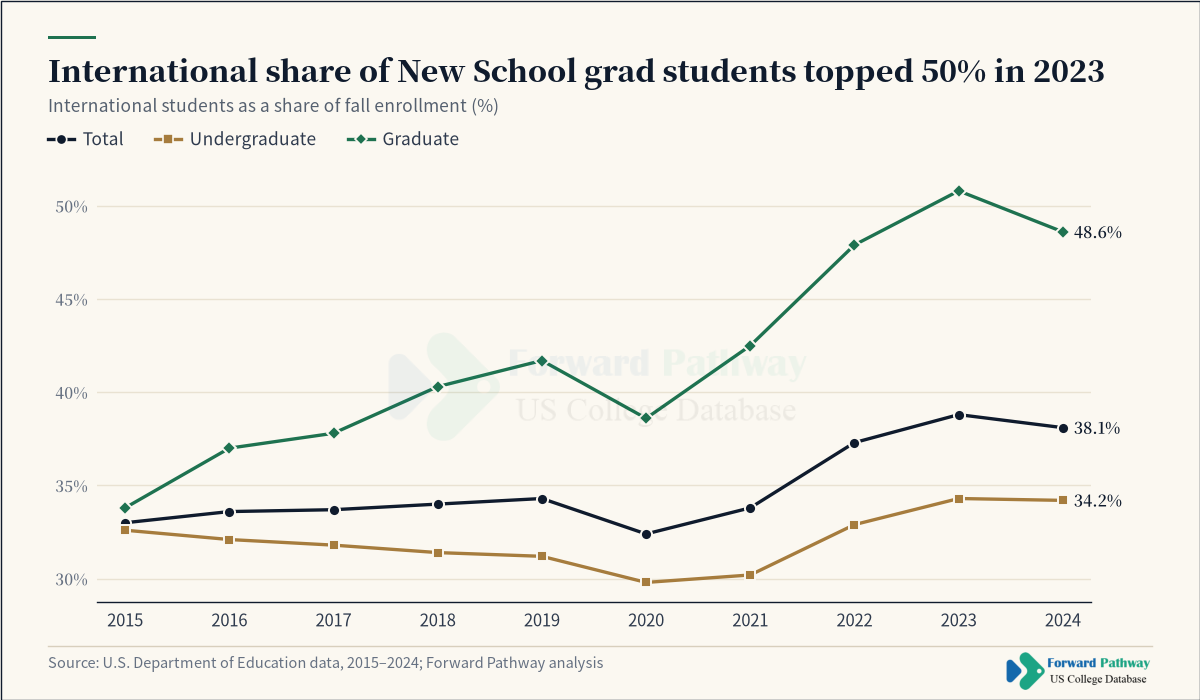
- International enrollment held steady at 3,411 in 2015 and 3,457 in 2024, raising the international share from 33.0% to 38.1%. Among graduate students it peaked at 50.8% in 2023.
- Under ICE rules, an F-1 transfer student must start classes at the new school within five months of the last day of attendance at the old one, and any OPT ends on the transfer release date.
- The president has said current students will be able to finish their studies; no plan under discussion, as reported, closes Parsons School of Design.
What is happening at The New School
The New School, in Manhattan, includes Parsons School of Design, Eugene Lang College of Liberal Arts, The New School for Social Research (NSSR, its graduate school in the social sciences and humanities), and its performing arts school, among other units. The current debate centers on Lang and NSSR.
- Nov. 17, 2025: In a message to the community, Towers said the board had adopted a 2025–26 budget with a $31 million deficit and that the projected deficit for the year ending in June 2026 had grown to $48 million. “This will be the third consecutive year ending with a significant structural deficit exceeding $30 million,” he wrote. The university paused PhD admissions for 2026–27, except in Clinical Psychology, and proposed two academic units: Lang and NSSR as one, and Parsons, Performing Arts and Media as another. The goal is a balanced budget by the 2027–28 academic year.
- February–March 2026: Higher Ed Dive reported on March 18 that S&P Global Ratings downgraded the university’s bond rating in February, and that after a 7% reduction through voluntary buyouts, the school planned to cut 15% of its workforce through layoffs and by eliminating vacant positions.
- Nov. 24, 2026: The New School Free Press reported that the board would vote Dec. 2 on whether to close all or most Lang and NSSR programs. According to the paper, administrators presented three models; two would phase out new admissions, and the one trustees favored most would fold undergraduate liberal arts into Parsons or keep a slimmed-down liberal arts bachelor’s degree outside Parsons.
- Nov. 25, 2026: In a message titled “Our Ongoing Work,” Towers responded to reports of a Dec. 2 decision, writing that “there are many considerations of shape, scale, and composition of The New School that are yet to be determined.” The Free Press reported the same day that the vote had been delayed to January.
The clearest written commitment to current students is in the November 2025 message: “Current students will not be impacted by program discontinuance or merger.” That promise is about finishing a degree. It does not guarantee that every elective, adviser or resource will stay the same.
The data: fewer graduate students, a growing international share
U.S. Department of Education data show The New School’s fall enrollment fell from 10,344 in 2015 to 9,068 in 2024, a drop of about 12%. Graduate students account for most of the loss, falling from 3,382 to 2,477, or about 27%. Undergraduate enrollment fell about 5%, from 6,962 to 6,591. The 2020 low and 2021 rebound reflect the pandemic; enrollment then declined three years in a row.
While total enrollment shrank, the number of international students barely moved: 3,411 in 2015 and 3,457 in 2024. Their share of enrollment rose from 33.0% to 38.1%. The shift was sharper at the graduate level, where the international share climbed from 33.8% in 2015 to 50.8% in 2023 before easing to 48.6% in 2024. International students have held up a large part of the school’s enrollment, which also leaves its tuition revenue more exposed to visa policy and global recruiting. Nationally, the Open Doors (IIE) Fall 2025 Snapshot found new international enrollment down 17% and international graduate enrollment down 12%.
Federal enrollment data are reported for the university as a whole, so they do not show how many international students are in Parsons versus Lang or NSSR.
How enrollment has changed at other art and design schools
Many Parsons and Lang students looking at alternatives consider other art and design schools. The table compares fall 2019 (before the pandemic) with fall 2024 at eight schools. Falling enrollment alone does not mean a school is in trouble; deficits, endowment and credit ratings matter too, and those are not in enrollment data.
| School | Fall 2019 enrollment | Fall 2024 enrollment | Change, 2019–2024 (%) | International share, 2024 (%) |
|---|---|---|---|---|
| The New School | 10,432 | 9,068 | -13.1 | 38.1 |
| School of Visual Arts | 4,562 | 3,812 | -16.4 | 50.5 |
| Pratt Institute | 5,069 | 5,356 | 5.7 | 32.4 |
| Rhode Island School of Design | 2,501 | 2,520 | 0.8 | 36.7 |
| School of the Art Institute of Chicago | 3,682 | 3,394 | -7.8 | 29.1 |
| Art Center College of Design | 2,335 | 2,308 | -1.2 | 47.2 |
| California College of the Arts | 1,860 | 1,308 | -29.7 | 35.0 |
| Maryland Institute College of Art | 2,227 | 1,687 | -24.2 | 19.9 |
Source: U.S. Department of Education data, fall 2019 and fall 2024 enrollment (undergraduate and graduate); Forward Pathway analysis.
California College of the Arts, which had the steepest decline in the table, announced on Jan. 13, 2026, that it will close by the end of the 2026–27 academic year under an agreement with Vanderbilt University, which will take over the San Francisco campus. According to the school’s message to parents, students already on track to finish within that time will be able to graduate, and CCA is working with accredited institutions on transfer and completion pathways for the rest. Students got roughly a year and a half of notice.
The 2024 collapse of the University of the Arts in Philadelphia shows the other extreme. According to the Middle States Commission on Higher Education (MSCHE), the school notified its accreditor of an “unplanned, imminent closure” on May 29, 2024, and the withdrawal of accreditation took effect June 1. Students had to find new schools over the summer; The New School was one of the approved teach-out partners. MSCHE also stated that the university “cannot withhold the transfer of international students’ I-20” over unpaid balances.
What happens to current students when a program closes
When a U.S. college closes a program or shuts down, it generally must give its accreditor a teach-out plan. MSCHE, The New School’s accreditor, has such a policy. Teach-outs usually take one of three forms:
- The school keeps teaching until current students finish. It stops admitting new students, and enrolled students graduate under their original requirements. Biola University, for example, told sociology students on Nov. 19, 2026, that it would phase out the program because of low enrollment. According to The Chimes, the teach-out runs through spring 2028, and students must complete all degree requirements by fall 2028. Students who cannot finish by then would generally need to change majors or transfer.
- A teach-out agreement with another school. This is common when a whole institution closes. The partner school accepts students and most of their credits, but admission is not automatic; students still have to apply.
- A merger into another unit. The program’s name, home school or curriculum may change. Folding liberal arts into Parsons, one option reported at The New School, falls into this group.
Common problems during a teach-out include fewer electives, departing faculty and courses offered only every other year, all of which can push back graduation. An F-1 student who needs more time must ask the designated school official (DSO) to extend the program end date on the I-20 before it expires. Changing majors within the same school is also handled by the DSO, who updates the I-20; it is not a transfer.
F-1 transfer timeline: the rules that matter
A student who decides to leave must follow the ICE rules for F-1 transfers:
- Get admitted first. The new school must be SEVP-certified. Give the current DSO the written acceptance and the new school’s details.
- Set a transfer release date with the current DSO. On that date the SEVIS record moves to the new school. The current DSO must transfer the record on request and may not refuse for financial or business reasons.
- Plan around work authorization. On-campus work and CPT at the old school can continue only until the release date. OPT ends on the release date and does not transfer, so a student who wants to finish OPT should set the release date after OPT ends.
- Start classes within five months. Classes at the new school must begin within five months of the last day of attendance at the old school (or of the end of authorized OPT), or at the next available session, whichever comes sooner.
- Report to the new DSO. In most cases a transfer student must report to the new school within 15 days of the program start date.
The biggest risk is a status gap. A student who stops attending or withdraws without completing a transfer can have the SEVIS record terminated, which rules out a normal transfer and leaves reinstatement or leaving and re-entering the U.S. as the remaining options. If a school loses SEVP certification, ICE sets a deadline by which students must transfer, change status or leave the country (see ICE’s school alerts page).
What students and applicants should do now
Based on official statements, current New School students are likely to be able to finish their programs, and reported closure plans do not include Parsons. But three years of deficits above $30 million, paused PhD admissions, layoffs and a rating downgrade suggest more changes may follow.
Current Lang and NSSR students
- Ask your school and the international student office how your program would fare under each proposed model, whether required courses will run on schedule, and whether your graduation date could slip. Get the answers in writing and keep the emails.
- Count the credits you still need. With one or two semesters left, staying to finish is usually the better choice. With two or more years left, start building a transfer plan now.
- Many schools set spring deadlines for fall transfer admission; check each school’s website. Gather transcripts, course syllabi and portfolios now, since credit evaluations often depend on syllabi. Switching fields, such as from liberal arts to design, usually means fewer credits transfer.
Parsons and other New School students
- Watch for the board’s decision in January and any later changes to courses and faculty, especially if your program shares general education or humanities courses with Lang.
- There is no reason to transfer in a hurry, but check your degree progress each semester.
Applicants for fall 2027
- If you are applying to a Lang or NSSR program, ask whether it will admit students in 2027 and whether you could graduate under its current requirements.
- Warning signs of financial stress include several years of falling total and first-year enrollment, publicly disclosed deficits, paused admissions or layoffs, a credit rating downgrade, and heavy reliance on international enrollment. One signal on its own means little; several together call for more research.
Frequently asked questions
Is The New School closing Parsons School of Design?
No such plan has been reported. The closure discussion reported by the New School Free Press concerns Eugene Lang College and The New School for Social Research; one option would fold undergraduate liberal arts into Parsons. As of Nov. 26, 2026, the board vote had been delayed to January and no decision had been made.
Can current Lang and NSSR students still graduate if their program closes?
President Joel Towers wrote on Nov. 25, 2026, that “no action will be taken that will impede your ability to complete your studies,” and a November 2025 message said current students would not be affected by program discontinuance or merger. Teach-outs usually keep courses running for enrolled students, but electives and faculty may shrink and graduation can be delayed.
How long does an F-1 student have to transfer to a new school?
Under ICE rules, classes at the new SEVP-certified school must begin within five months of the last day of attendance at the old school, or at the next available session if that is sooner. The student must be admitted first, set a transfer release date with the current DSO, and report to the new school within 15 days of the program start date in most cases. Any OPT ends on the release date.
What if a program closure delays my graduation on an F-1 visa?
Ask your DSO to extend the program end date on your I-20 before it expires. Switching to another major at the same school is handled by the DSO updating your I-20 and does not require a transfer.
How can I tell if a college is in financial trouble?
Look for several years of falling enrollment, public reports of repeated deficits, paused admissions or layoffs, a credit rating downgrade, and a very high share of international students. At The New School, total enrollment fell about 12% from 2015 to 2024 while international students rose to 38.1% of enrollment, alongside a projected $48 million deficit and a February 2026 rating downgrade.
Sources
- The New School: Our Ongoing Work (Joel Towers, Nov. 25, 2026)
- The New School: Important Update on University Planning and Finances (Joel Towers, Nov. 17, 2025)
- New School Free Press: Board of Trustees set to vote on new model for the university, with Lang and NSSR in peril (Nov. 24, 2026)
- New School Free Press: Vote to potentially close Lang and NSSR delayed as community rallies, administration responds (Nov. 25, 2026)
- Higher Ed Dive: The New School turns to layoffs to help cut another 15% of employees (March 18, 2026)
- ICE: F-1 Transfers
- ICE: School Alerts
- MSCHE: University of the Arts Frequently Asked Questions
- California College of the Arts: Parent Message (Jan. 13, 2026)
- The Chimes: Biola to phase out Sociology program (Nov. 19, 2026)
- IIE: Fall 2025 Snapshot on International Student Enrollment
- U.S. Department of Education enrollment data, 2015–2024; Forward Pathway analysis