
Applications to the full-time two-year MBA at New York University‘s Stern School of Business fell 16% for the Class of 2028. The acceptance rate rose from 24% to 32%, the entering class shrank from 336 to 321 students, and the share of students with international citizenship dropped from 43% to 38%. Stern is not an outlier: GMAC’s 2026 survey found that international applications to U.S. graduate business programs fell 38% this year, while domestic applications fell 6%.
For international applicants, that means two things at once. Top programs are somewhat easier to get into than a year ago, but the cost and uncertainty of working in the U.S. after graduation have risen. Getting admitted and being able to stay afterward now need to be weighed as separate questions.
Key takeaways
- NYU Stern’s full-time MBA received 4,130 applications for the Class of 2028 and admitted 1,309, an acceptance rate of 32%, up from 24% a year earlier.
- Applications to U.S. graduate business programs fell 25% in 2026: international applications dropped 38% and domestic applications 6%, according to GMAC.
- Among MBA programs that admit fewer than 40% of applicants, international applications fell 22% while domestic applications fell 6%.
- U.S. business master’s degrees awarded to international students in STEM-designated fields rose from 3,304 in 2017 to 20,808 in 2025; in general business administration, they fell from 14,973 in 2015 to 9,023 in 2025.
- As of Nov. 24, 2026, a proposed OPT fee of $70,000 for initial OPT and a proposed $103,265 fee on cap-subject H-1B petitions are both still pending, not final.
What changed at NYU Stern
Stern’s Class of 2028 profile lists 4,130 applications, 1,309 admits, a 32% admission rate and 321 enrolled students from 39 countries. Women make up 42% of the class, students average 5.0 years of work experience, the average GMAT Focus score is 676 and the average undergraduate GPA is 3.63. Washington Square News, NYU’s student newspaper, compared the figures with the prior class on Nov. 23, 2026: applications fell 16.3%, enrollment fell from 336 to 321, and the international share fell from 43% to 38%.
| NYU Stern full-time MBA | Class of 2027 | Class of 2028 |
|---|---|---|
| Acceptance rate (%) | 24 | 32 |
| Enrolled students | 336 | 321 |
| Students with international citizenship (%) | 43 | 38 |
Stern’s international figure is broad. The school says it includes foreign nationals, dual citizens and U.S. permanent residents, so the share of students actually on F-1 visas is lower than 38%.
Stern was tied for No. 7 in the 2026 U.S. News ranking of graduate business schools, among the most selective programs in the country. In the student newspaper’s report, Stern professor Micheal North attributed the drop in applications to concerns about visas and immigration, doubts about whether an MBA is worth the price, affordability, and alternatives emerging with AI. A first-year student from Italy told the paper about keeping a close eye on news of visa changes and international graduates’ job struggles while applying.
How much did international MBA applications fall in 2026?
GMAC’s Application Trends Survey 2026 Report covers 1,162 programs at 314 business schools, including 526 MBA programs, surveyed between June and August 2026. It reflects applications for the 2026–27 academic year.
- Applications to graduate business programs worldwide fell 10%, and MBA applications fell 13%, after two years of growth.
- The U.S. saw the steepest decline of any region: total applications fell 25%, with domestic applications down 6% and international applications down 38%. Three-quarters of U.S. programs reported fewer applications.
- Among U.S. programs, 54% said changes in visa policies and practices had a major impact on their application volume, the most-cited factor. Next were domestic geopolitical changes (45%) and economic changes (35%).
- For full-time two-year MBA programs worldwide, domestic applications fell 11% and international applications fell 28%.
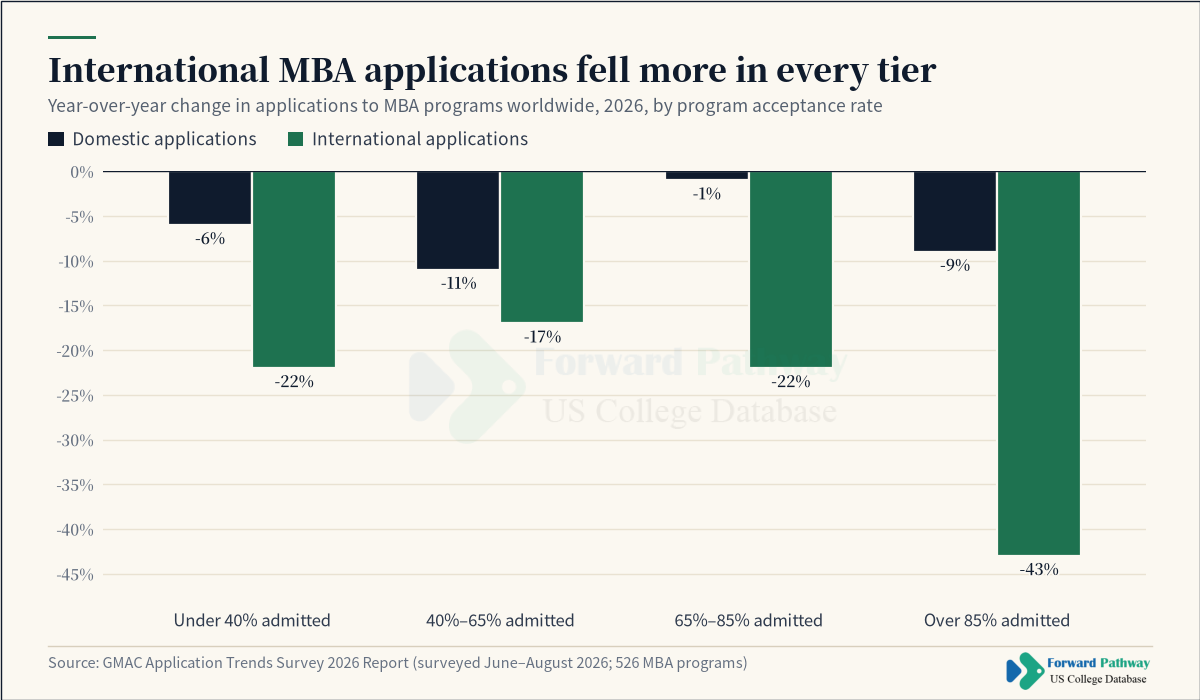
Selective programs held up better than the least selective ones. MBA programs that admit fewer than 40% of applicants saw total applications fall 9%, compared with 21% at programs admitting more than 85%. But even at the most selective tier, international applications fell 22%. GMAC notes that international candidates make up 43% of the applicant pool at these selective MBA programs and 57% at programs admitting 40% to 65%, so those schools are more exposed to shifts in international demand even when their overall decline is smaller. Stern fits the pattern: a program with a large international share sees its acceptance rate rise when international applications drop.
GMAC does not report applications by individual sending country for the U.S. It does say 41% of U.S. programs named India as the source of their largest decline. In Canada, 54% of programs said their largest drop came from Greater China; in the UK, 38% did.
Domestic demand is also softer. GMAC links the U.S. decline in part to a low-hiring, low-firing job market that keeps employed people from leaving to study, and to new annual and lifetime caps on federal student loans for graduate business students. One-third of U.S. programs said changes in government education funding, such as student loans, had a major impact on applications.
International students were already shifting to STEM business degrees
The application drop showed up in 2026, but international students’ choice of business master’s programs had already changed. Forward Pathway analyzed U.S. Department of Education degree data from 2002 to 2025, counting business master’s degrees awarded to international students by first major. We grouped them into three categories: STEM business fields on the Department of Homeland Security’s STEM list, such as management science, business statistics and actuarial science (many STEM-designated MBAs and some business analytics programs are classified here); general business administration, where most traditional MBAs fall; and other business fields such as finance, accounting and marketing.
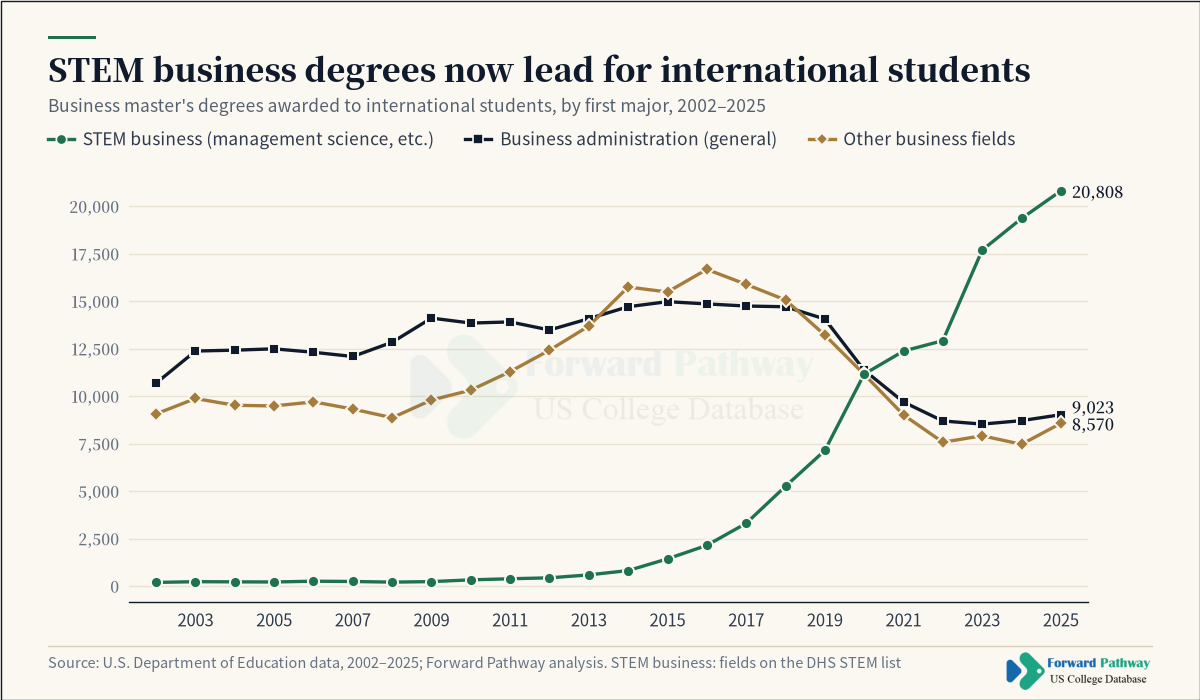
- STEM business went from niche to dominant. International students earned 3,304 of these degrees in 2017 and 20,808 in 2025. In 2025 they received 43.2% of all 48,196 master’s degrees awarded in these fields.
- General business administration lost international students. Degrees awarded to international students fell from 14,973 in 2015 to 9,023 in 2025. Their share of these degrees fell from 14.0% in 2017 to 9.1% in 2025, with a low of 8.1% in 2023.
- The total did not shrink. In 2025, international students earned 38,401 business master’s degrees, 18.4% of all business master’s degrees and the highest number since at least 2002.
Part of this shift is schools reclassifying their programs. NYU Stern announced in January 2020 that its two-year full-time MBA had received STEM designation, and many business schools have since sought STEM designation for their MBAs or for some MBA concentrations. When the same MBA gets a new classification code, it moves from “business administration” to “STEM business” in the statistics. So the data does not mean international students stopped pursuing MBAs. A better reading is that eligibility for the STEM OPT extension has become one of the first things international students check when choosing a business program, and schools have responded.
The data has limits. It does not identify degrees as MBAs or specialized master’s degrees. Many business analytics master’s programs are classified under an interdisciplinary business analytics code outside the business category and are not counted here. And the 2025 data reflects students who enrolled several years ago, so it does not yet capture the 2026 application cycle.
Why international applicants are pulling back: visas and post-graduation work
For most international MBA students, the investment pays off through several years of work in the U.S. after graduation. Each step on that path has become more expensive or less certain. Status as of Nov. 24, 2026:
- Proposed OPT fee. The Department of Homeland Security published a proposed rule in the Federal Register on Oct. 8, 2026, that would charge a fee for each F-1 student’s OPT authorization through the school: $70,000 for initial OPT and $30,000 for each subsequent period, including the STEM OPT extension. The comment period closed Nov. 9. The rule is not in effect.
- H-1B costs. A September 2025 presidential proclamation required an additional $100,000 payment with certain new H-1B petitions. According to USCIS, a federal district court in Massachusetts vacated the agency guidance implementing that payment on June 8, 2026, and the First Circuit denied the government’s motion for a stay on July 24; DHS says it still plans to collect the payment if the order is lifted. Separately, DHS proposed on Aug. 25, 2026, a $103,265 fee on all cap-subject H-1B petitions, including those under the advanced degree exemption. No final rule had been published as of Nov. 24. Employers pay this fee, but it directly affects whether they will sponsor international graduates.
- Job outcomes are still strong. Stern’s employment reports show a median base salary of $175,000 for the full-time MBA Class of 2025. Poets&Quants reported that the median for international graduates was also $175,000, the same as for U.S. citizens and permanent residents. Pay for those who land jobs has not changed. What has changed is the uncertainty about staying in the U.S. after landing one.
What this means for MBA applicants
- Higher acceptance rates are real, but modest. Stern’s acceptance rate rose 8 percentage points, and GMAC found international applications to selective programs fell 22%. But GMAC also found that changes in average acceptance rates in every region were within the margin of error (U.S. programs went from 70% to 73%), and applicants’ academic profiles were similar to last year. If your experience and test scores are close to a target school’s averages, this may be a good year to aim higher. Standards have not dropped: Stern’s Class of 2028 still averages 676 on the GMAT Focus and a 3.63 GPA.
- Check STEM designation first. Graduates of a STEM-designated program can apply for a 24-month STEM OPT extension on top of 12 months of OPT, which means more time working in the U.S. and more chances in the H-1B lottery. Without STEM designation, OPT is 12 months. Some schools designate the entire MBA; others only certain concentrations. Rely on written confirmation from the school’s international student office and the program code on your I-20.
- Build visa costs into your budget. If the OPT fee is finalized as proposed, it is unclear whether schools, students or employers will bear it. Higher H-1B costs may make employers less willing to sponsor. When you run the numbers, include a scenario in which you can work in the U.S. for only one to three years, or leave right after graduation, and check whether the degree still pays off.
- Treat one-year and two-year programs differently. GMAC found international applications to full-time one-year MBA programs worldwide fell 12%, much less than the 28% drop for two-year programs. One-year programs cost less, but they often expect a business background or a clear career goal and leave little room for a summer internship. They suit applicants who plan to build careers outside the U.S.
- Recent college graduates have different options. Applicants without much work experience are usually better served by STEM-designated business analytics or management science master’s programs than by an MBA. These programs rely most heavily on international students, who earned 43.2% of STEM business master’s degrees in 2025, so competition is concentrated. Apply to a wider range of schools.
Frequently asked questions
What is the NYU Stern MBA acceptance rate for the Class of 2028?
Stern’s full-time MBA admitted 1,309 of 4,130 applicants for the Class of 2028, an acceptance rate of 32%, up from 24% for the Class of 2027. It enrolled 321 students, down from 336. Students with international citizenship made up 38% of the class, down from 43%; Stern’s figure includes foreign nationals, dual citizens and U.S. permanent residents.
How much did international MBA applications drop in 2026?
GMAC’s Application Trends Survey 2026 Report found that applications to U.S. graduate business programs fell 25% in 2026, with international applications down 38% and domestic applications down 6%. Worldwide, international applications to full-time two-year MBA programs fell 28%. Among U.S. programs, 54% said changes in visa policies and practices had a major impact on application volume.
Is it easier to get into a top MBA program now?
Somewhat, at programs that rely heavily on international applicants. At MBA programs admitting fewer than 40% of applicants, total applications fell 9% and international applications fell 22%, and Stern’s acceptance rate rose from 24% to 32%. But GMAC found that average acceptance rates changed within the margin of error in every region, and admitted students’ academic profiles held steady. Stern’s Class of 2028 averages 676 on the GMAT Focus and a 3.63 GPA.
Why are international students choosing STEM-designated business programs?
STEM-designated programs qualify graduates for a 24-month STEM OPT extension in addition to 12 months of OPT. U.S. Department of Education data shows business master’s degrees in STEM-designated fields awarded to international students rose from 3,304 in 2017 to 20,808 in 2025, when international students earned 43.2% of those degrees. Stern’s two-year MBA has been STEM-designated since January 2020.
Are the OPT fee and the H-1B fee in effect?
No, as of Nov. 24, 2026. DHS proposed in October 2026 an OPT fee of $70,000 for initial OPT and $30,000 for each later period, including STEM OPT; the comment period closed Nov. 9, and no final rule has been issued. A federal court vacated guidance implementing the $100,000 H-1B payment in June 2026, and a separate proposal for a $103,265 fee on cap-subject H-1B petitions has not been finalized.
Sources
- NYU Stern: Full-time MBA Class Profile
- Washington Square News: Stern MBA applications fall 16% for class of 2028 (Nov. 23, 2026)
- GMAC: Application Trends Survey 2026 Report
- NYU Stern: NYU Stern’s Two-year Full-time MBA Program Receives STEM Designation
- U.S. Immigration and Customs Enforcement: DHS STEM Designated Degree Program List
- Federal Register: Optional Practical Training Fees (proposed rule)
- Federal Register: Fee for Certain H-1B Petitions (proposed rule, Aug. 25, 2026)
- USCIS: H-1B Specialty Occupations
- NYU Stern: Employment Reports
- Poets&Quants: 2025 MBA Jobs: At NYU Stern, Sharper Gains For International Grads
- U.S. Department of Education degree completions data, 2002–2025; Forward Pathway analysis