
Campus police at all 12 universities in the State University System of Florida have signed 287(g) agreements with U.S. Immigration and Customs Enforcement (ICE). The agreements let trained officers question people about their immigration status during routine police work. Those 12 schools enrolled 24,959 international students in 2024, according to U.S. Department of Education data. For F-1 students who are in the country legally, 287(g) creates no new violations. The real risk is that an ordinary police encounter, such as a traffic stop, a minor charge or an arrest that is later dropped, can lead to a terminated SEVIS record or a revoked visa.
The issue is back in the news. On Nov. 10, 2026, the Student Senate at the University of South Florida (USF) voted unanimously to ask the university to end its police department’s 287(g) agreement. The resolution is nonbinding, and as of Nov. 23, 2026, the agreement remains in effect.
Key takeaways
- All 12 State University System of Florida schools signed 287(g) agreements after Gov. Ron DeSantis’s Feb. 19, 2025, directive, according to Inside Higher Ed. Most use the Task Force Model, the broadest of ICE’s three models.
- As of Nov. 23, 2026, ICE lists 2,817 287(g) agreements in 38 states and two territories, including 2,052 under the Task Force Model.
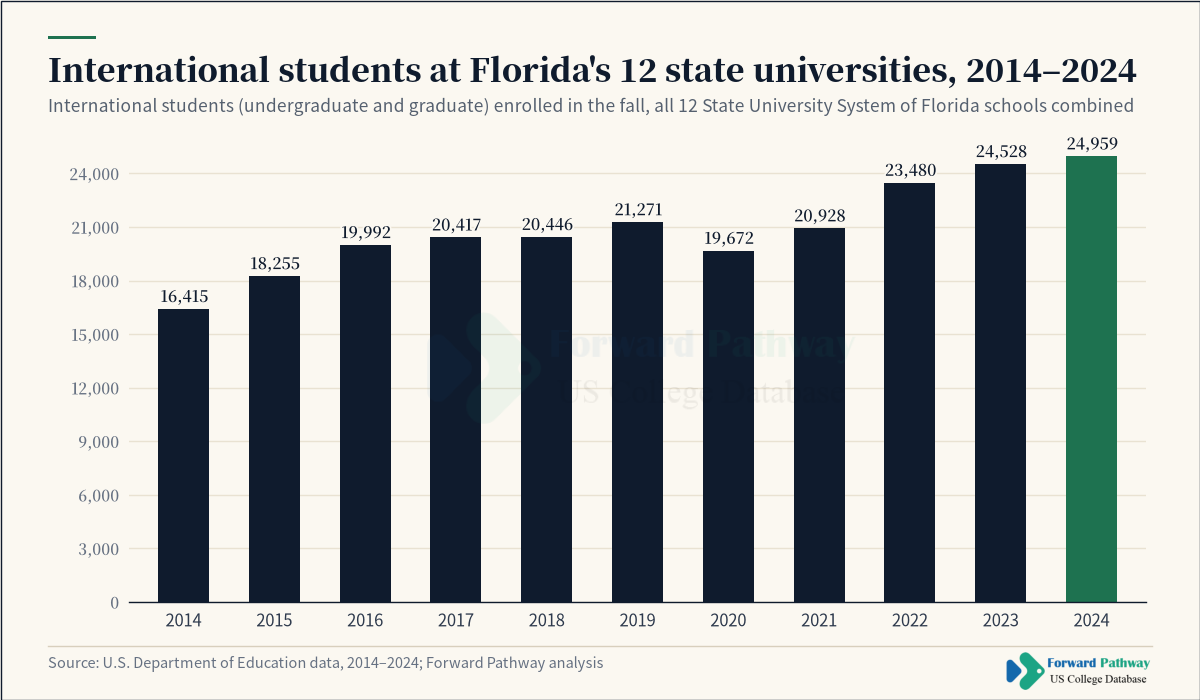
- The 12 universities enrolled 24,959 international students in 2024, up about 52% from 16,415 in 2014. International students made up 16.3% of graduate students but only 4.2% of undergraduates.
- In spring 2025, ICE screened more than 1 million international students against a federal crime database. It found about 6,400 possible matches and terminated thousands of SEVIS records, including some tied to speeding tickets and dismissed charges.
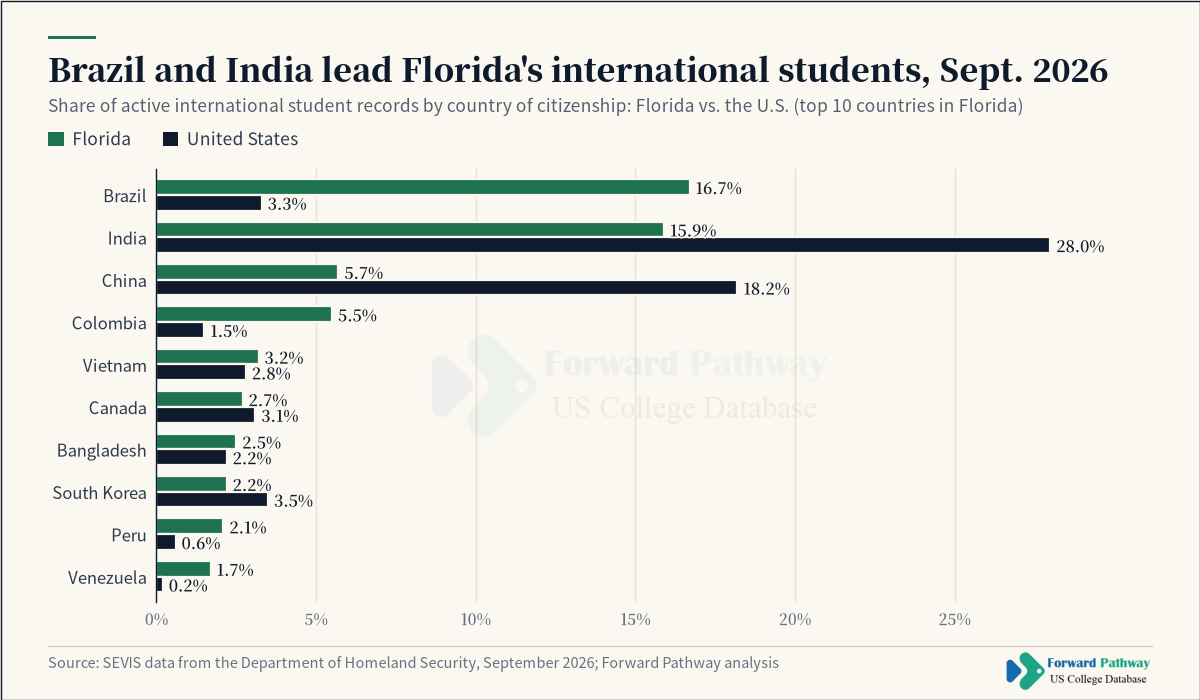
- Florida had 66,710 active international student records in September 2026. Brazil (16.7%) and India (15.9%) were the largest groups, while China’s share (5.7%) was far below its 18.2% share nationally.
What happened at USF this month
According to a Nov. 19 report in The Oracle, USF’s student newspaper, the Student Senate unanimously passed resolution R 7-011, which says the agreement “unnecessarily sacrifices campus safety.” The resolution also argues that the agreement pushes students to carry documents proving their legal status and raises the risk of racial profiling. USF Police Chief Christopher Daniel signed the agreement in 2025, and The Oracle, citing ICE’s website, reports that it took effect in February. Under it, certain USF officers can issue immigration detainers, prepare charging documents for ICE supervisors and transport arrested people to ICE-approved detention facilities.
USF spokesperson Crystal Price told the paper that the USF Police Department, like police at other state universities, is following the governor’s February 2025 directive, and that there has been no ICE activity on USF campuses. Copies of the resolution went to President Moez Limayem and the Board of Trustees. The resolution cannot end the agreement by itself.
The same week, University of Maryland-College Park President Darryll Pines wrote on Nov. 18 that student Maria Flores Garcia and her mother, who were taken into custody off campus in Baltimore by federal immigration enforcement officials, had been released from an immigration detention facility in Louisiana. That case had nothing to do with 287(g). Gov. Wes Moore signed emergency legislation (SB 245 / HB 444) on Feb. 17, 2026, ending formal 287(g) agreements in Maryland. The two cases show what 287(g) does and doesn’t change. It decides whether local officers can check immigration status. Federal immigration enforcement continues in states with no 287(g) agreements at all.
What is 287(g), and why did every Florida state university sign?
Section 287(g) of the Immigration and Nationality Act lets ICE delegate some immigration enforcement authority to state and local police. ICE describes three models:
- Jail Enforcement Model (185 agreements): officers identify and process removable noncitizens “who have pending or active criminal charges.”
- Warrant Service Officer Model (580): officers serve and execute administrative warrants on people already in their custody.
- Task Force Model (2,052): officers “enforce limited immigration authority while performing routine police duties.”
The Florida university agreements are mostly Task Force Model agreements. CBS News reported in April 2025 that participating officers can question “any alien or person believed to be an alien” about their right to be in the country and, in some cases, make arrests without a warrant.
The trigger was the Feb. 19, 2025, directive from Gov. Ron DeSantis telling state law enforcement agencies to work with federal immigration enforcement. Florida Atlantic University spokesperson Joshua Glanzer told CBS the school was “simply following guidance from the Governor’s Feb. 19 directive.” Inside Higher Ed reported on April 29, 2025, that all 12 state universities had signed. The University of Florida, University of Central Florida, Florida A&M University, New College of Florida and University of West Florida already appeared in ICE’s list of participating agencies. Florida State University, Florida International University (FIU), Florida Atlantic University (FAU), USF, the University of North Florida (UNF), Florida Gulf Coast University and Florida Polytechnic University had also signed. Inside Higher Ed found that only Florida institutions appeared in ICE’s database of active and pending agreements, and immigration experts it spoke with did not know of similar university agreements in other states.
The agreements took effect over the following months. UNF’s police department joined the program as of July 7, 2025 (Action News Jax). FAU police had officially signed by July 24, 2025, with an agreement covering the Broward County area (University Press).
A signed agreement doesn’t mean campus officers are actively checking status. In July 2025, Limayem, then UNF’s president, said no UNF officers had been trained by ICE and no training had been scheduled. Writing in The Conversation in April 2026, two FIU professors quoted a university statement: “Since signing the agreement, there have been no immigration-related enforcement actions on our campuses.” They also noted that a few college students had been detained off campus by local police and then turned over to ICE.
How many international students attend Florida’s state universities?
Forward Pathway analysis of U.S. Department of Education fall enrollment data for 2024 (graduate figures include doctoral and professional students):
| University | City | Total enrollment (2024) | International students (2024) | International share (%) | International share of graduate students (%) |
|---|---|---|---|---|---|
| University of South Florida | Tampa | 49,622 | 5,316 | 10.7 | 20.6 |
| University of Florida | Gainesville | 56,311 | 5,128 | 9.1 | 20.5 |
| Florida International University | Miami | 54,723 | 4,634 | 8.5 | 15.0 |
| University of Central Florida | Orlando | 69,713 | 3,215 | 4.6 | 12.3 |
| Florida Atlantic University | Boca Raton | 31,607 | 2,437 | 7.7 | 24.7 |
| Florida State University | Tallahassee | 43,889 | 2,418 | 5.5 | 14.5 |
| University of North Florida | Jacksonville | 16,154 | 592 | 3.7 | 10.4 |
| University of West Florida | Pensacola | 14,822 | 582 | 3.9 | 6.0 |
| Florida Gulf Coast University | Fort Myers | 16,612 | 419 | 2.5 | 3.3 |
| New College of Florida | Sarasota | 881 | 115 | 13.1 | 10.3 |
| Florida Polytechnic University | Lakeland | 1,769 | 57 | 3.2 | 16.5 |
| Florida A&M University | Tallahassee | 9,313 | 46 | 0.5 | 2.3 |
| All 12 combined | — | 365,416 | 24,959 | 6.8 | 16.3 |
International students in the system are mostly graduate students. They made up 16.3% of graduate enrollment (12,946 students) but 4.2% of undergraduates (12,013). At FAU, USF and UF, about one in five graduate students is international. New College and Florida Polytechnic enroll only a few dozen graduate students, so their percentages say little.
The number has grown. The 12 schools enrolled 16,415 international students in 2014 and 24,959 in 2024, an increase of about 52% (Figure 1; the series starts in 2014, the first year Florida Polytechnic enrolled students). Federal data for 2025, the first year after the governor’s directive, has not been released yet.
Across all Florida schools, SEVIS data from the Department of Homeland Security counted 66,710 active international student records in September 2026, down 2.4% from 68,363 a year earlier. Nationally, the count fell 7.7%, from 1,300,491 to 1,200,231. Florida’s mix of students also differs from the national one. Brazil (11,171 students) and India (10,586) together account for about a third of the state’s total, and Colombia, Peru and Venezuela are far more represented than they are nationally. China, with 3,773 students, makes up 5.7% of Florida’s records compared with 18.2% nationwide (Figure 2).
How a traffic ticket can turn into an immigration problem
287(g) doesn’t add any new way for an F-1 student to fall out of status. A student who entered legally, attends class and can produce documents when asked is generally not at risk just because a campus officer asks about status. What changes is who handles a routine stop. On a Florida state university campus, the officer may also hold immigration authority. The danger is the chain reaction a police record can set off across several federal systems.
Step 1: Not carrying proof of registration
According to USCIS, nonimmigrants admitted with an I-94 are already registered. But people 18 and older “must carry and have in their personal possession evidence of their registration at all times.” A printed copy or a phone showing it counts. Failing to do so is a misdemeanor punishable by a fine of up to $5,000, up to 30 days in jail, or both.
Step 2: An arrest or charge enters a crime database
This is how the spring 2025 wave of SEVIS terminations started. NPR reported on May 5, 2025, that ICE began screening more than 1 million international students against the National Crime Information Center in March, found about 6,400 possible matches and used them to terminate thousands of SEVIS records. Many involved minor contact with police. A former USF master’s student was charged with failing to yield to a police officer. The charge was dismissed, but his record was still terminated. “So for getting a speeding ticket, they all of a sudden lost their visa status,” immigration lawyer Brad Banias told NPR. The terminated records were later restored under pressure from lawsuits. But an April 26, 2025, internal SEVP broadcast message, filed in litigation, kept two grounds for termination: objective evidence that a student is not complying with the terms of their status, and a State Department visa revocation with immediate effect.
Step 3: The visa is revoked
A State Department official told CBS News in August 2025 that more than 6,000 student visas had been revoked that year. About two-thirds involved students who violated the law, and the “vast majority” of cases involved assault, driving under the influence, burglary or “support for terrorism.” Indiana University Indianapolis’s international office warns that a DUI arrest in particular can lead to a visa being canceled. That does not end a student’s status while they remain in the U.S., but they would need a new visa to return after traveling abroad. The State Department also said in August 2025 that all U.S. visa holders, more than 55 million people, are subject to “continuous vetting” (PBS NewsHour/AP).
Step 4: A conviction
Under 8 CFR 214.1(g), a nonimmigrant convicted of a crime of violence that carries a possible sentence of more than one year has failed to maintain status, even if no such sentence is actually imposed. A guilty plea counts as a conviction for immigration purposes, so a plea deal that looks lenient in criminal court can carry heavy immigration consequences.
Step 5: Every future visa, OPT and H-1B application
Indiana University Indianapolis advises students to answer “yes” to visa application questions about arrests even if charges were dropped or they were acquitted. Giving false information “could result in a finding of fraud,” which can permanently bar a person from entering the U.S. An unresolved ticket or a dismissed arrest follows a student into every later immigration application.
What international students in Florida can do
- Carry proof of registration. Print your most recent I-94 from the U.S. Customs and Border Protection website and keep it with copies of your passport, visa and I-20. Ask your international student office (DSO) where to keep the originals.
- Deal with traffic tickets on time. Pay them, or appear in court on the date listed, or have a lawyer handle it. Don’t let a small citation become a criminal case.
- If police stop you, stay calm, show genuine documents and don’t lie. Don’t sign documents you don’t understand without a lawyer, especially anything about immigration proceedings or voluntary departure.
- If you are arrested or detained, contact both a criminal defense lawyer and an immigration lawyer, and talk to the immigration lawyer before entering any plea. Tell your DSO so they can check whether your SEVIS record has changed. Tell your family and your country’s consulate where you are held and your case number.
- If you already have a record, get a certified court disposition, even for dismissed charges or acquittals. Before traveling, find out whether your visa has been revoked. Before applying for OPT, STEM OPT or a transfer, confirm with your DSO that your SEVIS record is active.
For applicants, the agreements are the status quo across Florida’s public university system, and a nonbinding student resolution won’t change that soon. For students with no criminal record who maintain status, they are not a reason to rule out these schools. Program, cost and career outcomes still matter most. Students who choose Florida should build these habits from their first day.
Frequently asked questions
Which Florida universities have 287(g) agreements with ICE?
All 12 universities in the State University System of Florida: the University of Florida, Florida State University, the University of South Florida, the University of Central Florida, Florida International University, Florida Atlantic University, the University of North Florida, the University of West Florida, Florida Gulf Coast University, Florida A&M University, New College of Florida and Florida Polytechnic University. Inside Higher Ed reported this on April 29, 2025. The agreements followed Gov. Ron DeSantis’s Feb. 19, 2025, directive.
Will USF end its 287(g) agreement?
Not as a result of the student vote. The Student Senate’s Nov. 10, 2026, resolution is nonbinding. It was sent to the president and Board of Trustees, and as of Nov. 23, 2026, the agreement remains in effect. A USF spokesperson said the university is following the governor’s directive and that there has been no ICE activity on USF campuses.
Can an F-1 student lose status because of 287(g)?
287(g) itself creates no new violations. The risk comes from police records. Arrests, charges and even dismissed cases have led to terminated SEVIS records and revoked visas. In spring 2025, ICE terminated thousands of records after screening more than 1 million students against a federal crime database.
Can a speeding ticket affect a student visa?
It did in 2025, when some SEVIS records were terminated over traffic violations, though those records were later restored after lawsuits. Any arrest, even one that doesn’t lead to a conviction, must be disclosed on future visa applications. A DUI arrest can lead to visa cancellation.
What documents should international students carry in Florida?
USCIS requires registered noncitizens 18 and older to carry proof of registration at all times. For most F-1 students, that is the I-94, and a printed copy or a phone display counts. Violations carry a fine of up to $5,000, up to 30 days in jail, or both. Many students also carry copies of their passport, visa and I-20.
Sources
- The Oracle: Student Senate urges USF to end campus police ICE agreement (Nov. 19, 2026)
- Maryland Today: Pines Thanks Campus Community, Lawmakers for Support in Student’s, Mother’s Release (Nov. 18, 2026)
- ACLU of Maryland: Statement on Governor Moore Signing Emergency Legislation Banning Formal 287(g) Agreements in Maryland (Feb. 17, 2026)
- ICE: Delegation of Immigration Authority Section 287(g) Immigration and Nationality Act
- CBS News: Florida universities partnering with ICE on immigration enforcement (April 12, 2025)
- Inside Higher Ed: At Least 15 Florida Institutions Have ICE Agreements (April 29, 2025)
- Action News Jax: UNF finalizes agreement with ICE (July 15, 2025)
- University Press: FAU police officially partner with ICE under 287(g) agreement (July 28, 2025)
- The Conversation: We teach at a Florida university that agreed to cooperate with ICE (April 7, 2026)
- USCIS: Alien Registration Requirement
- NPR via WUSF: Minor infractions lead to big problems for international students (May 5, 2025)
- SEVP Broadcast Message: SEVIS Notice – Policy Regarding Termination of Records (April 26, 2025)
- CBS News: State Department revokes over 6,000 student visas (Aug. 19, 2025)
- PBS NewsHour: Trump administration vetting all 55 million U.S. visa holders (Aug. 21, 2025)
- 8 CFR 214.1: Requirements for admission, extension, and maintenance of status
- Indiana University Indianapolis: Effect of arrest on visa status
- U.S. Department of Education fall enrollment data, 2014–2024; SEVIS data from the Department of Homeland Security, 2025–2026