
A 4+1 bachelor’s-to-master’s program can save a year of graduate tuition, which runs about $37,000 at the median top-100 national university and more than $60,000 at 18 of them, according to a Forward Pathway analysis of U.S. Department of Education data. For international students on F-1 visas, the bigger question is work authorization. A student who moves straight from the bachelor’s into the one-year master’s usually gives up the 12 months of OPT the bachelor’s degree would have earned. Whether the master’s leads to a 24-month STEM extension depends on the program’s CIP code, not on its name.
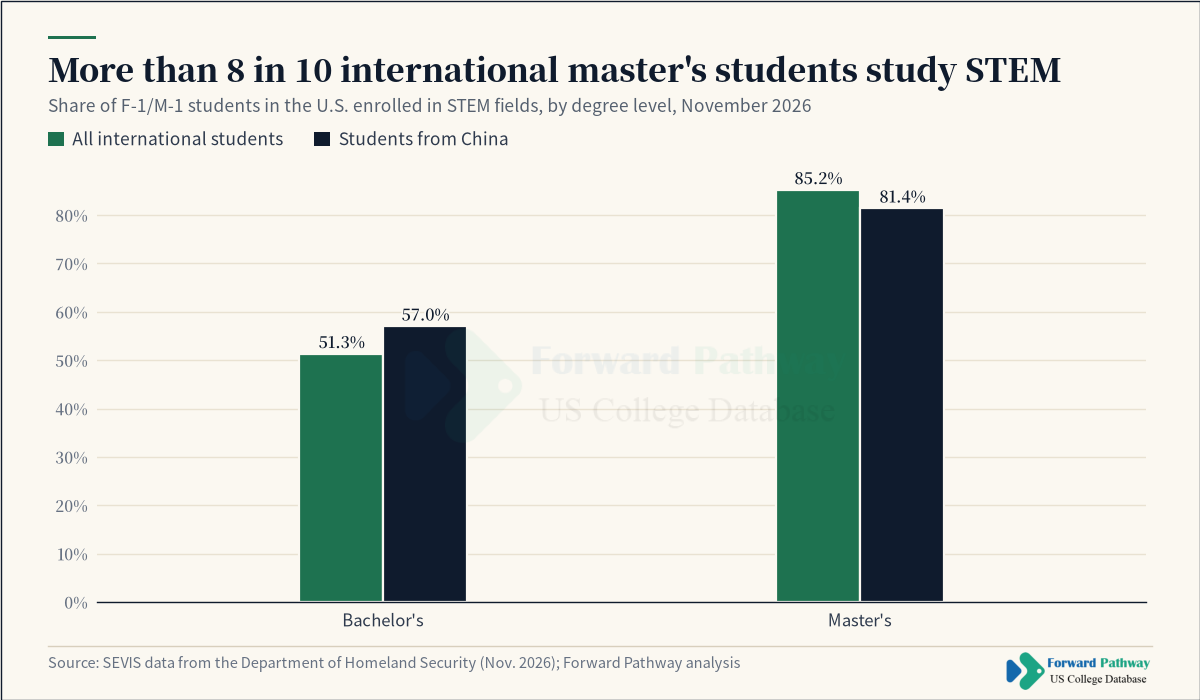
Four colleges announced new accelerated or direct-entry graduate options between Nov. 20 and Nov. 24, 2026: Muhlenberg, Hobart and William Smith, Macalester and UNC-Chapel Hill. More than 8 in 10 international master’s students in the U.S. are in STEM fields, so the CIP code can decide whether a graduate works in the U.S. for one year or for three.
Key takeaways
- One year of graduate tuition and fees at the 108 universities in the US News 2027 national top 100 (ties included) has a median of about $37,000. At 18 of them it tops $60,000 (2024 federal data; public universities at out-of-state rates).
- Once an F-1 student switches to a master’s-level I-20, they can no longer apply for OPT based on the bachelor’s degree. A student who receives both degrees at the same time gets one 12-month OPT period, not two.
- STEM OPT adds 24 months, for up to 36 months in total, but only if the degree’s CIP code is on the DHS STEM list. General business administration (52.0201), finance (52.0801) and accounting (52.0301) are not on it. Business analytics (30.7102) and management science (52.1301) are.
- In November 2026, 85.2% of international master’s students in the U.S. were in STEM fields (385,004 of 451,872), compared with 51.3% of international bachelor’s students (SEVIS data from the Department of Homeland Security).
- As of Nov. 27, 2026, a proposed rule would charge $70,000 for a student’s initial OPT and $30,000 for any later OPT. The public comment period closed Nov. 9, and the rule is not final.
What colleges announced in November 2026
Muhlenberg College announced on Nov. 23 a 4+1 pathway into its new MBA. Eligible undergraduates can take up to four MBA courses during their junior and senior years and earn both degrees “in as few as five years.” The college already offers 4+1 master’s degrees in teaching and data analytics. International students should note that the MBA is delivered fully online, with one live (synchronous) class each week. Under federal rules (8 CFR 214.2(f)(6)(i)(G)), an F-1 student can count no more than one online class or 3 credits per term toward a full course of study. A student who wants to stay in F-1 status while completing this MBA after graduation should ask the international student office whether that is possible.
Hobart and William Smith Colleges announced a partnership with Niagara University on Nov. 20. Students in any major who graduate with a GPA of at least 3.0 and complete three of four approved sociology courses taught by Professor of Sociology James Sutton can finish Niagara’s master’s in criminal justice administration in two semesters instead of three. HWS says this could save more than $6,500 in tuition. International students already make up a large share of Niagara’s graduate output. In 2025, 311 of the 760 master’s degrees Niagara awarded went to international students, about 41%, according to U.S. Department of Education data.
Macalester College and Babson College signed a three-year agreement, also announced Nov. 20. Macalester seniors and alumni of any major who apply to Babson programs, including the MBA, the M.S. in Management in Entrepreneurial Leadership, the M.S. in Business Analytics and the M.S. in Finance, pay no application fee and receive a scholarship of at least 20%. This is an admissions pathway, not a shortened degree. The master’s takes as long as it does for any other student. At Babson, international students earned 305 of the 544 master’s degrees awarded in 2025, or 56% (Forward Pathway analysis of federal data).
The University of North Carolina at Chapel Hill moved in the other direction. Its Master of Public Policy was previously offered only as an accelerated option for UNC-Chapel Hill undergraduates. On Nov. 24 the university announced a new two-year option open to a wider pool of applicants. The application deadline is Dec. 1.
How much does a 4+1 master’s save?
4+1 programs rely on double counting. Graduate courses taken in the last two undergraduate years count toward the master’s, so the graduate phase shrinks to about one year. In the HWS–Niagara case, three semesters become two. Compared with four years of college plus a two-year master’s, a student saves roughly one year of graduate tuition and one year of living costs, and starts working a year earlier.
To estimate that year of tuition, we took the 108 universities in the US News 2027 national top 100 (ties included) and looked at one year of graduate tuition plus fees in 2024 federal data, using out-of-state rates for public schools. The median is about $37,000, and 18 schools charge more than $60,000.
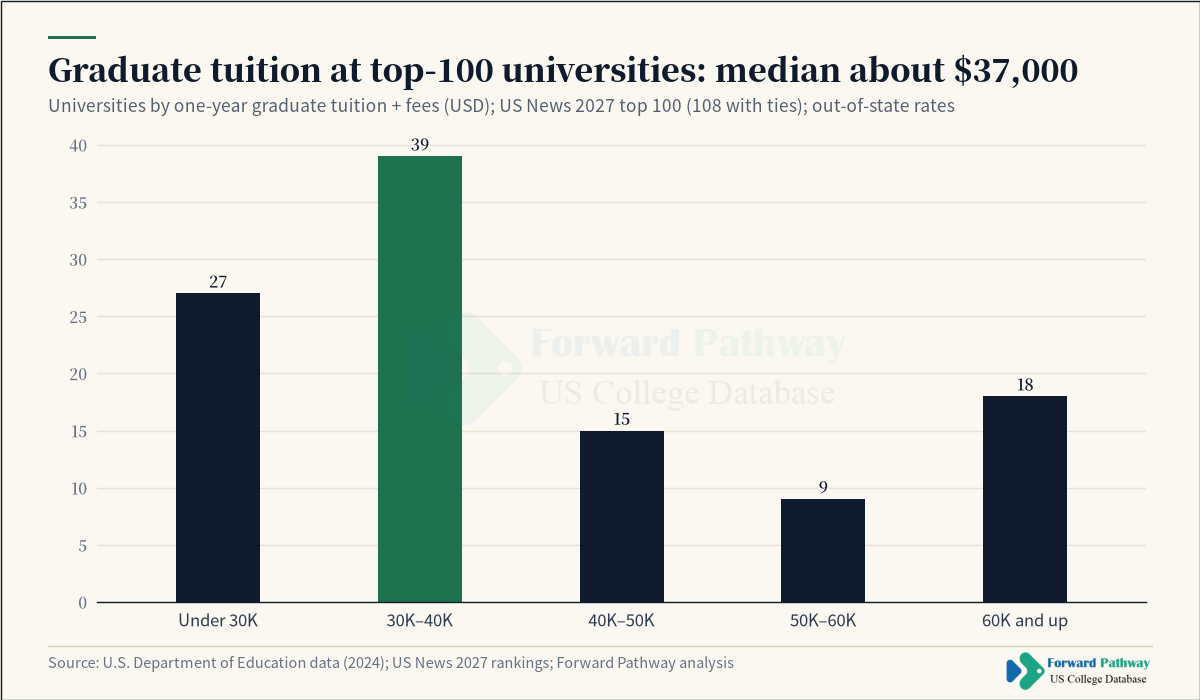
Treat this as a floor. The federal figure is a school’s general graduate tuition. MBA and computer science master’s programs often have their own, higher prices, and many schools charge per credit. Check the program’s own tuition schedule for the year you would enroll.
The value of starting work a year earlier depends on the field. The table shows national median earnings for graduates in each field and degree level. These figures come from College Scorecard and cover only graduates who received federal student aid, were working and were not enrolled in further study. International students are not included. The 1-year and 5-year figures describe different graduating classes, not the same people followed over time.
| Field | Bachelor’s, 1 year after graduation (USD) | Master’s, 1 year after graduation (USD) | Bachelor’s, 5 years after graduation (USD) | Master’s, 5 years after graduation (USD) |
|---|---|---|---|---|
| Computer science | 80,182 | 116,146 | 116,280 | 152,128 |
| Computer engineering | 83,729 | 111,925 | 118,456 | 148,366 |
| Finance | 63,115 | 86,560 | 89,719 | 117,142 |
| Business administration | 55,206 | 86,260 | 71,390 | 107,252 |
| Accounting | 60,798 | 74,869 | 80,105 | 101,080 |
Source: College Scorecard (U.S. Department of Education), national median earnings by field of study and degree level; Forward Pathway analysis.
Take computer science. Master’s graduates earn a median of about $116,000 one year after graduation. Finishing a year sooner means paying about one less year of tuition and earning about one more year of salary. Using the two medians above ($37,000 in tuition plus $116,000 in pay, before taxes and without living costs), the difference is roughly $150,000. There are two caveats. First, many business administration master’s graduates went back for an MBA after several years of work, so their earnings overstate what a 4+1 MBA student straight out of college should expect. Second, an international student can only earn that salary in the U.S. with work authorization, through OPT, STEM OPT and then a work visa.
How F-1 status carries over from a bachelor’s to a master’s
A new I-20, the 60-day grace period and the five-month rule
Under 8 CFR 214.2(f)(5)(ii), an F-1 student who moves to a higher degree level and otherwise follows the rules is treated as maintaining status. There is no need to leave the country and reapply. The school processes a change of education level in SEVIS and issues a master’s-level I-20. According to DHS’s Study in the States:
- The change-of-level I-20 must be issued before the 60-day grace period after the bachelor’s program end date runs out.
- The new program must start within five months of finishing the current one.
- The student must again show enough funds to cover the master’s program, just as for an initial I-20.
Colorado State University’s international office notes that students do not need a new F-1 visa for a change of level. The current visa stays valid until it expires, and a renewal is needed only if it has expired and the student travels abroad. Students who travel between programs need the new I-20 to re-enter. Some have had trouble at the border because Customs and Border Protection could not see the new program in its system, so the office advises waiting for the new I-20 before leaving the U.S. if possible.
OPT is 12 months per degree level, and a new I-20 ends bachelor’s eligibility
F-1 rules allow 12 months of practical training per degree level, so in principle a bachelor’s and a higher-level master’s each come with 12 months of OPT. For 4+1 students, the bachelor’s OPT is easy to lose:
- Switching to the master’s I-20 ends bachelor’s OPT eligibility. Stanford University‘s Bechtel International Center tells its coterminal students: “Once you switch to the Master’s level I-20/DS-2019, you cannot revert back to the Bachelor’s level.” For F-1 students, Stanford adds, “this means you are no longer eligible for OPT based on your bachelor’s degree.” At Stanford, a change to graduate-level tuition or enrollment below 12 units triggers the switch, and so does going straight into the master’s after finishing the bachelor’s requirements.
- You can use OPT first and come back, but OPT ends early. Under the regulation, OPT ends automatically when a student starts a program at another degree level. Stanford tells students to stop working before requesting the new I-20 and notes that “Immigration rules prohibit you from taking classes for a new degree while on post-OPT.”
- Two degrees conferred together earn one OPT period. Stanford’s answer for students finishing both degrees at the same time: “you only qualify for 12 months of post-OPT,” plus a 24-month extension if the graduate degree is STEM.
A student who goes straight from the bachelor’s into a one-year master’s usually trades the bachelor’s 12 months of OPT for finishing the master’s a year sooner. They then apply for OPT on the master’s degree. The application window runs from 90 days before to 60 days after the program end date, and the student must file within 30 days of the school’s recommendation. Students who want both OPT periods need a program that lets them work first and come back, and should confirm in writing how long the school will hold their master’s admission.
The CIP code decides between one year and three
The STEM OPT extension adds 24 months to the 12-month OPT, for up to 36 months. Eligibility depends on whether the CIP code on the I-20 appears on the DHS STEM Designated Degree Program List, last updated July 22, 2024. Words like “technology” or “analytics” in a program’s name do not matter. On the current list:
- Included: computer science (11.0701), data science (30.7001), business analytics (30.7102), management science (52.1301), business statistics (52.1302), actuarial science (52.1304) and econometrics (45.0603), among others.
- Not included: general business administration (52.0201), finance (52.0801) and accounting (52.0301). Criminal justice and public policy codes are not on the list either.
Two “business 4+1” programs can therefore differ by two years of work authorization. Babson lists four STEM master’s programs: the MBA with a Quantitative Finance concentration, the MBA with a Business Analytics and Machine Learning concentration, the M.S. in Business Analytics and the M.S. in Finance. The criminal justice administration master’s in the HWS–Niagara partnership and UNC-Chapel Hill’s public policy master’s fall in fields outside the list’s categories. In every case, the code on the school’s I-20 is what counts.
Two more rules matter for 4+1 planning. A student can receive at most two STEM extensions in a lifetime, and the second must be based on a higher degree. A student whose master’s is not STEM can still apply for the extension based on an earlier STEM degree, such as a STEM bachelor’s, earned within the past 10 years from an accredited, SEVP-certified U.S. school, as long as the job is directly related to that degree.
This affects most international graduate students. SEVIS data from the Department of Homeland Security for November 2026 show that 85.2% of international master’s students in the U.S. study STEM fields, against 51.3% at the bachelor’s level. Among students from China, the figures are 81.4% at the master’s level (62,073 of 76,300) and 57.0% at the bachelor’s level.
Two rules still in flux (as of Nov. 27, 2026)
- Proposed OPT fees. DHS published a proposed rule in the Federal Register on Oct. 8, 2026, that would charge $70,000 for a student’s initial OPT and $30,000 for any subsequent OPT. Schools would pay the fee, and the rule text acknowledges that they may pass the cost on to students or employers. Comments closed Nov. 9. The rule has not been finalized and is not in effect. If adopted, using OPT once after the bachelor’s and again after the master’s would become much more expensive.
- Ending duration of status. A final rule published July 17, 2026, would cut the F-1 post-completion grace period from 60 days to 30 days and require post-completion OPT applications within 30 days of the program end date. A federal court issued a nationwide preliminary injunction on Sept. 14, so the old rules still apply. If the rule takes effect, the window for moving from a bachelor’s to a master’s I-20 will be tighter.
Who should, and shouldn’t, choose a 4+1
A 4+1 is a poor fit for some students. Think twice if your GPA may fall below the cutoff (3.0 for HWS–Niagara), if you want to work on OPT before choosing a graduate field, or if you hope to move to a more selective school for the master’s, since most 4+1 programs feed into the same school or a partner. It is also a poor fit if you need STEM OPT and the target master’s is online-only or carries a non-STEM code.
High school seniors choosing colleges. A 4+1 with a STEM-coded master’s is a real advantage. Find out whether it is an internal program or a partnership, in which year students apply and how many credits count toward both degrees. Business-minded students should look for master’s programs in fields such as business analytics or management science, whose codes are on the STEM list.
Current sophomores and juniors. Compare two paths with the full numbers. Path one is the 4+1: give up bachelor’s OPT, then use master’s OPT plus STEM OPT. Path two is working on bachelor’s OPT, then applying to a master’s. Put tuition, living costs, months of work authorization and expected pay side by side. Then confirm three things with the international student office: when the master’s I-20 will be issued, which term graduate tuition starts and the master’s program’s CIP code.
Transfer students. Most 4+1 programs start graduate coursework in the junior and senior years (up to four courses at Muhlenberg). A student who transfers in as a junior may not have time to complete the double-counted courses. If a 4+1 is one reason to transfer, ask whether transfer students are eligible and what the latest application point is.
Seniors and alumni. Pathways like Macalester–Babson save money through the fee waiver and scholarship, but the master’s is just as long. Prepare as you would for any graduate application.
Frequently asked questions
Can I use OPT after my bachelor’s if I’m in a 4+1 program?
Usually not. Once an F-1 student switches to a master’s-level I-20, they can no longer apply for OPT based on the bachelor’s degree. Stanford’s Bechtel International Center says students who receive both degrees at the same time qualify for one 12-month post-completion OPT period, plus 24 months if the graduate degree is STEM. To use both, a student has to work on bachelor’s OPT first, stop working and then request the master’s I-20.
Do I need a new F-1 visa to move from a bachelor’s to a master’s?
Generally no. Federal regulations treat moving to a higher degree level as maintaining F-1 status. The school changes the education level in SEVIS and issues a new I-20, which must happen before the 60-day grace period ends. The master’s must start within five months, and the student must show funding again. Colorado State University notes that the existing visa remains valid until it expires. A renewal is needed only if it has expired and the student travels abroad.
How much money does a 4+1 master’s save?
Roughly one year of graduate tuition and living costs compared with a two-year master’s. In 2024 federal data, the median for one year of graduate tuition and fees at the 108 universities in the US News 2027 national top 100 was about $37,000, and 18 charged more than $60,000. MBA and computer science programs are often priced higher. Hobart and William Smith estimates that its Niagara University partnership could save more than $6,500 in tuition.
Does a 4+1 MBA qualify for STEM OPT?
Only if the CIP code on the I-20 is on the DHS STEM list. General business administration (52.0201), finance (52.0801) and accounting (52.0301) are not. Management science (52.1301) and business analytics (30.7102) are. At Babson, the STEM-designated programs are the MBA with a Quantitative Finance or a Business Analytics and Machine Learning concentration, the M.S. in Business Analytics and the M.S. in Finance.
Can international students do an online 4+1 master’s?
F-1 students can count no more than one online class or 3 credits per term toward a full course of study. Muhlenberg’s MBA is fully online with a weekly live class. An international student who wants to stay in F-1 status during that MBA after graduating should confirm with the international student office first.
Sources
- Muhlenberg College: Muhlenberg Expands MBA with 4+1 Pathway (Nov. 23, 2026)
- Hobart and William Smith Colleges: Expanding the Possibilities (Nov. 20, 2026)
- Macalester College: Macalester College and Babson College Launch Graduate Pathway Program (Nov. 20, 2026)
- UNC-Chapel Hill: Carolina’s Master of Public Policy program offers new 2-year option (Nov. 24, 2026)
- Babson College: STEM Masters Programs
- Study in the States (DHS): Change Education Level
- Colorado State University ISSS: Change of Level
- 8 CFR 214.2: F-1 change of educational level, online courses, practical training and STEM OPT
- Stanford University Bechtel International Center: Coterm
- DHS STEM Designated Degree Program List (updated July 22, 2024)
- Federal Register: Optional Practical Training Fees (proposed rule, Oct. 8, 2026)
- Federal Register: Establishing a Fixed Time Period of Admission and an Extension of Stay Procedure for Nonimmigrant Academic Students, Exchange Visitors, and Representatives of Foreign Information Media (final rule, July 17, 2026)